


What the Survey Found
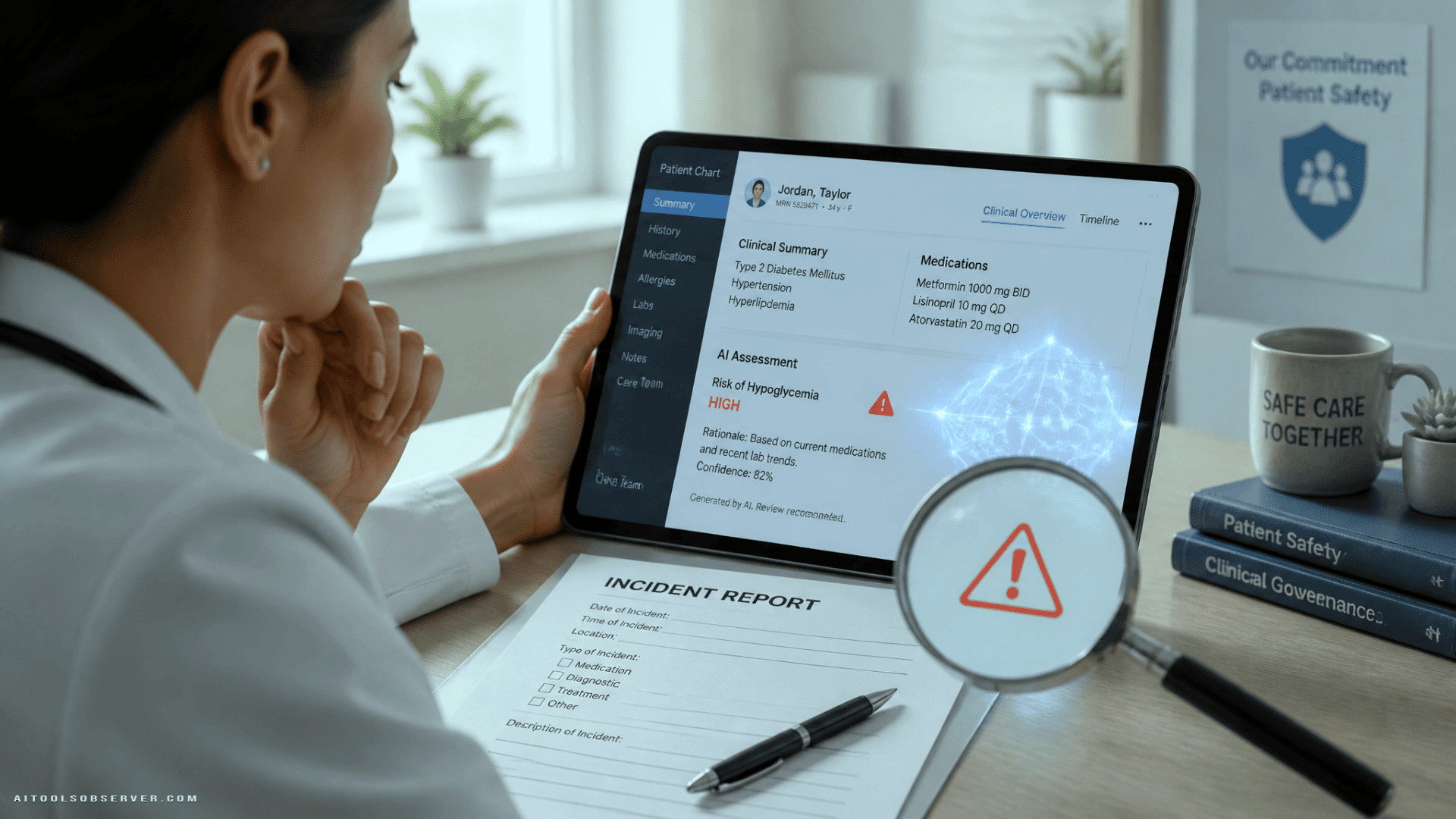
ECRI surveyed 124 quality, safety, risk, and compliance leaders across healthcare. The numbers are worth paying attention to:
- Nearly one-third reported encountering an AI output they believed was incorrect or misleading in the past year.
- 9% reported an AI error that reached a patient or directly affected a care decision.
That 9% figure is the one that matters most. It means AI errors aren’t just a theoretical governance concern — they’re a clinical reality happening right now, at scale.
Which AI Tools Are Involved
Ambient scribes topped the list of AI tools encountered in the survey, ranking ahead of EHR-embedded clinical decision support systems and clinical AI assistants.
That’s a meaningful detail. Ambient scribes — tools that automatically document patient encounters — are being adopted quickly because they reduce physician documentation burden. But if those tools produce inaccurate summaries or miss critical clinical details, the downstream effects on care decisions can be serious.
EHR-embedded clinical decision support tools carry similar risk. These systems are often trusted by default because they live inside established clinical workflows, which can make errors harder to catch and question.
How ECRI’s Reporting Network Works
ECRI’s Problem Reporting Network has been operating since 1972. It accepts free, confidential reports from healthcare professionals and institutions. Once submitted, reports are triaged and investigated by ECRI’s clinical and engineering experts, who follow up directly with submitters.
When a safety risk is confirmed, ECRI issues hazard reports to manufacturers, healthcare providers, and regulatory agencies.
Expanding this network to cover AI errors gives the healthcare industry something it currently lacks: a structured, independent channel for surfacing AI-related patient safety incidents without fear of liability or institutional pushback.
Why This Matters for Healthcare AI Governance
Right now, most healthcare organizations don’t have a clear process for reporting or escalating AI errors internally — let alone externally. That means incidents get absorbed quietly, patterns go undetected, and the same errors can repeat across different institutions using the same tools.
ECRI’s expansion addresses a real structural gap. A centralized, confidential reporting system creates the kind of aggregated signal that individual hospitals can’t generate on their own.
For AI vendors selling into healthcare, this also raises the stakes. Hazard reports issued to manufacturers carry weight. If a clinical AI tool generates a pattern of misleading outputs, that’s no longer just a product quality issue — it becomes a documented safety concern with regulatory visibility.
This is why Healthcare AI Governance matters.
What Healthcare AI Adopters Should Watch
If you’re evaluating or currently deploying AI tools in clinical environments, a few practical implications stand out:
- Ambient scribes need output review protocols. Fast adoption without validation workflows is a liability.
- EHR-embedded AI deserves the same scrutiny as standalone tools. Integration doesn’t equal accuracy.
- Incident reporting culture matters. Staff need a clear, low-friction way to flag AI outputs that seem wrong — before those outputs affect care.
The broader takeaway: healthcare AI governance is shifting from voluntary best practices toward structured accountability. ECRI’s expanded network is an early signal of what that looks like in practice. Organizations that build internal AI error reporting habits now will be better positioned as external reporting expectations grow.













Comments (0) No comments yet
Want to join this discussion? Login or Register.
No comments yet. Be the first to share your thoughts!