


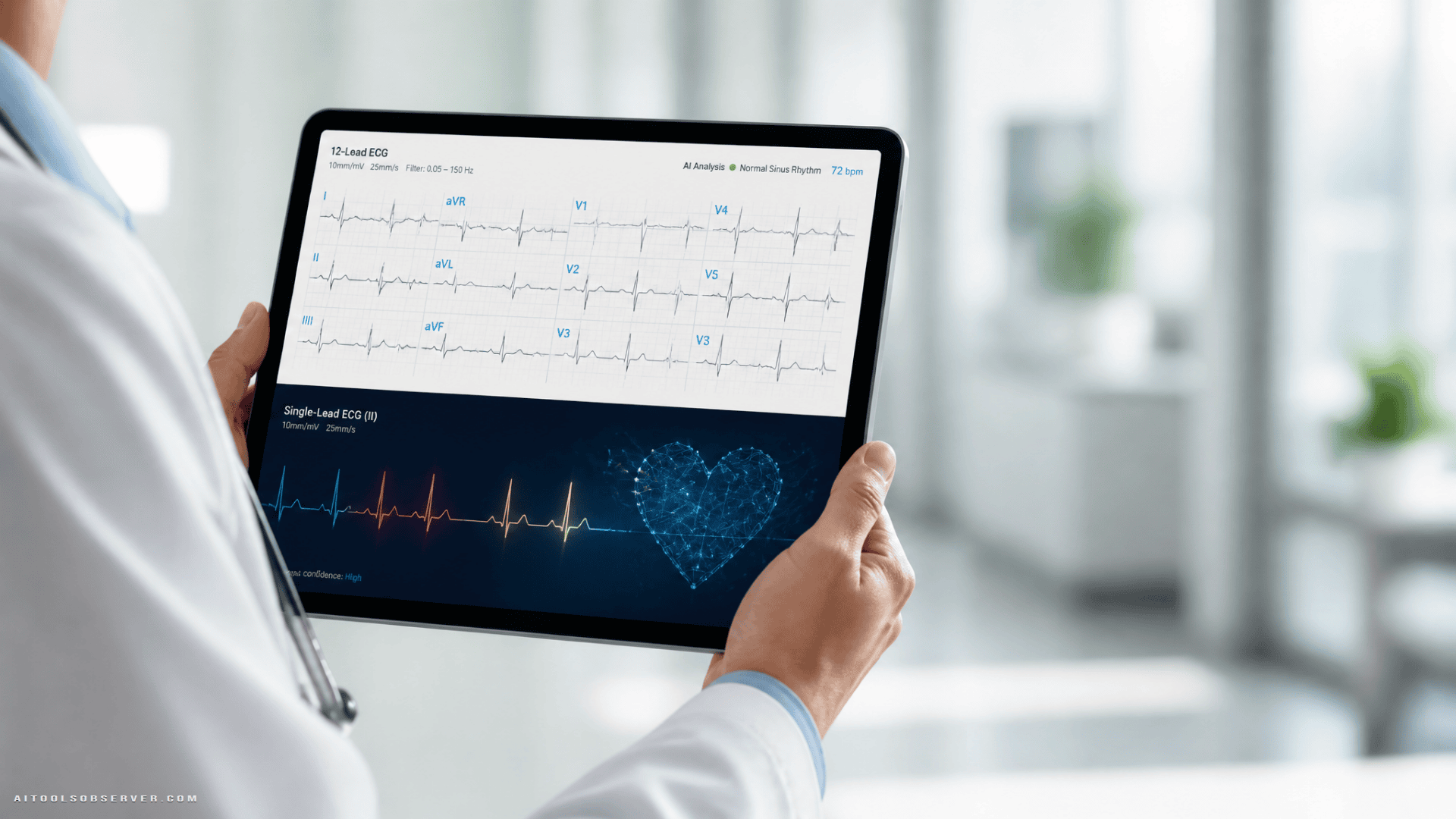
What ECG-CLIP Actually Does
Published in Lancet Digital Health, ECG-CLIP was trained on over 1.7 million ECGs from more than 540,000 patients — paired with clinicians’ notes, not just disease labels. That pairing is the key design choice. Instead of learning “this ECG pattern equals this disease,” the model learns the broader language of cardiac physiology first, then adapts to specific tasks with far fewer examples.
The result: ECG-CLIP matched the performance of the next-best model on disease detection while using roughly 91% less labeled training data on average.
As senior author Giorgio Quer puts it, the model learns the way a clinician does — not from a million examples, but from understanding the underlying physiology and then seeing a handful of specific cases.
Where It Performed Well
The team tested ECG-CLIP across three clinical task types:
- Disease detection — acute myocardial infarction, cardiac amyloidosis, and hypertrophic cardiomyopathy. ECG-CLIP consistently outperformed standard models, especially when labeled examples were scarce (as few as 10 positive cases).
- Disease prediction — ECG-CLIP outperformed all tested models at predicting future atrial fibrillation from ECGs showing normal rhythms. That’s a genuinely hard task.
- Adverse outcome prediction — 30-day survival after an ED visit or surgery, plus 3-year risk of chronic kidney disease and type 2 diabetes. ECG-CLIP led the field here too.
It also held up using single-lead ECG data, which matters a lot for settings where a full 12-lead setup isn’t available.
The Interpretability Angle
A model that cardiologists can’t trust won’t get used. The Scripps team addressed this by implementing saliency maps — visual overlays that highlight which parts of the ECG signal drove the model’s predictions. It’s a practical step toward clinical adoption, not just benchmark performance.
What’s Still Ahead
The researchers are clear that prospective clinical trials are needed before ECG-CLIP moves into real-world care. The team is also working to expand the model’s data inputs for specific settings like emergency departments, and to test compatibility with wearable ECG devices — which could eventually support continuous, remote cardiac monitoring.
The gap between “strong research results” and “deployed clinical tool” is real and often wide. ECG-CLIP appears to be a serious step in the right direction, but the validation work is still ahead.
Why This Matters Beyond Cardiology
The low-labeled-data angle is the most transferable insight here. Foundation models that can adapt to new clinical tasks with minimal annotation could reshape how medical AI gets built across specialties — not just cardiology. If the approach holds up in trials, it’s a meaningful shift in what’s feasible for rare diseases and under-resourced healthcare settings.
For anyone tracking medical AI tools: ECG-CLIP is worth watching as a case study in how foundation model design choices directly affect real-world deployability.








Comments (0) No comments yet
Want to join this discussion? Login or Register.
No comments yet. Be the first to share your thoughts!