



The Problem Every Physician Recognizes
Dr. Peter Jewell sees 20 to 25 patients a day at Artesia General Hospital in Artesia, New Mexico. After each shift, he faced hours of additional documentation work — updating electronic health records, writing up visit notes, capturing everything that happened in each appointment.
This is not a niche problem. Physician burnout driven by administrative overload is one of the most documented issues in modern healthcare. Doctors spend more time typing into EHR systems than they spend talking to patients. The computer becomes the third person in every exam room.
For rural physicians like Jewell, the burden is even heavier. There is no large support staff to absorb the overflow. You do the work yourself, or it does not get done.
What Microsoft Dragon Copilot Actually Does Here

Microsoft Dragon Copilot is an AI-powered clinical assistant. In practical terms, it listens to the conversation between a doctor and a patient, transcribes it in real time, and then automatically updates the electronic health record.
No manual note-taking. No post-shift documentation marathon. The system handles the structured output so the physician can focus on the person in front of them.
What makes the Artesia General case notable is not the technology itself — it is who is using it. Dr. Jewell describes himself as not particularly tech-savvy. The fact that he adopted this tool and found it genuinely useful says something about where AI scribe technology has landed in terms of usability.
What Changed Day-to-Day
The shift in Jewell’s workflow comes down to a few concrete things.
After-hours documentation dropped significantly. Time that previously went to catching up on records now goes elsewhere — including rest, which matters enormously for physician performance and longevity.
More visibly, Jewell can maintain eye contact during appointments. He can observe patients more closely, pick up on non-verbal cues, and engage in real conversation rather than splitting attention between the patient and a keyboard. Patients consistently report frustration when doctors seem more focused on their screens than on them. This tool directly addresses that friction.
What the AI Is Not Doing
This is worth stating clearly because it matters for how you think about AI in clinical settings.
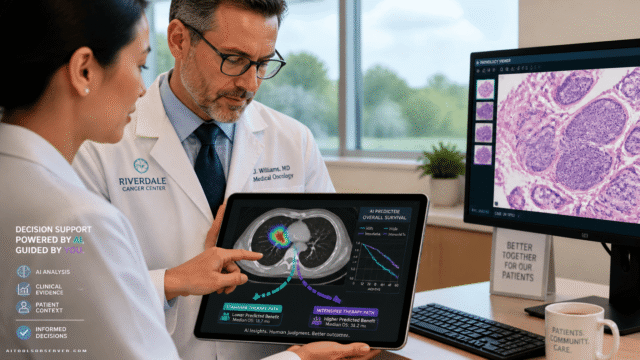
Dragon Copilot does not diagnose. It does not recommend treatments. It does not make any medical decisions. Jewell is explicit about this — the AI handles documentation so that he can handle medicine.
That distinction is important both practically and for patient trust. The physician remains fully in control of care. The AI is a workflow tool, not a clinical decision-maker. Understanding that boundary is essential for any healthcare organization evaluating these tools.
Why This Use Case Translates Beyond Rural Hospitals
Artesia General is a specific context, but the underlying workflow problem is universal across healthcare settings.
Any physician carrying a high daily patient volume faces the same documentation pressure. Any practice where doctors are spending significant time on EHR updates after hours is a candidate for this kind of automation. The rural setting here actually makes the case stronger — if a non-technical physician at a small hospital can implement this effectively, the barrier to adoption is lower than most assume.
The core value proposition is straightforward: reduce the time physicians spend on structured data entry so they can spend more time on actual patient care.
Choosing an AI Scribe Tool: What to Evaluate

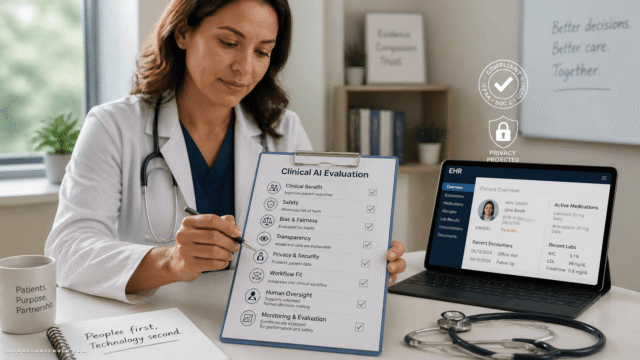
If you are exploring AI documentation tools for a clinical environment, the Artesia General case gives you a useful framework for evaluation.
Ease of use for non-technical staff. If the tool requires significant training or ongoing IT support, adoption will stall. Jewell’s experience suggests Dragon Copilot clears this bar, but you should verify this against your own team’s profile.
EHR integration. The tool needs to connect cleanly with whatever system you are already running. Fragmented workflows create more problems than they solve.
Accuracy and physician review workflow. AI transcription is not perfect. You need to understand how errors surface, how physicians review and correct notes, and what the liability posture looks like for your organization.
Patient consent and data handling. Recording patient conversations requires clear consent protocols and compliant data handling. This is non-negotiable.
Impact on actual physician time. Ask vendors for concrete data on after-hours documentation reduction, not just feature lists.
The Takeaway
The Artesia General story is useful precisely because it is unglamorous. No cutting-edge research lab. No massive implementation budget. Just a rural family doctor who needed to spend less time on paperwork and more time with patients — and found an AI tool that actually delivered on that.
If you are evaluating AI tools for healthcare documentation, start with the workflow problem you are actually trying to solve. In most clinical settings, that problem is time lost to EHR documentation. Tools like Microsoft Dragon Copilot are now mature enough that a non-technical physician at a small rural hospital can deploy them effectively.
That is the signal worth paying attention to.




Comments (0) No comments yet
Want to join this discussion? Login or Register.
No comments yet. Be the first to share your thoughts!