


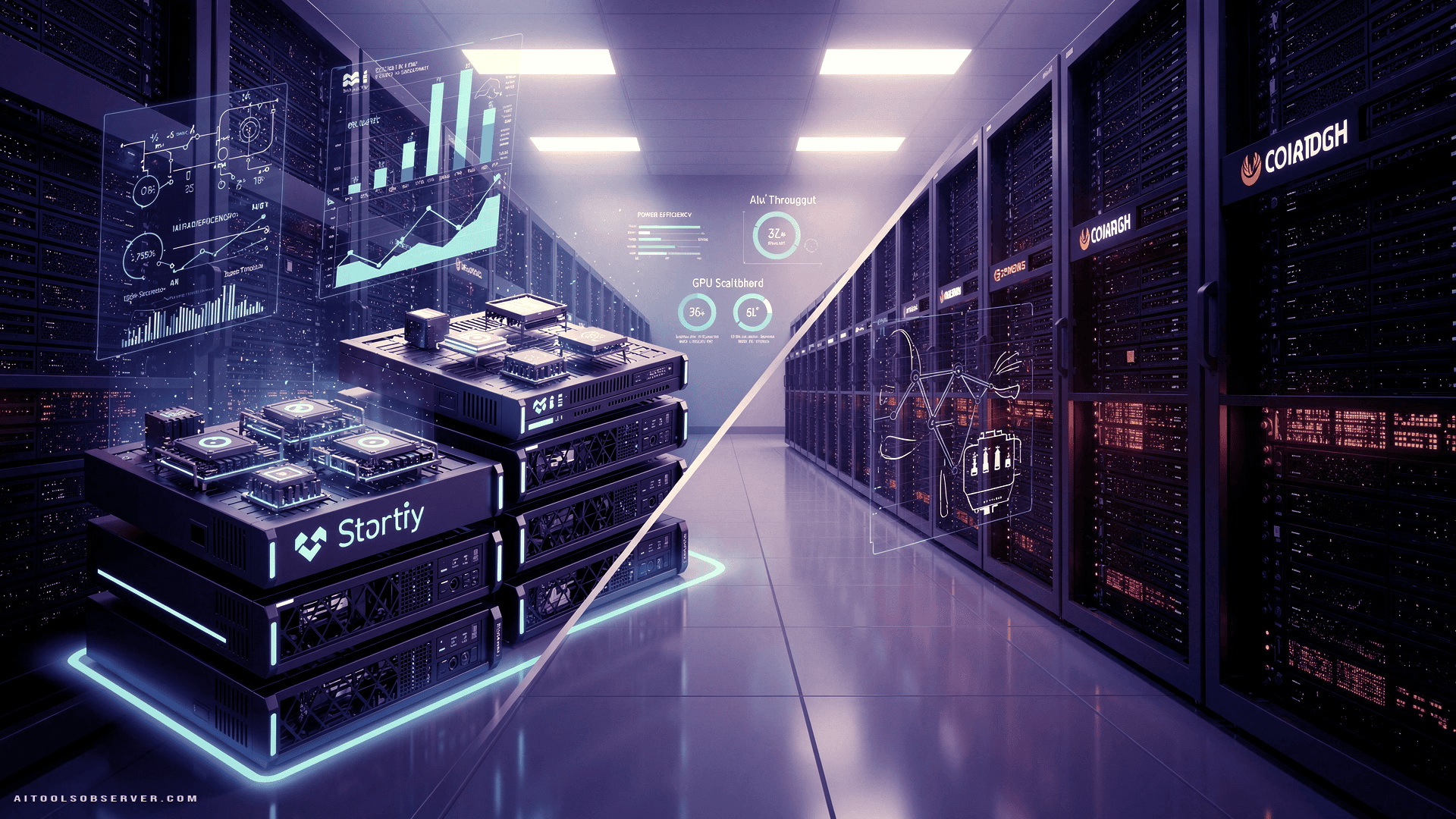
What Etched Actually Announced

On Tuesday, Etched issued a progress report confirming that TSMC has successfully manufactured its first chip. The startup has already secured $1 billion in contract orders for what it calls “frontier inference clusters” — full systems that bundle its custom chips with purpose-built racks and software.
These aren’t just chips in a box. Etched is selling complete, vertically integrated inference infrastructure designed to run frontier AI models faster, cheaper, and with better power efficiency than existing solutions.
The company also confirmed it has raised a total of $800 million to date. The most recent tranche was a $500 million round closed quietly in December 2024 at a $5 billion post-money valuation — led by Stripes, with participation from Jane Street, Hudson River Trading, Two Sigma, Ribbit Capital, and VentureTech Alliance.
Why Inference Is the Battleground That Matters

Inference is the compute that happens every single time a user submits a prompt. It’s not training — it’s serving. And right now, it’s the biggest cost center and the biggest bottleneck for any AI company trying to scale.
Every ChatGPT response, every Copilot suggestion, every Claude output runs on inference hardware. As usage scales into the billions of daily interactions, the economics of inference become existential for AI companies.
That’s exactly why specialized inference chips are attracting serious capital. General-purpose GPUs like Nvidia’s H100 were designed for flexibility. Etched is betting that purpose-built silicon — optimized specifically for AI inference workloads — can dramatically outperform them on cost and efficiency at scale.
The Investors Behind the Bet
The cap table alone signals how seriously the market is taking Etched.
Beyond the institutional names, the angel investor list reads like an AI hall of fame: Andrej Karpathy (former Tesla AI director and OpenAI co-founder), Geoffrey Hinton (the “Godfather of AI”), Fei-Fei Li (Stanford AI Lab), Arthur Mensch (Mistral CEO), and Scott Wu (Cognition AI). Billionaires Stanley Druckenmiller and Peter Thiel also have skin in the game.
When the people who built the foundational models and the people who fund generational companies are both writing checks, that’s a meaningful signal — not just hype.
From Nearly Running Out of Cash to a $5B Valuation
The Etched origin story is worth understanding because it reframes the current moment in AI investing.
Co-founders Gavin Uberti (CEO) and Robert Wachen (president) both dropped out of Harvard and became Thiel Fellows to start the company in 2022. In 2023, they were pitching a 30-page memo arguing that AI would eventually need specialized chips — not general-purpose GPUs. Every major investor passed. The company was reportedly operating month-to-month, close to running out of money.
Fast forward two years. The same thesis that couldn’t get a meeting in 2023 just closed a $500 million round at a $5 billion valuation.
The market didn’t change. The timing did. And Etched survived long enough to be right.
The Competitive Landscape Is Getting Crowded Fast
Etched isn’t operating in a vacuum. The AI chip space is heating up from multiple directions simultaneously.
Cerebras delivered what many called the first meaningful AI chip IPO of the year. Groq just raised $650 million to scale its inference-focused LPU architecture. Meanwhile, the hyperscalers — Amazon, Google, and Microsoft — are all building proprietary in-house silicon to reduce their dependency on Nvidia.
Most significantly, OpenAI just announced its first custom chip built in partnership with Broadcom. When the world’s most prominent AI lab starts designing its own silicon, it validates the entire thesis that general-purpose GPUs aren’t the endgame.
Nvidia remains dominant. But the walls are being built around it from every direction — startups, hyperscalers, and AI labs alike.
What Makes Etched Different From the Rest
Most AI chip startups compete on raw performance benchmarks. Etched is competing on system-level economics.
By selling complete inference clusters — chips, racks, and software as a unified product — Etched is targeting the full cost structure of running AI at scale, not just one component of it. That’s a harder product to build, but it’s also a harder product to displace once it’s deployed.
The $1 billion in booked orders before the product is even fully in customers’ hands suggests the market is responding to that framing. These aren’t speculative pre-orders — they’re contract commitments from organizations planning their inference infrastructure now.
What This Means for AI Tool Builders and Buyers
If you’re building on top of AI APIs or evaluating AI infrastructure, the Etched story has direct implications.
The cost of inference is coming down — not because models are getting cheaper to run, but because the hardware layer is getting more competitive. More specialized chips mean more pricing pressure on inference providers, which eventually flows downstream to the tools and platforms built on top of them.
Watch which inference providers start adopting specialized silicon over the next 12 to 18 months. The platforms that move early on more efficient infrastructure will have a structural cost advantage — and that advantage will show up in pricing, latency, and reliability for end users.
The Bottom Line
Etched went from nearly running out of cash in 2023 to a $5 billion valuation, $800 million raised, and $1 billion in booked orders in 2025. That trajectory isn’t just a startup success story — it’s a signal about where the AI infrastructure race is heading.
The inference layer is the new battleground. Specialized silicon is the weapon. And the companies that control the hardware stack will have enormous leverage over the economics of AI at scale.
Nvidia isn’t going anywhere. But for the first time, the challengers have real chips, real customers, and real capital behind them.








Comments (0) No comments yet
Want to join this discussion? Login or Register.
No comments yet. Be the first to share your thoughts!