


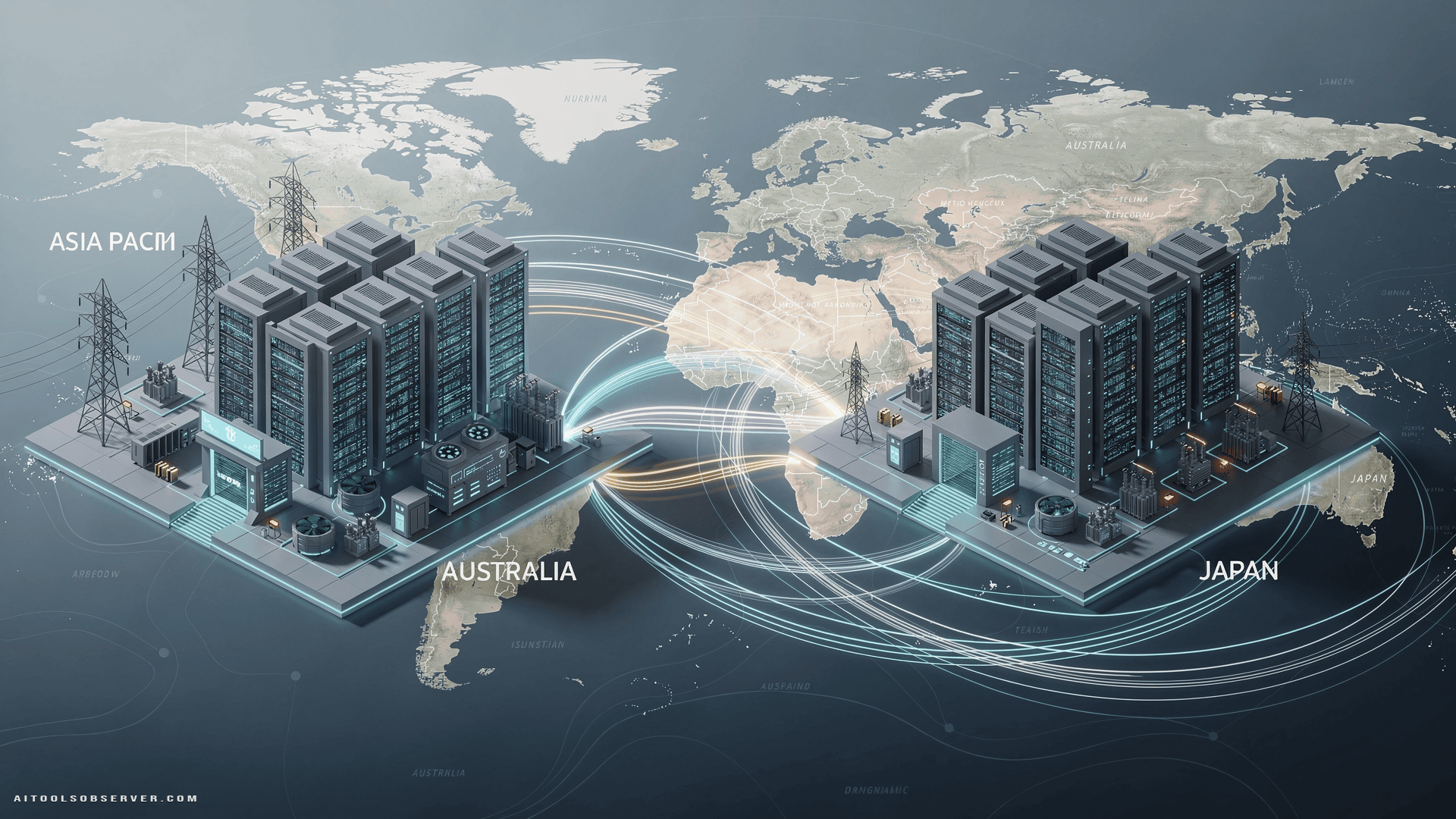
Why APAC, and Why Now
Anthropic’s domestic U.S. infrastructure push accelerated sharply in early 2026, with a series of data center deals announced in the spring. But domestic capacity alone cannot absorb the growth the company is experiencing. In April, Anthropic acknowledged publicly that its “unprecedented consumer growth” was placing “an inevitable strain on our infrastructure,” affecting reliability and performance.
The revenue trajectory makes the urgency concrete. Anthropic’s revenue run-rate crossed $4.7 billion in May 2026 — a figure several times higher than the approximately $900 million reported at the end of 2025. At that velocity, compute demand does not wait for deliberate, multi-year infrastructure planning cycles. It compounds.
International expansion is the logical pressure valve. Europe was already on the radar in April, with a London-based deal sourcing role offering salaries between £225,000 and £270,000. APAC is now the next front.
Australia: Strategic Depth, Regulatory Friction

Australia presents a compelling infrastructure case on multiple dimensions. The country offers abundant land, significant renewable energy potential, and a politically stable environment — factors that matter increasingly as AI infrastructure becomes entangled with national security considerations.
The Five Eyes intelligence-sharing partnership between Australia, the U.S., and three other anglophone democracies adds a layer of geopolitical trust that few other regions can match. This matters more than it once did. As AI models grow more powerful and are increasingly treated as sensitive national assets, compute location is no longer a purely logistical question. The Middle East’s vulnerability was demonstrated early in the current conflict cycle, when two Amazon data centers were targeted — a reminder that political geography shapes infrastructure risk.
Yet Australia’s most significant obstacle is not physical but legal. Copyright law remains a live threat for any AI company seeking to train commercial models on locally sourced content. Australian politicians are actively resisting copyright carve-outs for AI firms, and the legal exposure this creates is non-trivial. Anthropic has signaled it will partner only with countries whose “legal and regulatory frameworks support investments of this scale” — which means the copyright question in Australia is not a footnote. It is a condition.
Japan: Grid Constraints on a Strong Foundation

Japan’s appeal is structural. Political stability, a reliable power grid, advanced subsea cable infrastructure, and a technically skilled workforce make it one of the most attractive AI investment destinations in Asia. Microsoft committed $10 billion to Japan in April 2026, including AI infrastructure development. GMI Cloud announced a $12 billion sovereign AI project in March. Anthropic’s interest fits a clear pattern of democratic, technically advanced nations becoming preferred compute destinations.
The Japanese government’s active interest in domestic AI infrastructure development adds a policy tailwind that accelerates deal timelines and reduces regulatory uncertainty. For a company moving as fast as Anthropic, that matters.
The critical constraint, however, is energy. Japan’s grid infrastructure is evolving, but access to sufficient power capacity is becoming the defining bottleneck for data center development across the entire Asia-Pacific region. As one analyst from Wood Mackenzie put it plainly: securing power is now more challenging than securing land, financing, or permits. Grid availability is the constraint that determines whether a multi-hundred-megawatt facility remains a job listing or becomes operational infrastructure.
What This Signals for the AI Tools Ecosystem
Anthropic’s APAC expansion is not merely a corporate infrastructure story. It carries direct implications for the tools and services built on top of Claude.
Latency and reliability for APAC users will improve. Regional compute capacity means shorter round-trip times for enterprise customers in Australia and Japan — a meaningful competitive differentiator for API-dependent products and Claude-powered applications.
Enterprise AI adoption in APAC will accelerate. Local infrastructure signals local commitment. Enterprises in regulated industries — finance, healthcare, government — are far more willing to adopt AI tools when the underlying compute resides within a trusted, proximate jurisdiction.
Sovereign AI is becoming a procurement criterion. The emphasis Anthropic places on democratic legal frameworks and secure supply chains reflects a broader market shift. Buyers are beginning to ask not just what a model can do, but where it runs and under whose legal jurisdiction. Tool selection will increasingly factor in infrastructure provenance.
The power constraint is a shared problem. Every AI lab, cloud provider, and infrastructure developer faces the same energy bottleneck. This will drive innovation in power procurement, grid partnerships, and energy-efficient compute — and will likely reshape which geographies emerge as dominant AI infrastructure hubs over the next five years.
The Takeaway
Anthropic’s move into Australia and Japan is a precise, deliberate expansion driven by compounding demand, geopolitical calculation, and the hard physics of compute capacity. The multi-hundred-megawatt ambition signals that this is not a pilot program — it is a long-term infrastructure commitment.
For founders and enterprise buyers evaluating AI tools, the message is clear: the geography of compute is becoming a strategic variable, not a background assumption. Where your AI infrastructure runs — and under what legal and political conditions — will shape reliability, compliance, and ultimately, competitive advantage. Observing where the leading labs are building is one of the clearest ways to anticipate where the ecosystem is heading next.










Comments (0) No comments yet
Want to join this discussion? Login or Register.
No comments yet. Be the first to share your thoughts!