


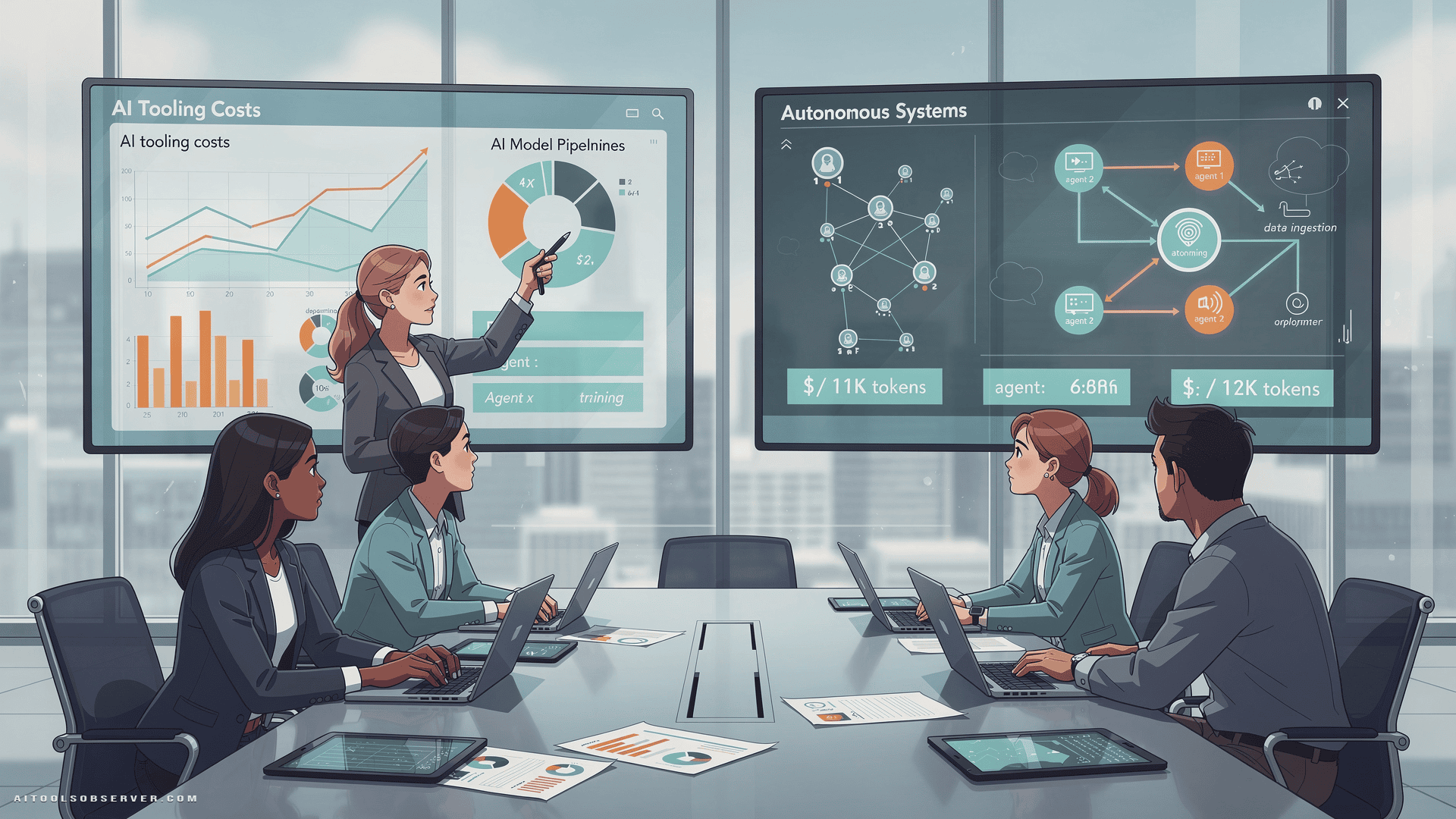
The Cost Problem Is Now an Engineering Problem

When AI access was bundled into a subscription, cost was someone else’s concern. Now that every token has a price tag, engineers are being handed the bill — and they are responding with characteristic ingenuity.
AJ Fisher’s talk on diffusion language models offered one of the conference’s most practically useful frameworks. Unlike the dominant autoregressive frontier models — which generate text sequentially, at high cost and relatively low speed — diffusion models generate text in parallel, trading some accuracy for significant gains in throughput and economy.
Fisher’s proposed solution is elegant in its pragmatism: use a cheaper, lower-accuracy diffusion model and run it iteratively until it converges on a satisfactory output. The approach, which he described with the memorable shorthand of a “Ralph Wiggum loop,” can deliver comparable results to a premium model at anywhere from half to one-tenth the cost.
The timing proved prescient. Google released DiffusionGemma — a diffusion-based text model capable of generating output at prodigious speed — just days after Fisher’s presentation. The model gave the broader developer community an immediate, accessible way to test this cost-reduction strategy in production conditions.
What This Means for Model Selection
The diffusion-versus-autoregressive trade-off is not merely a cost conversation. It is a signal that the tooling stack is maturing into something more nuanced than “use the best model available.” Engineers are now expected to reason about model characteristics — speed, accuracy, cost, failure modes — and compose pipelines accordingly.
This is a meaningful shift. It moves AI integration closer to traditional systems design, where component selection involves deliberate trade-offs rather than defaulting to the most capable option.
The Human Fault Line: Outcomes vs. Learning
Not every engineer at the conference was optimising token spend. Some were questioning whether AI tooling belongs in their workflow at all — and their reasons deserve more than dismissal.
Annie Vella, author of the widely circulated essay The Software Engineering Identity Crisis, offered a framework for understanding the field’s deepening divide. On one side: engineers who are outcome-oriented, for whom AI tools represent a legitimate acceleration of value delivery. On the other: engineers for whom the process of understanding — the slow, effortful journey through a problem — is itself the point. For this cohort, AI short-circuits the reward mechanism entirely.
This is not a skills gap. It is a values gap, and it will not close through evangelism or mandate.
Vella’s prescription is deliberately human: sensitivity, genuine listening, and openness to change on both sides of the divide. In a conference dominated by benchmarks and architecture diagrams, that message carried unusual weight. The most durable AI adoption strategies will account for the psychological reality of the engineers being asked to change, not just the technical capability of the tools being introduced.
Keeping the Mind in the Loop
Jeremy Howard, known to many through Kaggle and fast.ai, arrived with a different kind of warning — less about cost, more about cognition.
His core argument was a plea for critical thinking in an environment increasingly designed to make thinking feel unnecessary. The warm bath of machine-generated output is comfortable precisely because it removes friction. Howard’s concern is that friction, in the right doses, is where understanding lives.
His demo of SolvelT — a still-in-beta environment that blends the interactivity of Python notebooks with the depth of Mathematica and the accessibility of a conversational interface — offered a concrete counterproposal. Rather than a tool that answers questions, SolvelT is designed to keep the engineer swimming in the problem space, navigating knowledge rather than outsourcing it.
The distinction matters architecturally as well as philosophically. Tools that preserve human reasoning in the loop produce engineers who understand their systems. Tools that replace reasoning produce engineers who are dependent on outputs they cannot interrogate.
The Self-Healing Pipeline: A Working Vision

The talk that generated the most discussion — and the most genuine astonishment — came from Daniel Rodgers-Pryor, whose presentation carried the deliberately provocative title Fully Automated Luxury Gay Space Engineering.
The substance matched the ambition. Rodgers-Pryor has built a CI/CD pipeline in which every signal the system generates — metrics, logs, error messages, user feedback — is continuously fed into a set of AI agents. Those agents identify issues, trace root causes, implement fixes, integrate changes into the codebase, run tests, and deploy to users. The loop is closed, and it runs without waiting for a human to notice something is wrong.
Why This Is Not a Recipe for Disaster
The instinctive reaction to a fully automated deployment pipeline is alarm. The more considered reaction, after examining how the system actually behaves, is something closer to admiration.
Rodgers-Pryor’s architecture is explicitly anti-fragile: it improves under load. More users generate more signals. More signals give the agents more data. More data produces better-calibrated interventions. The system does not degrade under pressure — it learns from it.
The analogy he offered is instructive: a production line worker sampling items from a conveyor belt, checking quality, and returning them to the stream. The job is not to build each item. The job is to maintain the feedback loop — to make it shorter, tighter, and more responsive.
The Redefined Engineering Role
This is the practical implication that deserves the most attention. Rodgers-Pryor is not describing a world where engineers are replaced. He is describing a world where the engineer’s primary responsibility shifts from writing code to designing and maintaining feedback systems.
That is a genuine change in job description. It requires different instincts, different tooling literacy, and a different relationship with failure — one that treats errors as signal rather than embarrassment.
Reading the Stack as a Whole
Taken together, the conversations at AI Engineer Melbourne sketch a coherent picture of where the developer tooling stack is heading — and what it demands from the engineers working within it.
Cost pressure is driving architectural creativity. Diffusion models, iterative loops, and deliberate model tiering are becoming legitimate engineering disciplines rather than workarounds. The question is no longer which model is best, but which model is appropriate for this specific task at this specific cost tolerance.
Human factors are not soft concerns. The divide between outcome-oriented and learning-oriented engineers is a structural challenge for any organisation attempting to scale AI adoption. Ignoring it produces resistance; addressing it produces durable change.
Critical thinking is a system requirement. As AI-generated output becomes ambient, the ability to interrogate, verify, and reason about that output becomes a core engineering competency — not a nice-to-have.
Feedback loops are the new architecture. The self-healing pipeline is not a curiosity. It is an early, working example of what AI-native engineering infrastructure looks like when it is designed from first principles rather than retrofitted onto existing workflows.
The Price of Admission
Software engineers have absorbed more fundamental change in the past three years than in the preceding three decades. The grievance is legitimate. The disruption is real.
What the speakers at AI Engineer Melbourne collectively demonstrated is that the response to that disruption need not be capitulation or refusal. It can be something more interesting: deliberate, critical, human-centred engagement with tools that are genuinely powerful and genuinely incomplete.
The engineers who will navigate this transition most effectively are not the ones who adopt everything or reject everything. They are the ones who ask the right questions — about cost, about cognition, about feedback, about what the journey is actually for.
That, in the end, is the oldest engineering discipline of all.













Comments (0) No comments yet
Want to join this discussion? Login or Register.
No comments yet. Be the first to share your thoughts!