


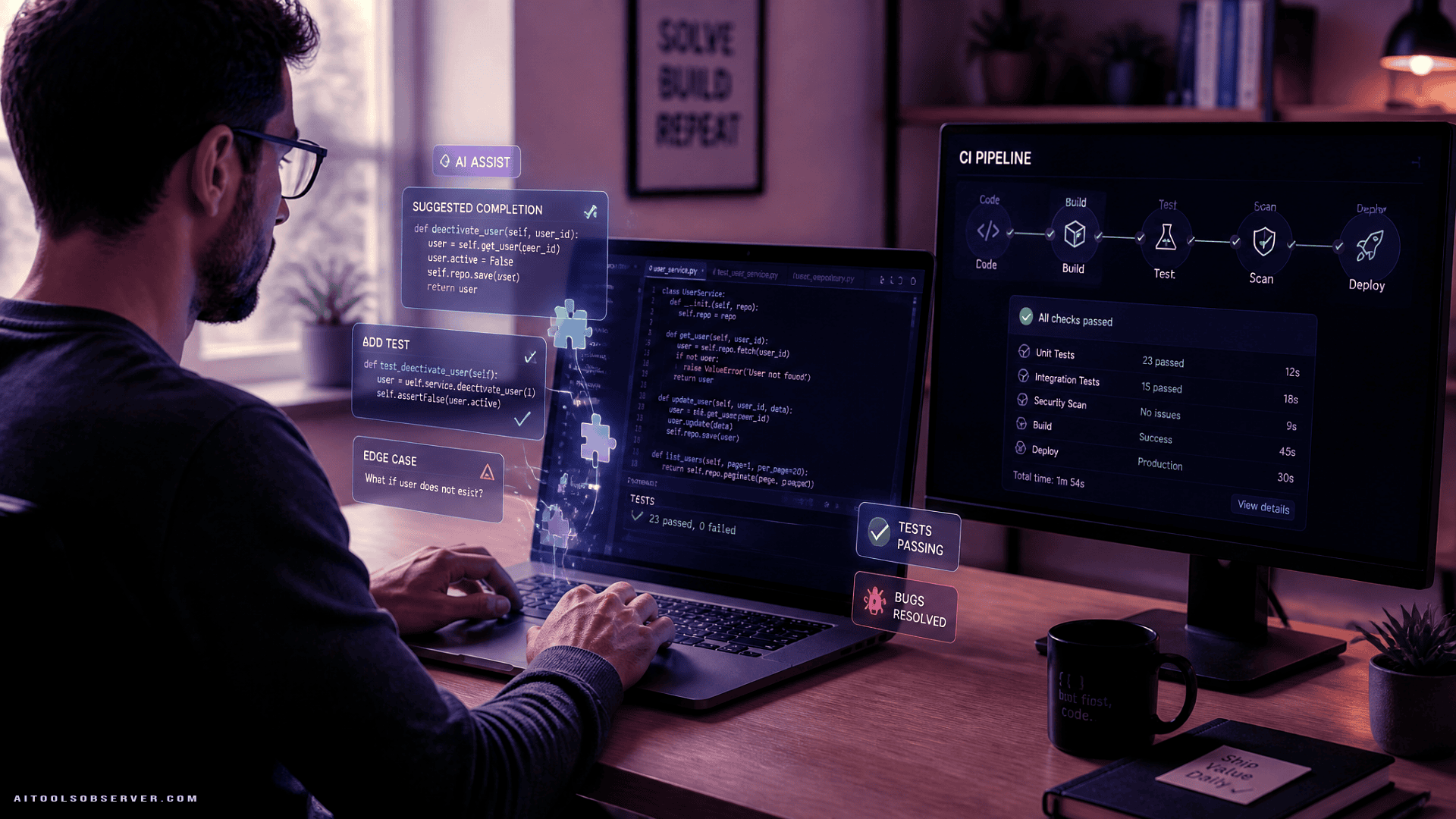
The real productivity gain: less grunt work, more judgment
A lot of engineering time disappears into tasks that are necessary but not especially high-value on their own. Boilerplate code. Repetitive tests. Chasing down predictable bugs. Re-reading the same docs because the thread was lost somewhere between tabs 14 and 15.
AI tools help by turning some of that work into assisted work.
Instead of writing every line from scratch, developers can describe intent and get a draft. Instead of manually building every test case, they can start from generated coverage and refine it. Instead of scanning a codebase for obvious mistakes, they can use AI to surface patterns worth reviewing first.
That changes the job in a subtle but important way: engineers spend less time producing raw output and more time evaluating, steering, and improving it.
Smarter coding without pretending drafts are done
The most visible shift is in code creation. AI-assisted coding tools can generate snippets, functions, and structural suggestions from natural language or surrounding context.
That speeds up a few very common moments:
- scaffolding routine functions
- filling in repetitive patterns
- suggesting next lines or blocks
- translating intent into a first implementation
- reducing boilerplate across familiar workflows
The value here is not magical code production. It’s momentum.
A blank file is slow. A rough draft is fast.
That said, generated code is still draft material. It may be syntactically correct and still be logically wrong, poorly scoped, insecure, or hard to maintain. Teams that benefit most tend to treat AI output like an eager junior contributor: useful, fast, and absolutely in need of review.
Testing and debugging get less painful
Testing and debugging have always been where optimism goes to be corrected.
AI tools can make both stages more efficient by helping teams identify bugs, suspicious patterns, and weak coverage earlier in the process. They can also assist with generating test cases across expected and unexpected scenarios, which improves reliability without requiring someone to manually enumerate every possibility.
This matters because quality problems are cheaper when caught early and annoying when caught late.
In practical terms, AI can support:
- earlier bug detection
- broader test case generation
- faster isolation of likely fault areas
- surfacing inefficiencies and risky patterns
- reducing repetitive debugging cycles
The biggest productivity win is not “fewer bugs forever.” It’s spending less time hunting obvious issues after they’ve already spread.
AI across the SDLC, not just inside the editor
The editor gets most of the attention, but the bigger shift is happening across the software development lifecycle.
AI appears increasingly useful at multiple stages:
Requirements and planning
Natural language inputs can be turned into clearer specifications, structured tasks, or implementation outlines. That helps reduce ambiguity before development starts, which is cheaper than untangling misunderstandings later.
Design and architecture
AI can support architectural thinking by suggesting patterns, highlighting tradeoffs, or helping teams reason through performance and complexity earlier in the cycle.
It won’t own system design. But it can speed up exploration.
Development
This is the obvious zone: code generation, autocompletion, refactoring support, and faster navigation through large codebases.
Testing and validation
AI-assisted testing improves breadth and speed. It can help generate cases, flag likely regressions, and support more consistent validation.
Deployment and operations
Once software is live, AI can help monitor behavior, detect anomalies, and recommend areas worth investigating. That creates a tighter loop between shipping and improving.
In other words, AI is less a single feature and more a layer of assistance spread across the workflow.
What changes for software engineers
The engineer’s role does not disappear. It shifts.
As AI handles more repetitive execution, developers spend more time on:
- framing the right problem
- defining constraints
- reviewing outputs
- making tradeoffs
- designing systems
- protecting quality and security
That’s a healthier definition of engineering anyway.
Writing code still matters, of course. But modern productivity increasingly comes from knowing what should be built, how it should behave, and what should never be trusted without verification.
The keyboard is still involved. It just no longer deserves sole credit.
Why teams feel the impact beyond engineering
Better developer productivity is not just an engineering metric. It shows up in delivery speed, software quality, and team capacity.
When repetitive work is reduced, teams can:
- ship faster
- spend less time on avoidable rework
- improve reliability
- focus more on product value
- allocate effort more deliberately
The description suggests that AI-assisted workflows also improve project scheduling and resource use. That makes sense. If less time is lost to routine effort and late-stage firefighting, planning gets less fictional.
Not perfect. Just less fictional.
The tradeoffs are real
AI tools are useful, but they are not neutral.
The risks are familiar and worth taking seriously:
- overreliance that weakens core engineering skills
- incorrect outputs that look convincing
- security issues introduced through unreviewed code
- hidden bias in generated suggestions
- low transparency in how recommendations are produced
This is where teams need discipline, not just enthusiasm.
Good use of AI in engineering usually includes human review, regular auditing, clear documentation, and explicit ownership of final decisions. Automation helps. Accountability remains human.
How to adopt AI developer tools without making a mess
The fastest way to get value is usually not “put AI everywhere.” It’s picking high-friction tasks and improving those first.
A practical approach looks like this:
- Start with repetitive workflows such as boilerplate code, test generation, or routine debugging.
- Keep review standards high, especially for logic, security, and maintainability.
- Measure usefulness by outcomes, not novelty.
- Treat generated output as a draft, not a final artifact.
- Expand usage where the tool consistently saves time without lowering quality.
This avoids a common trap: gaining speed in the first week and technical debt in the sixth.
AI developer tools are most useful when adopted with that kind of restraint.
What this means for software productivity now
AI developer tools are changing software engineering productivity in a simple way: they reduce the cost of routine effort and increase the amount of time available for higher-level work.
That does not make engineering easy. It makes good engineers more effective when they use these tools with care.
The useful takeaway is straightforward: use AI where repetition slows the team, keep humans responsible for judgment, and optimize for better software, not just faster output. That’s where the real productivity gain lives.









Comments (0) No comments yet
Want to join this discussion? Login or Register.
No comments yet. Be the first to share your thoughts!