


The Problem June Is Solving
The standard industry response to enterprise AI implementation has been to throw people at it. Forward-deployed engineers—specialists who embed inside a company to get AI systems operational—have become a growth business in their own right. The irony, as June’s CEO Efrat Rapoport frames it, is that AI is increasing demand for professional services rather than reducing it.
Rapoport and her three co-founders—Ohad Hen, Barak Goldstein, and Idan Tsitiat—previously built Bonobo AI, a pre-transformer voice-to-text company acquired by Salesforce in 2019. After spending several years inside Salesforce working on AI initiatives, they watched enterprise customers repeatedly struggle with the same integration challenges. That experience became the founding thesis for June.
The pre-seed round was led by Marc Benioff’s Time Ventures, with participation from Michael Dell, Aaron Levie, and George Kurtz. The company declined to disclose its valuation.
The broader challenge sits within enterprise automation, where getting systems to work together is often harder than building the AI layer itself.
How the Platform Works
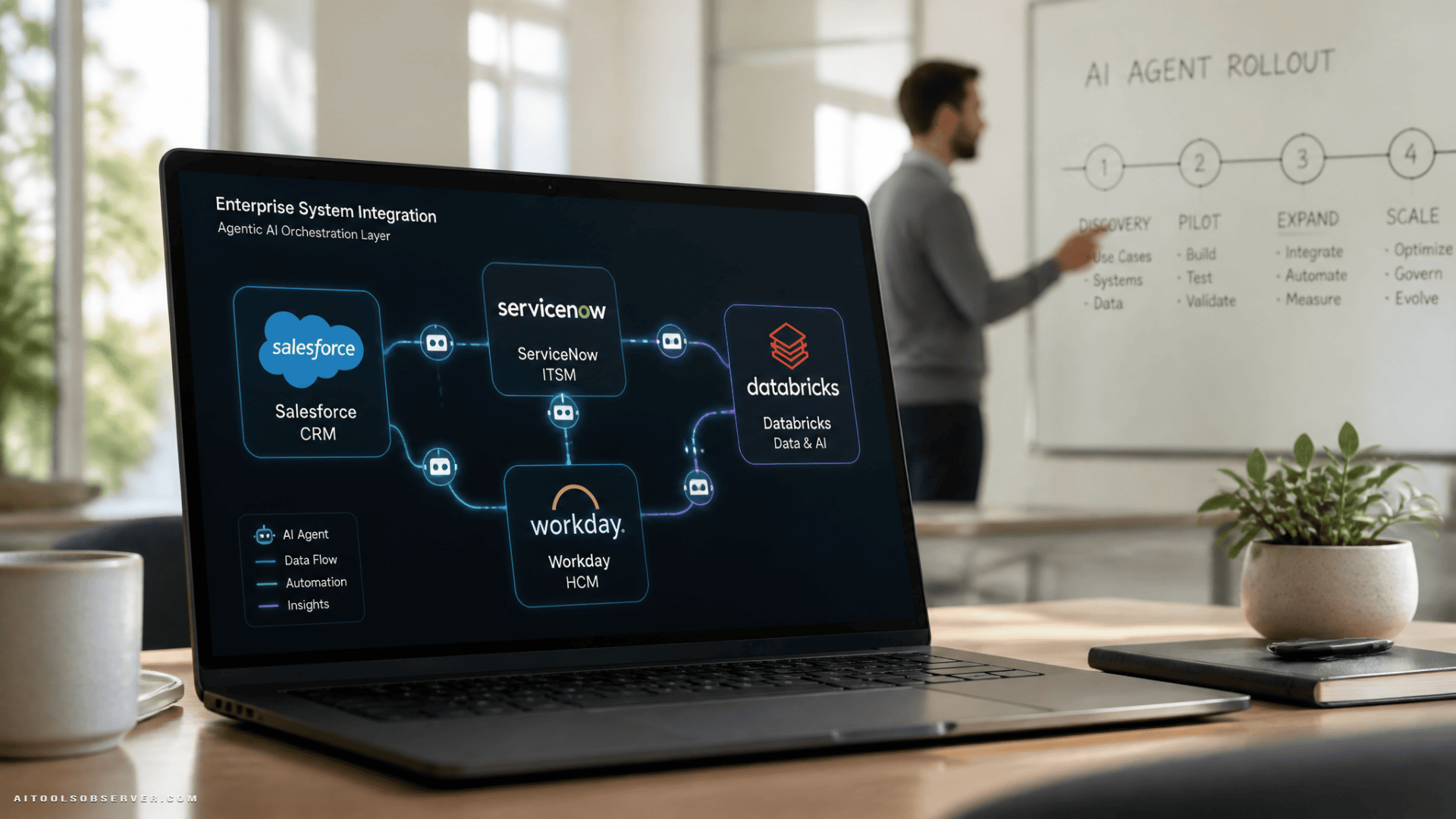
June scans a company’s existing systems—Salesforce, ServiceNow, Databricks, Workday, and similar platforms—to map business workflows, identify bottlenecks, and surface the specific technical issues blocking agent deployment. It then generates a step-by-step implementation roadmap and automates the build process task by task.
The platform’s output is concrete and actionable: remove these duplicate fields, connect to this data source, then click to build. Teams receive notifications through their existing communication channels as work progresses. The goal is to give non-specialist teams a clear, auditable path to deploying agents without requiring a dedicated implementation team.
This matters because building an agent template is, as Rapoport puts it, the easy part. The hard part is making it function reliably inside a real enterprise environment where the same data might live in ten different fields across three systems, maintained inconsistently by different teams.
A Real-World Test Case
Paul Akinmade, Chief Strategy Officer at CMG, a major U.S. mortgage lender, offers a useful illustration of the problem June addresses. His team had moved software engineering to Claude Code quickly, but hit a wall integrating it with Salesforce. Weeks of meetings with architects and forward-deployed engineers produced no progress.
Akinmade’s condition for piloting June was direct: if the product requires FDEs to operate, he did not want it. He had already been through that experience and found it unsatisfactory—opaque, slow, and dependent on specialists his team could not retain. June gave his team visibility into where to deploy agents and let them proceed independently, reportedly before the official onboarding call had even taken place.
The Positioning Tension Worth Watching
Rapoport describes June as a tool that complements forward-deployed engineers and consultants rather than replacing them. Her customers appear to be drawing a different conclusion. The appeal of the platform, at least based on early customer feedback, is precisely that it reduces or eliminates the need for external implementation specialists.
That tension is worth tracking. If June’s core value proposition is speed and autonomy for internal teams, the product’s long-term positioning will likely drift toward displacement rather than complement—regardless of how the company frames it today.
What This Signals for Enterprise AI Adoption
The funding and the problem June is addressing point to something specific: the bottleneck in Enterprise AI is not capability, it is integration. Models are capable enough. The infrastructure underneath most large organizations is not ready to support them without significant preparation work.
Platforms that can automate that preparation work—mapping systems, resolving data conflicts, generating deployment roadmaps—are addressing a real and underserved gap. Whether June’s approach proves durable at scale remains to be seen, but the problem it is targeting is well-defined, and the early customer evidence suggests the demand is genuine.
For enterprise teams currently stuck in the gap between a working AI demo and a production-ready agent, June is worth evaluating on one specific question: does it reduce the time and specialist dependency required to get from pilot to deployment inside your existing stack.












Comments (0) No comments yet
Want to join this discussion? Login or Register.
No comments yet. Be the first to share your thoughts!