



The Scale of Energy Demand

Every query sent to ChatGPT, Gemini, or Claude routes through a data centre running specialised chips around the clock. Unlike conventional web servers, AI inference and training hardware performs thousands of parallel calculations continuously, making it substantially more energy-intensive per unit of compute.
The International Energy Agency estimates that data centres consumed approximately 415 terawatt hours of electricity globally in 2024 — roughly 1.5 percent of total global supply. That figure has grown at around 15 percent annually over the past five years and is projected to nearly double to 945 TWh by 2030.
Hyperscale facilities sit at the extreme end of this spectrum. A single 100-megawatt hyperscale campus — the minimum threshold for the largest class of facilities — draws enough electricity to power hundreds of thousands of homes simultaneously. These are not edge cases. They are the dominant infrastructure model for every major cloud and AI provider.
Water: The Cooling Equation

Heat is the unavoidable byproduct of computation at this density. Managing it requires water — large volumes of it, consumed continuously through evaporative cooling towers and liquid cooling systems.
A UK government digital sustainability advisory body has quantified the demand precisely: a single 100-megawatt hyperscale data centre consumes approximately 2.5 billion litres of water per year. That is equivalent to the annual water needs of 80,000 people drawn from a single facility.
Multiply that across a global fleet of more than 11,600 active data centres — with hyperscale capacity nearly doubling since 2021 from 700 to 1,297 facilities according to Synergy Research Group — and the aggregate water demand becomes a material concern for regional water authorities, particularly in drought-prone or water-stressed geographies.
The Data Heat Island Effect
Beyond electricity and water, a Cambridge-led study published in June 2026 has introduced a third dimension to the environmental accounting: localised thermal pollution.
Researchers from Cambridge, Nanyang Technological University, and partner institutions analysed NASA satellite land surface temperature data from 2004 to 2024, cross-referencing it against more than 11,000 data centre locations worldwide. Their methodology focused on 6,733 centres situated outside densely populated areas, comparing temperatures in the months following each facility’s opening against a five-year baseline at the same location.
The findings are precise and significant. Land surface temperatures around AI data centres rise by an average of 2°C after a facility opens, with effects detectable up to 10 kilometres away. Individual cases recorded increases as high as 9.1°C. The researchers termed this the data heat island effect — a direct analogue to the urban heat island phenomenon, where concentrated human activity causes cities to run measurably warmer than surrounding rural areas.
More than 340 million people live within 10 kilometres of a data centre globally. The study describes the cumulative thermal impact on these communities as having a “remarkable influence on regional welfare” — affecting health outcomes, local energy demand for cooling, and broader environmental quality.
Documented Cases
The study maps the 10-kilometre thermal radius around four major facilities as illustrative examples:
- OpenAI/Oracle’s Stargate AI Campus, Abilene, Texas, United States
- OpenAI/NEXTDC’s S7 Hyperscale AI Campus, Eastern Creek, Australia
- Google Data Centre, Jurong West, Singapore
- Alibaba Cloud’s Zhangbei Data Centre, Zhangbei, China
Each represents a distinct geographic and climatic context, yet all exhibit the same measurable warming signature in satellite data.
Where the Infrastructure Is Concentrated
The global distribution of data centre capacity is uneven and increasingly strategic. The United States hosts more than 4,300 facilities — by far the largest national concentration. Europe follows as the second-largest hub, led by the United Kingdom with over 540 facilities clustered heavily around London, Germany with 520-plus, and France with 390-plus.
Across Asia, China and India lead with 360-plus and 300-plus facilities respectively. Southeast Asia is emerging as one of the fastest-growing markets for data centre capacity, driven by cloud adoption and proximity to undersea cable infrastructure.
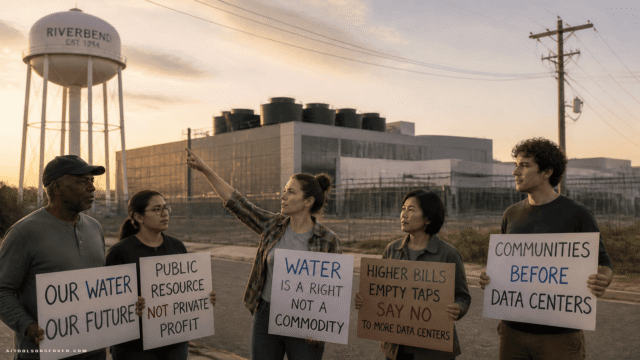
The geographic logic of siting decisions has historically followed cheap land, stable power grids, and favourable climate for cooling. That logic is now being complicated by water scarcity, community opposition, and the thermal externalities the Cambridge study has quantified.
Capital Expenditure and the Build-Out Ahead
The investment pipeline signals that this expansion is accelerating, not plateauing. Goldman Sachs projects a combined $5.3 trillion in capital expenditure between 2025 and 2030 across the four largest hyperscalers — Microsoft, Amazon, Alphabet, and Meta.
Major projects already announced or under construction include:
- Meta’s Hyperion campus in Louisiana — $27 billion
- Microsoft’s multiphase campus expansion in Wisconsin — $20 billion
- Amazon’s infrastructure investment in Mississippi — $25 billion
- Google’s Project Spade in New Florence, Missouri — $15 billion
- Oracle’s Project Stargate in Abilene, Texas — a dedicated OpenAI AI supercluster with projected capacity of 1.2 to 2 gigawatts
These are not incremental upgrades. They represent a structural commitment to physical AI infrastructure at a scale that will define the thermal, hydrological, and electrical geography of entire regions for decades.
What This Means for the AI Tools Ecosystem
For founders building on top of AI infrastructure and for organisations evaluating AI tools at scale, the environmental load of the underlying compute layer is becoming a due-diligence variable — not merely an ethical one.
Regulatory pressure on water usage, carbon disclosure requirements, and community-level opposition to siting decisions are already influencing where hyperscalers can build and at what speed. That, in turn, affects latency, availability, and ultimately the pricing and reliability of the AI services built on top of these facilities.
The data heat island effect adds a new accountability dimension. As satellite monitoring becomes more precise and publicly accessible, the thermal footprint of individual facilities will become measurable, attributable, and — increasingly — regulated.
Closing Observation
The AI tools ecosystem is often discussed in terms of capabilities, pricing models, and workflow integration. Those conversations are necessary. But they rest on a physical substrate that consumes electricity equivalent to mid-sized nations, draws water at municipal scale, and measurably warms the land around it.
Quantifying that load — as the Cambridge study now does with satellite precision — is not a critique of AI adoption. It is the kind of rigorous environmental accounting that allows the industry to make better siting decisions, invest in more efficient cooling technologies, and engage honestly with the communities absorbing the externalities. Observing the ecosystem clearly means observing all of it.






Comments (0) No comments yet
Want to join this discussion? Login or Register.
No comments yet. Be the first to share your thoughts!