


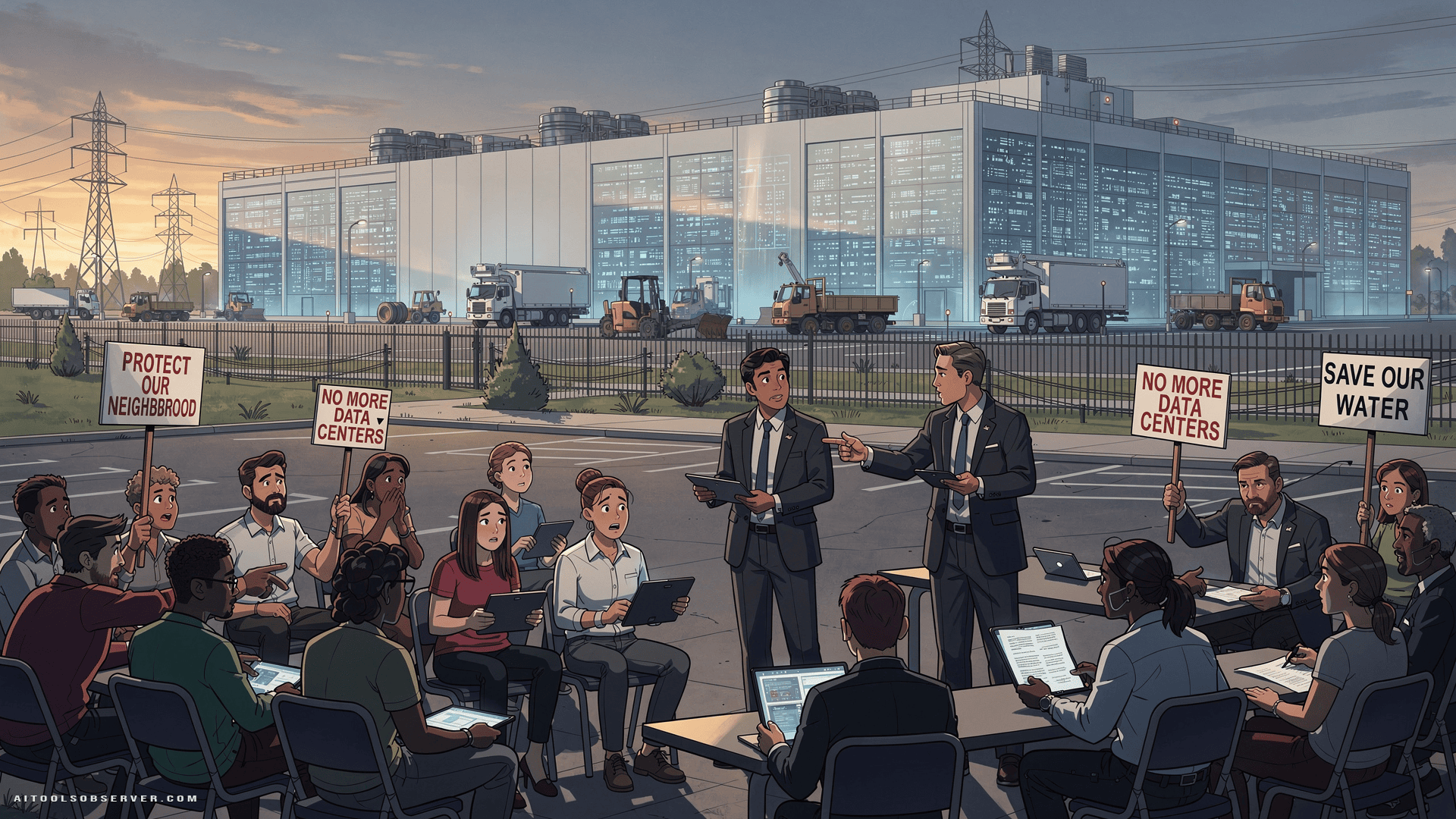
From Zoning Fights to Foiled Plots

The clearest indicator of how far the backlash has escalated came in June 2026, when a foiled plot targeting a UFC event at the White House listed data centers among its stated grievances. Five individuals were charged with conspiracy to commit murder. Authorities say the group planned to deploy explosive-laden drones over the crowd before opening fire on fleeing attendees.
Data centers were not the sole grievance — U.S. foreign policy also featured — but their presence in a domestic terrorism case marks a threshold. These buildings, which most people never see and rarely think about, have become symbols potent enough to appear in the ideological frameworks of violent actors.
That is a significant shift from where this conversation stood even eighteen months ago.
A Pattern of Targeted Violence
The White House plot is the most dramatic example, but it sits within a documented pattern of escalating incidents.
In April 2026, a man threw a Molotov cocktail at the San Francisco home of OpenAI’s CEO, then walked to the company’s headquarters and threatened to burn it down. Investigators found writings expressing opposition to AI and warnings of “impending extinction.”
Four days earlier, an Indianapolis city councilman found thirteen rounds had been fired into his home after he voted to approve a local data center. A note left at his door read simply: “No Data Centers.”
In Michigan, a township treasurer resigned in May after receiving death threats connected to a 1.4-gigawatt project tied to OpenAI and Oracle’s Stargate initiative. “I can’t take it anymore,” she told her board. The threats had followed her vote against rezoning farmland for the facility.
These are not isolated incidents. They form a pattern — and researchers are beginning to name it.
Researchers Identify a New Strand of Extremism

The Soufan Center, a nonpartisan organization that monitors political violence, warned as early as November 2025 that online rhetoric targeting data center infrastructure could produce “a new violent strand of extremism.” By May 2026, that rhetoric was materializing in real-world targeting of individuals connected to AI construction projects.
A study from the Combating Terrorism Center at West Point, published in April 2026, identified a notable tactical shift: grievances are moving away from corporate executives and toward local officials. The reasoning is structural. Data centers make AI physically legible — they concentrate its costs in specific communities, on specific parcels of land, and on the desks of specific planning commissioners.
“Attacking a data center means attacking AI as a system,” one researcher from George Washington University’s Program on Extremism noted in the report.
Yannick Veilleux-Lepage of the Royal Military College of Canada, who authored the West Point study, described the opposition not as a unified movement but as a “grievance structure” — one that simultaneously activates the far right, the far left, and environmental extremists around the same core narrative. That cross-ideological reach makes it unusually durable.
He also identified what he calls a “substitution effect.” As executives acquire security details and corporate campuses harden, violence displaces toward softer targets. Local officials — whose home addresses are public record and who have no security infrastructure — have become the accessible proxy.
Why Data Centers Concentrate Public Anger
The facilities draw opposition from multiple directions at once, which is precisely what makes the backlash so difficult to contain.
Natalie Kerby of AI Forensics describes data centers as a “strong target for channeling distrust in AI” because they aggregate concerns that already exist across separate movements: environmental impact, energy costs, water consumption, and the concentration of economic power. A single project can simultaneously antagonize climate advocates, utility ratepayers, rural landowners, and labor organizers.
The energy dimension is particularly acute. A March 2026 Brookings Institution report found that U.S. electricity costs had risen 42 percent since 2019. The International Energy Agency projects that data center electricity consumption will roughly double by 2030. The five largest technology companies spent more than $400 billion on infrastructure in 2025 alone.
The question being asked with increasing sharpness — including before the Senate Banking Committee in June 2026 — is who bears the cost of that buildout. Sanya Carley, an energy policy professor at the University of Pennsylvania, framed it directly: “The fundamental question is whether middle-class families should subsidize the electricity needs of companies worth trillions of dollars.”
That question is landing on utility bills, and voters are noticing.
Public Opinion Is Shifting — and Accelerating
The polling data confirms what the incidents suggest: public sentiment toward AI infrastructure is deteriorating, and the shift is broad-based.
A Pew Research Center survey found that half of U.S. adults now say increased AI use makes them more concerned than excited — up from 37 percent in 2021. A Gallup survey found a majority of Americans oppose having a data center built in their area, citing water use, energy consumption, pollution, and rising utility bills.
The generational signal is particularly sharp. Among 14- to 29-year-olds, excitement about AI fell 14 points in a single year, dropping to 22 percent, while anger rose 9 points to 31 percent. This is the demographic that AI companies have historically counted on as their most enthusiastic constituency.
The political realignment is equally notable. Republicans and Democrats are now roughly equally likely to express concern over excitement about AI — a convergence that erases what had been a consistent partisan gap. More than 70 percent of Americans believe AI is advancing too quickly, according to an Economist/YouGov poll, with near-identical sentiment across party lines.
Politicians are responding. The data center issue is already shaping the 2026 midterm landscape, with local approval votes becoming flashpoints in competitive districts.
The Infrastructure Risk Is Now Quantifiable
Opposition is not just rhetorical. The research group Data Center Watch found that opponents blocked or delayed approximately $98 billion in data center projects between March and June 2025 alone. That figure represents a meaningful drag on the buildout that AI companies and their investors are counting on.
Security costs are rising. Regulatory friction is increasing. And the pool of local officials willing to approve projects — knowing they may face death threats — is narrowing.
Sarah Myers West, co-executive director of the AI Now Institute, told the Senate Banking Committee in June 2026 that AI infrastructure investment had become “increasingly risky and capital intensive.” That assessment, delivered in a formal legislative setting, signals that the risk is now being priced into policy conversations, not just community meetings.
What This Means for the AI Tools Ecosystem
For founders building on AI infrastructure, for enterprises evaluating cloud dependencies, and for anyone assessing the long-term reliability of AI-powered tools, the data center backlash is a supply-side risk that deserves serious attention.
The buildout is not stopping. But it is slowing, fragmenting, and becoming more expensive — politically, financially, and operationally. The communities where these facilities land are no longer passive recipients of infrastructure decisions. They are active, organized, and in some cases, dangerous.
The deeper issue is one of legitimacy. AI’s infrastructure expansion has outpaced the governance frameworks meant to manage it. Local officials are making trillion-dollar decisions with no security support and no policy scaffolding designed for this moment. That gap is where the violence is finding its footing.
Closing Reflection
The AI tools ecosystem runs on physical infrastructure — and that infrastructure is now a contested political object. Understanding where data centers can be built, at what cost, and under what conditions of public acceptance is no longer a real estate question. It is a strategic variable for every organization that depends on AI at scale.
The backlash will not halt AI development. But it will reshape where it happens, how fast it expands, and who pays for it. Observing that shift clearly — before it becomes a crisis in your supply chain or your regulatory environment — is exactly the kind of intelligence that separates reactive adoption from genuinely smart decision-making.












Comments (0) No comments yet
Want to join this discussion? Login or Register.
No comments yet. Be the first to share your thoughts!