


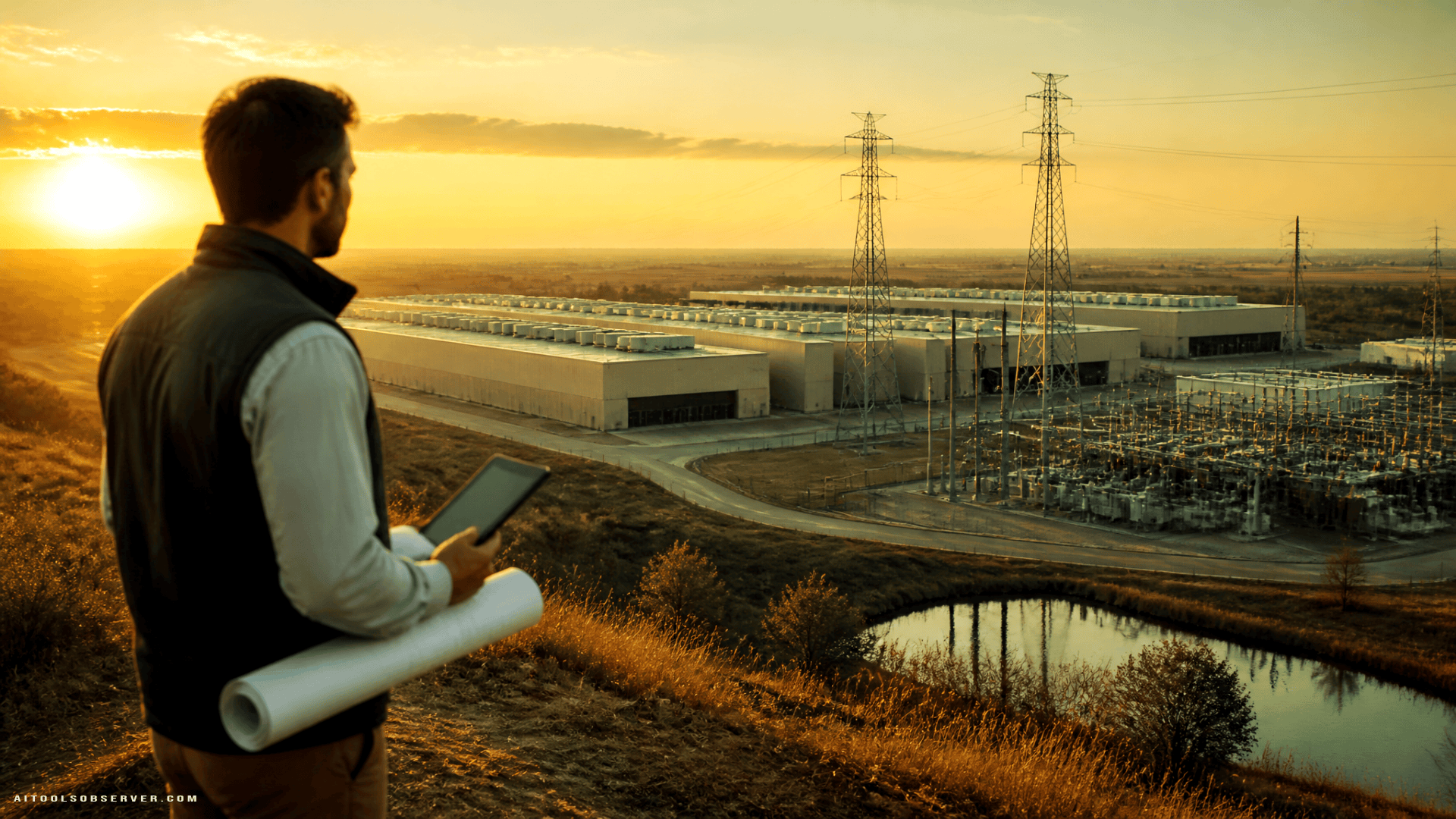
The Developers Behind the Boom
Most people associate AI infrastructure with hyperscalers—Microsoft, Google, Amazon, Meta. But a significant share of new capacity is being built by smaller, specialized developers that operate largely outside public awareness.
These companies acquire land, secure power agreements, construct facilities, and lease capacity to cloud providers, AI companies, and enterprises. They sit between the raw infrastructure layer and the large technology platforms most users interact with.
Their business model depends on long-term lease agreements, which in turn attract institutional financing. The AI boom has made these agreements easier to secure, which has unlocked substantial capital for developers that were previously considered niche.
What Is Driving the Financing
AI workloads—particularly model training and large-scale inference—require dense, power-hungry GPU clusters. That demand profile is different from traditional enterprise computing, and it has changed the economics of data center development.
Developers who can credibly promise GPU-ready facilities with sufficient power capacity are attracting financing at a scale that would have been unusual for this sector a few years ago. The underlying logic is straightforward: if AI demand is durable, the infrastructure supporting it carries predictable long-term revenue.
This has brought institutional investors, private equity, and infrastructure funds into a space that was previously dominated by more specialized players.
The Hard Constraints
Financing is available. Land can be acquired. The binding constraint is increasingly power.
Electricity Grid Pressure
Data centers for AI are extraordinarily power-intensive. A single large facility can draw as much electricity as a small city. Developers must negotiate directly with utilities, and in many regions, grid capacity is limited or requires years of infrastructure upgrades before new load can be connected.
This creates a geographic concentration effect. Developers gravitate toward areas with available grid capacity, favorable utility rates, and permitting environments that do not slow construction. Northern Virginia, Texas, and parts of the Southeast have attracted disproportionate development for these reasons.
Land and Local Opposition
Large data center campuses require significant land, often in areas where local communities have competing priorities. As these facilities have grown in scale and visibility, they have become political lightning rods.
Residents and local governments raise concerns about:
- Water consumption for cooling systems
- Noise from cooling equipment and generators
- Pollution from backup diesel generators
- Tax incentives granted to developers
- Limited local employment relative to facility size
These fights are no longer rare. They are becoming a routine part of the development process, and they add cost and timeline uncertainty that developers must now factor into project planning.
Environmental Scrutiny
The environmental footprint of AI infrastructure is receiving growing regulatory and public attention. Backup power systems, cooling water withdrawals, and the carbon intensity of grid electricity all contribute to a profile that is difficult to defend in communities already skeptical of large industrial development.
Some developers are responding with commitments to renewable energy procurement or more efficient cooling technologies. Whether those commitments are sufficient to satisfy regulators and communities remains an open question.
What This Means for the AI Tools Ecosystem
For founders and operators building on AI infrastructure, the developer layer is worth understanding even if it is rarely visible in day-to-day decisions.
Capacity constraints at the infrastructure level translate into GPU availability, pricing, and regional latency for the platforms and APIs that AI tools depend on. When a data center project stalls due to a permitting dispute or a grid interconnection delay, the effects eventually propagate upward through the stack.
The geographic concentration of new capacity also has practical implications. Regulatory environments, energy costs, and physical risk profiles vary significantly by region, and those differences are increasingly reflected in the pricing and availability of compute.
The Practical Takeaway
The AI infrastructure buildout is not a smooth, frictionless expansion. It is a capital-intensive, politically contested, physically constrained process being driven in significant part by companies most people have never heard of.
For anyone comparing AI tools or evaluating platforms, the underlying infrastructure layer is a real variable—not a given. Developers who understand where capacity is being built, what is slowing it down, and who controls it will be better positioned to anticipate the supply-side dynamics that shape AI tool availability and cost over the next several years.












Comments (0) No comments yet
Want to join this discussion? Login or Register.
No comments yet. Be the first to share your thoughts!