


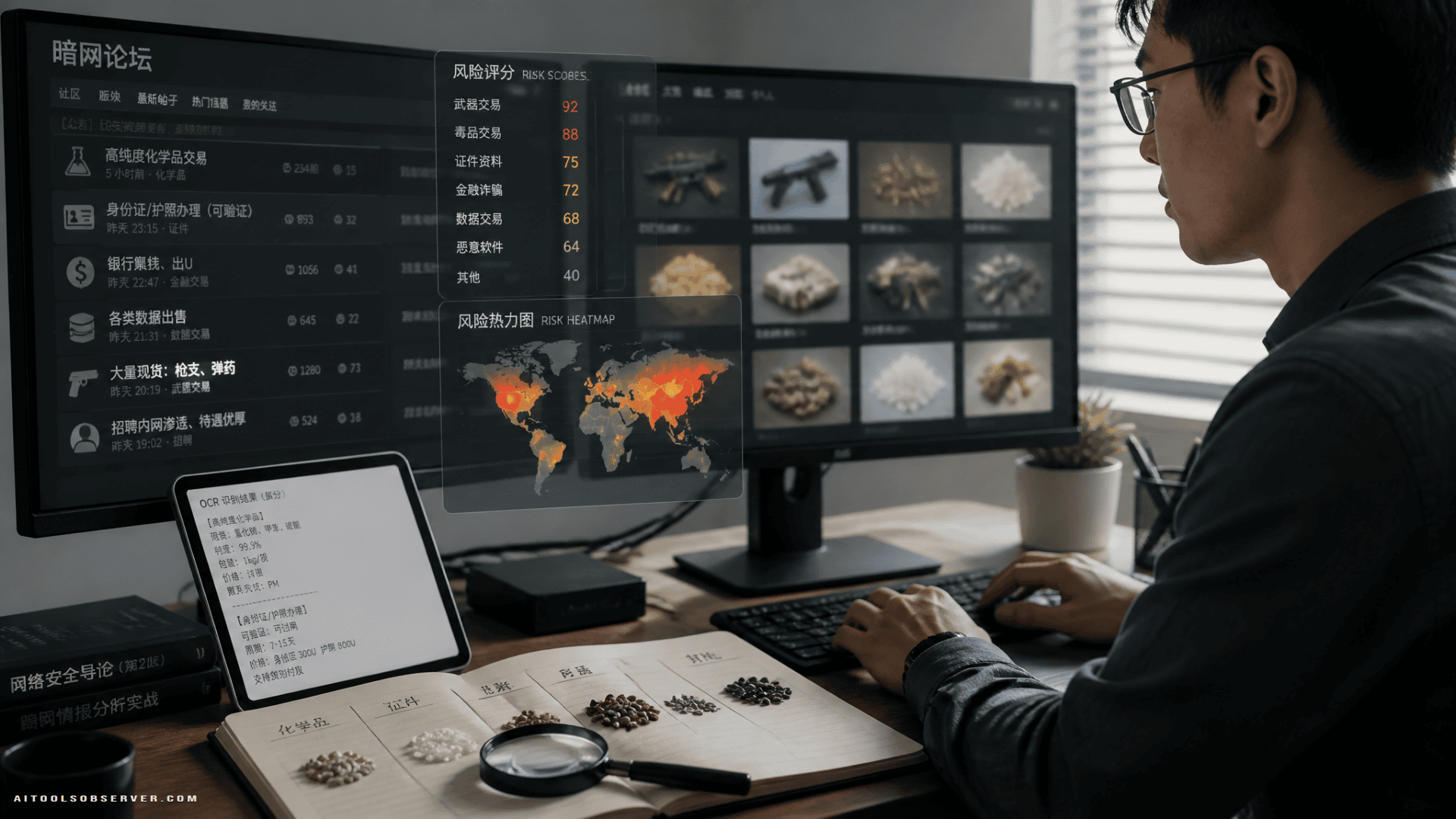
The Problem They Were Solving
Most dark web research focuses on English-language content. Chinese-language underground forums and trading sites have largely operated in a blind spot — not because they’re small, but because the tools to analyze them didn’t exist.
A research team from the Criminal Investigation Police University of China set out to change that. Their paper, published in the Journal of Chinese Computer Systems in May, describes a full pipeline: from data collection to classification to risk scoring.
Getting In: The Scraping Challenge
The first obstacle was access. Dark web platforms use login requirements, Captcha verification, and constantly rotating anti-scraping defenses that break standard web crawlers.
The team built a custom system designed to handle login flows, manage session lists, download images, and regulate access frequency to avoid triggering detection mechanisms. It’s a more sophisticated approach than typical academic scraping tools.
The result: over 10,000 data points collected from eight Chinese-language trading sites and forums.
Turning Images Into Text
A lot of dark web content isn’t plain text. Bank card details, identity documents, and other sensitive material often appear as images — deliberately, to evade keyword-based detection.
The researchers fed both text and images into a model that converted image content into unified text descriptions using OCR. This step alone significantly expanded what the classification system could actually analyze.
Active Learning to Scale the Labeling
Manually labeling thousands of dark web samples isn’t practical. The team used a hybrid approach:
- 1,800 samples were manually labeled as “seed” data to train an initial model
- The model then used active learning to label the remaining data
- Human reviewers verified the outputs
- After six rounds, the system had classified 12,467 samples across eight categories
Those categories included financial credential trading, identity data trafficking, illegal services, sexually explicit material, and extreme or violent content.
The Risk Scoring System
Classification alone wasn’t enough. The team added a numerical risk score to each piece of content:
- 0–0.2: No sensitive or illegal content
- 0.2–0.4: Sensitive phrases, but nothing clearly illegal
- 0.4–1.0: Illegal content, with score increasing by severity
Specific modifiers were applied within the illegal range. References to identity theft or illegal services added 0.05 points. Content involving minors or the provision of criminal tools added 0.1 points each.
This scoring approach turns a binary “illegal/not illegal” judgment into a prioritization tool — useful for analysts who need to triage large volumes of content. In practice, it functions as a form of risk scoring.
The Sensitive Word Lexicon
The system relied on a manually compiled list of sensitive words and phrases tied to known dark web activity. That lexicon was then updated based on the model’s own predictions over time — a feedback loop that lets the system adapt as underground language evolves.
The paper doesn’t detail exactly how that update mechanism works, which is one of the more opaque parts of the methodology.
Validation and What Comes Next
An independent test set of 200 samples validated the model’s ability to reliably categorize dark web content. The team described the system as capable of performing “risk-annotation tasks at limited human cost.”
The paper stops short of confirming whether the model is being deployed by law enforcement agencies. That gap between research and operational use is notable — and deliberate.
The researchers indicated future work will expand the dataset and explore additional analytical tasks tailored specifically to the Chinese dark web landscape.
Why This Matters Beyond China
This research is significant for a few reasons that go beyond Chinese law enforcement:
The methodology is transferable. The combination of custom scraping, OCR normalization, active learning, and risk scoring could be adapted for other languages or jurisdictions.
It shows what’s possible at scale. 12,467 classified samples across eight categories, built with a relatively small manual labeling effort, demonstrates how active learning can compress the cost of building specialized datasets.
It raises real questions about surveillance scope. A system designed to monitor underground forums can, by design, monitor a lot more than that. The architecture doesn’t enforce its own limits.
The practical takeaway: AI-assisted content classification for high-risk domains is no longer theoretical. The tooling exists, the methodology is documented, and the results are being validated. Whether that’s reassuring or concerning depends entirely on who’s running the pipeline.





Comments (0) No comments yet
Want to join this discussion? Login or Register.
No comments yet. Be the first to share your thoughts!