



The Problem: Reactive Housing Is Expensive Housing
Right now, most councils operate on a simple (and painful) principle: wait for things to break, then fix them.
Peter Campbell, head of housing at South Cambridgeshire District Council, put it plainly — “At the moment we’re very much waiting for things to break before we act.” And when one thing breaks, it rarely breaks alone. Damage cascades. A roof leak becomes a mould problem. A mould problem becomes a health issue. A health issue becomes a welfare case.
The cost — financial, human, and administrative — compounds fast.
The Solution: A Risk Score for Every Property

Researchers at the University of Cambridge, working alongside Cambridge City Council and South Cambridgeshire District Council, are building an AI tool designed to catch deterioration before it escalates.
The system pulls from three data sources and collapses them into a single risk score per property:
- Thermal satellite imagery — detecting heat loss from rooftops and walls before it’s visible at street level
- Energy Performance Certificates — the conventional baseline for a building’s efficiency and condition
- Anonymised tenant contact records — patterns in how residents have previously engaged with their council
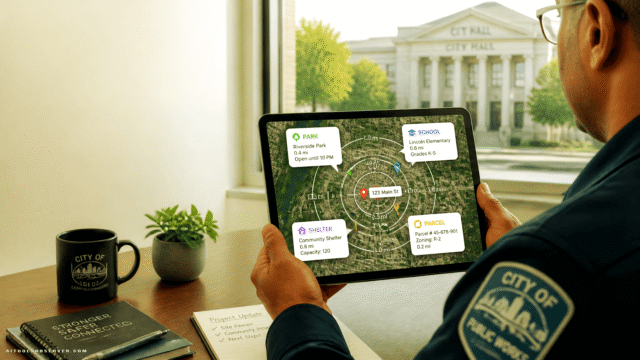
Feed those three streams into a model, and you get something genuinely useful: a dashboard showing a live map of risk hotspots across the housing stock.
Why Satellite Data Changes the Game

Thermal imagery from satellites is the quietly impressive piece here.
Traditional housing inspections are manual, slow, and expensive. You can’t send a surveyor to every property every year. But a satellite pass can capture heat signatures across thousands of rooftops simultaneously — flagging the ones bleeding warmth into the sky without anyone needing to knock on a single door.
It’s the kind of passive, scalable monitoring that makes a small team feel much larger.
What the AI Doesn’t Do
This is worth saying clearly: the tool flags risk. It doesn’t make decisions.
Prof Ronita Bardhan, one of the lead researchers on the project, was explicit on this point — welfare decisions stay with trained council officers. The AI surfaces the signal. Humans interpret it and act.
That’s the right call. Risk scores are probabilistic. Context matters. A property that looks like a hotspot on paper might have a tenant who’s already reported the issue and has a repair scheduled. The dashboard informs judgment — it doesn’t replace it.
The Bigger Picture: A Blueprint for Public Sector AI
Cambridge isn’t just solving a local problem. It’s prototyping a model.
“This is just a starting point, but we hope it can be replicated across different councils across the country,” said Prof Bardhan.
That ambition matters. The UK has millions of council homes. Most local authorities are under-resourced and reactive by necessity, not choice. A replicable, open-architecture tool that combines satellite data, existing housing records, and tenant history could give every council the kind of early-warning capability that currently only well-funded private property managers enjoy.
Predictive maintenance isn’t a new concept in industry. It’s standard practice in manufacturing, aviation, and infrastructure. Public housing is overdue for the same upgrade.
What This Looks Like as a Workflow
For teams thinking about how this kind of AI fits into real operations, the flow is straightforward:
Data ingestion → thermal imagery + EPC data + tenant records
Risk scoring → AI model assigns a score per property
Dashboard output → map view highlights hotspots by priority
Human review → council officers triage and schedule interventions
Outcome tracking → repairs logged, scores updated over time
Each step is legible. Each handoff is clear. That’s what good public sector AI design looks like — not a black box, but a better briefing.
The Takeaway
The most interesting thing about Cambridge’s approach isn’t the technology. It’s the philosophy behind it.
Don’t wait for tenants to report problems. Don’t wait for damage to become visible. Use the data you already have — plus a few smart new sources — to act earlier, spend less, and keep people safer.
Reactive is expensive. Predictive is smarter. And if Cambridge gets this right, the rest of the country’s councils won’t have to start from scratch.







Comments (0) No comments yet
Want to join this discussion? Login or Register.
No comments yet. Be the first to share your thoughts!