


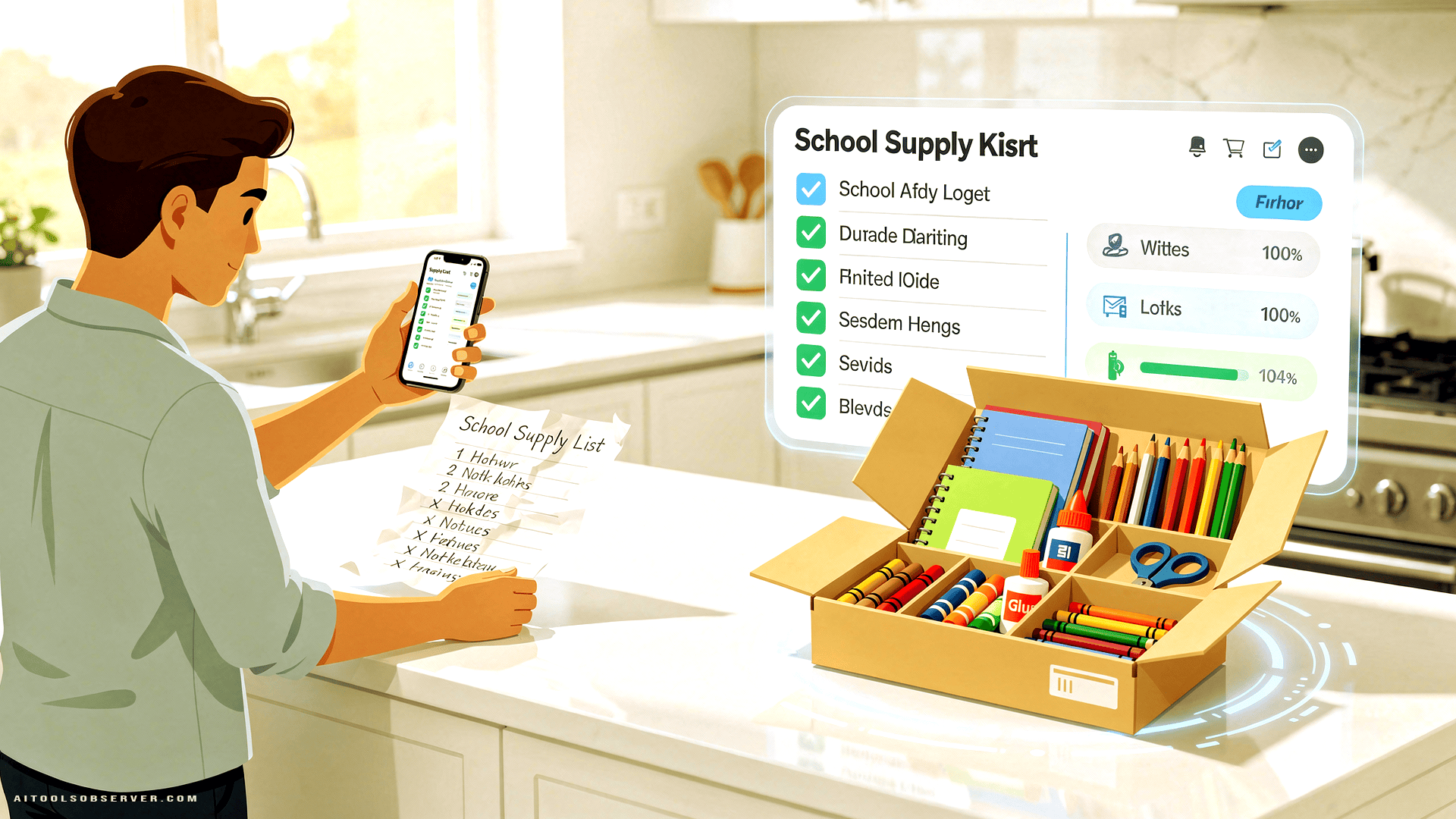
What KitGenie Actually Does

The workflow is deliberately minimal. A parent uploads a photo or digital scan of their child’s classroom supply list. KitGenie’s image-analysis engine reads the items and quantities specified by the teacher, then auto-assembles a kit of name-brand supplies matched to those requirements.
From there, parents can remove items they already own at home before proceeding to checkout. The assembled kit ships free to the door. Impacks states the entire process takes under five minutes from photo to confirmed order.
This is not a product recommendation engine or a search interface. It is a document-to-cart pipeline driven by computer vision — a meaningfully different interaction model for retail.
The Pricing Signal Worth Noting
Cost reduction is central to the product’s positioning, and the numbers are concrete. Impacks reports its average kit runs approximately $66. The National Retail Federation’s 2025 data puts the average American family’s annual school supply spend at over $140.
That gap — more than $70 per household — is the market argument. Whether the comparison holds across all grade levels and regional price variations requires scrutiny, but the directional claim is credible enough to anchor the value proposition for cost-conscious families.
Strategic Context: From B2B to B2C
Impacks has operated for six years building grade-specific supply kits through direct partnerships with schools and districts. That model works well within contracted relationships but leaves out the majority of parents whose schools have no such arrangement.
KitGenie represents a deliberate channel expansion. By shifting the intake mechanism from institutional agreements to a consumer-facing AI tool, Impacks effectively removes the school as a gatekeeper. Any parent, anywhere in the country, can now access the same kit-assembly logic the company has refined over six years.
This is a structurally sound move. The core operational capability — sourcing, bundling, and shipping school supplies — remains unchanged. The AI layer simply scales the intake process without requiring a sales cycle.
The Technology Layer: Computer Vision in a Retail Context

Image recognition applied to handwritten or printed supply lists is a non-trivial problem. Lists vary in format, handwriting quality, abbreviations, and item specificity. The accuracy of KitGenie’s output depends directly on how well the underlying model handles that variability.
Impacks has not published technical details about its image-analysis stack, which is typical for a consumer product launch. What matters at this stage is whether the assembled kits reliably reflect what teachers actually requested — a question that real-world usage over the coming weeks will begin to answer.
For the broader AI tools ecosystem, the application is a useful case study: computer vision solving a narrow, high-frequency consumer problem rather than a broad enterprise workflow. The specificity is a strength, not a limitation.
Who This Is For
Primary audience: Parents preparing for the 2026 school year who want to reduce both the time and cost of supply shopping, particularly those whose schools do not have an existing Impacks partnership.
Secondary audience: Retail and e-commerce operators watching how AI-driven intake mechanisms can replace traditional browse-and-search interfaces. KitGenie is a working example of document-to-cart automation at consumer scale.
Less relevant for: Parents in districts with existing Impacks school partnerships, who likely already receive pre-assembled kits through that channel.
Early Signals to Watch
The launch timing is precise — late June positions KitGenie squarely in the window when back-to-school lists begin circulating. Execution risk lies primarily in recognition accuracy across diverse list formats and in supply availability as demand scales through July and August.
The item-removal feature — allowing parents to exclude supplies they already own — is a small but meaningful design decision. It signals that Impacks is optimizing for household trust rather than maximizing order value, which tends to build repeat usage more reliably than the alternative.
Conclusion
KitGenie is a focused, well-timed product that applies image recognition to a problem most parents encounter every year and solve inefficiently. The technology is not novel in isolation, but the application is sharp. Whether the cost savings hold at scale and whether the AI reads real-world supply lists with sufficient accuracy are the two questions that will determine whether this launch translates into a durable product — or a clever proof of concept.















Comments (0) No comments yet
Want to join this discussion? Login or Register.
No comments yet. Be the first to share your thoughts!