


What the Tool Actually Does
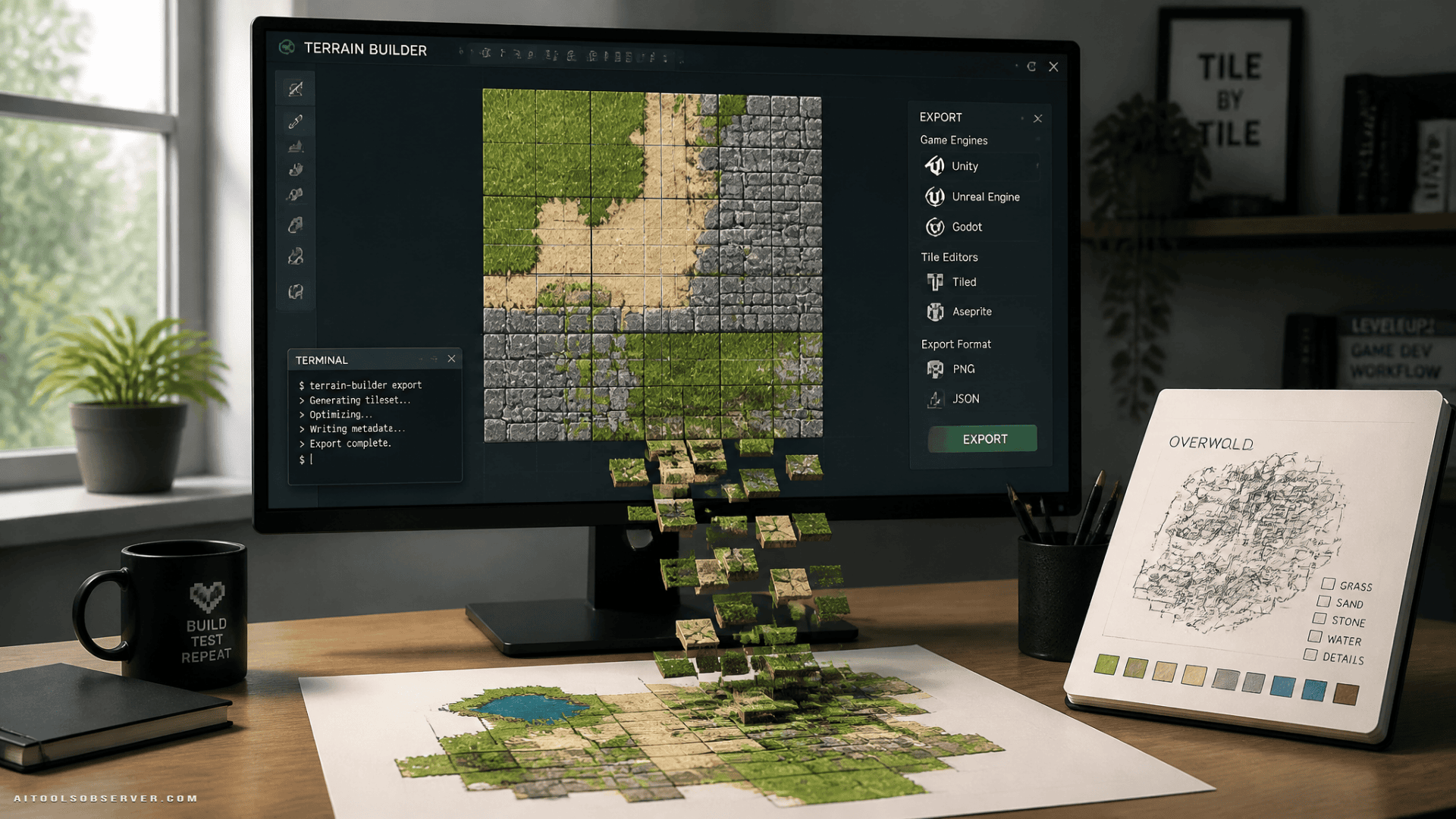
The Tileset Generator creates sets of 16 map tiles from text descriptions. Each set includes the edges and corners needed to connect different terrain surfaces cleanly — the parts that typically take the longest to get right by hand.
Developers can generate terrain types like grass, sand, cobblestones, and more, in a chosen art style or based on a reference image. The tool supports both top-down and isometric perspectives, and also handles features like roads, rivers, fences, and walls.
Before exporting anything, developers can paint a test map directly in the browser to see how the tiles actually fit together. That’s a practical quality-of-life feature that prevents the frustration of exporting assets only to find the transitions don’t work as expected.
Integration and Workflow Support
This is where the tool goes beyond a simple asset generator. Ludo.ai has built out support for several workflows:
- Godot 4 and Tiled — ready-made tileset files are available for both engines, reducing manual setup
- CLI and MCP server — useful for developers who want to automate asset generation as part of a build pipeline
- REST API — allows AI coding agents or custom tooling to generate tilesets on demand and drop them directly into a codebase
As Ludo.ai co-founder and CTO Jorge Gomes put it, a solo developer can describe a world and be painting a map with it a few minutes later. For teams running automated workflows, the API and CLI support means tileset generation can be triggered programmatically without any manual steps.
Pricing and Access
The credit structure is straightforward. Generating an individual tile costs 0.5 credits, while a full 16-tile set costs one credit. Developers on Ludo.ai’s pro and studio subscription plans get unlimited generation, which makes the economics particularly favorable for anyone working on a project with multiple terrain types or frequent iteration.
The tool is available now on the Ludo.ai platform.
Who This Is Actually For
The clearest use case is indie developers and small studios who need functional, stylistically consistent tilesets without the overhead of commissioning art or spending hours in a pixel editor. The ability to restyle an entire tileset with a text prompt also makes it useful for prototyping — you can test a visual direction quickly before committing to it.
For teams already using AI coding agents in their pipelines, the API and CLI support means tileset generation can slot in as just another automated step rather than a manual interruption.
The practical takeaway: if 2D map asset creation is currently a bottleneck in your workflow, this tool is worth testing. The browser-based map painter alone removes a meaningful friction point from the evaluation process — you can see whether the output actually works before it touches your project.




Comments (0) No comments yet
Want to join this discussion? Login or Register.
No comments yet. Be the first to share your thoughts!