


What Muse Actually Is
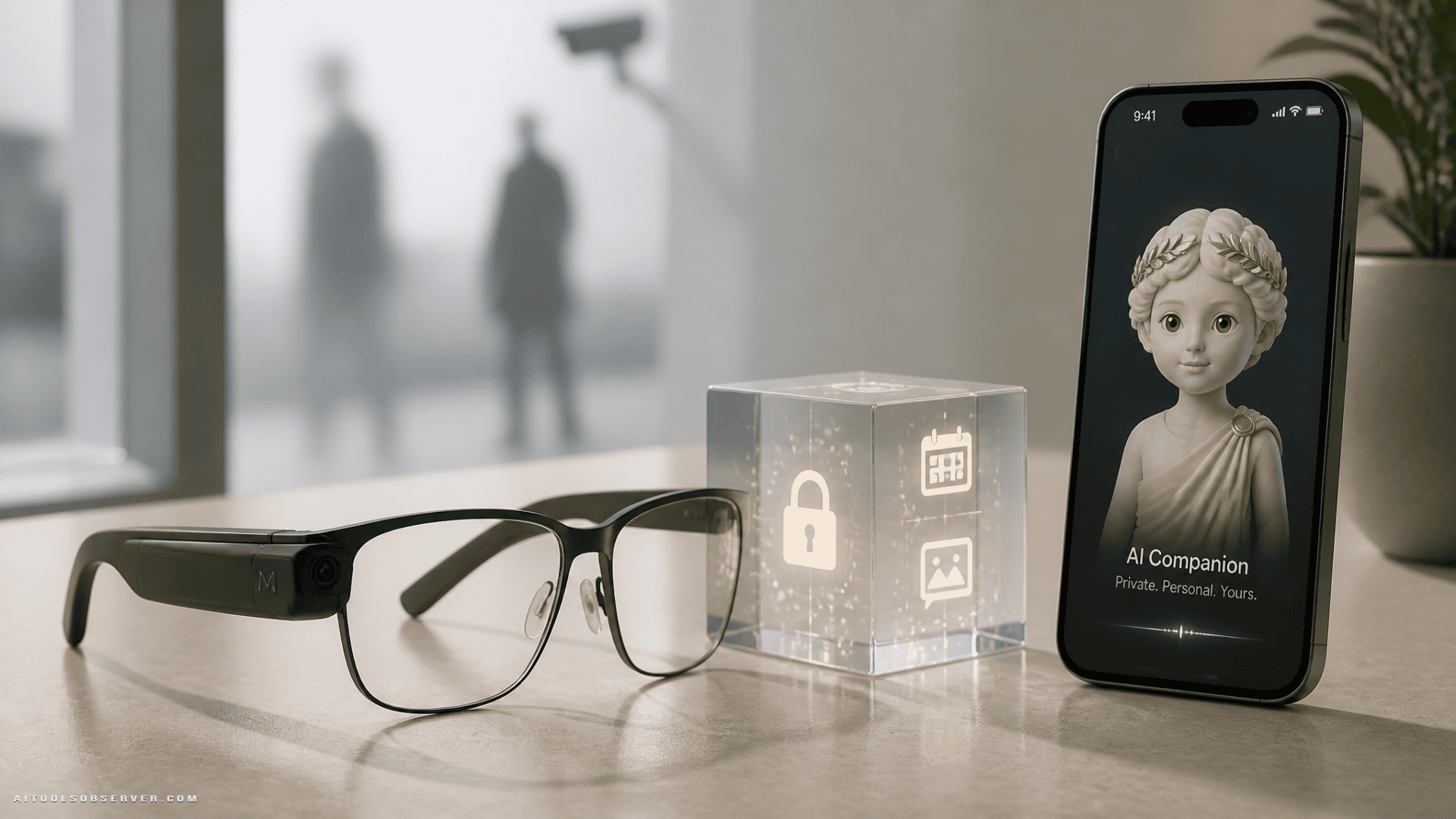
Muse is a customizable personal AI agent with a doll-like avatar, a configurable name and personality, and a stated purpose of helping users manage everyday tasks. The default avatar, named “Jolly,” is described as cream-colored with a simple, friendly face — a deliberate design choice that places Muse closer to a Tamagotchi than a productivity dashboard.
Users can personalize their agent’s appearance, name, and character. Meta CEO Mark Zuckerberg’s own agent, Agrippa, wears a toga and a laurel wreath. The customization layer appears designed to build attachment — a pattern increasingly common in consumer AI products.
A companion physical device, the “Muse charm,” was also teased at the event. It functions as a handheld activator for the agent, described as a blend of a Labubu and a Tamagotchi. Whether this device ships broadly or remains a concept accessory is not yet confirmed.
Smart Glasses Integration
Muse is being integrated into Meta’s lineup of AI-powered smart glasses. This is where the product moves from novelty into more contested territory.
Meta’s smart glasses have already drawn criticism over passive surveillance concerns — the ability to record or process visual information in public spaces without obvious signals to bystanders. Adding an always-available personal AI agent to that hardware layer compounds those concerns. Zuckerberg has stated that Meta will continue strengthening privacy safeguards for the glasses, though specific technical details of those safeguards have not been fully disclosed.
The Architecture: Secure VM and What It Promises
Each Muse agent runs within what Meta calls a “Muse Secure VM” — a dedicated virtual machine intended to isolate the agent and the user’s personal data. The framing is that your data lives in a contained environment, separate from general Meta infrastructure.
Meta has also announced a forthcoming “Muse Confidential VM,” described as a future state in which even Meta itself would not be able to access user data. This is a meaningful architectural commitment if it holds — but it is not yet available, and the timeline for its release has not been specified.
The distinction between what Secure VM offers today and what Confidential VM will offer later is worth tracking closely. Users evaluating Muse now are operating under the current architecture, not the promised one.
Privacy Concerns: What the Skeptics Are Saying
Public reaction has been split. Some users engaged enthusiastically, building custom avatars and sharing them on social media. Others raised direct questions about data access and trust.
The core concern is straightforward: a personal AI agent capable of handling everyday tasks — ordering groceries, managing schedules, processing personal requests — requires access to a significant volume of personal information. For a company with Meta’s data history, that access is not a trivial ask.
Investor Jason Calacanis called for third-party testing of these platforms. An unnamed user’s reaction — “Am I the only one who doesn’t want to let Meta have access to my whole life?” — captured a sentiment that appeared widely in online commentary.
Meta’s chief AI officer Alexandr Wang framed Muse as bringing “the magic of personal superintelligence to everyone.” That framing is ambitious. It also sidesteps the structural question of what data flows are required to make that magic work.
Meta’s Safety Framing
Zuckerberg stated that Meta delayed Muse’s launch by several months specifically to address safety and security concerns. He also wrote publicly that trust and alignment are becoming the primary differentiators between AI agents and models, and that labs which neglect alignment will fall behind competitively.
This positions safety as both a product value and a market signal — not purely a regulatory or ethical obligation. Whether that framing translates into verifiable, auditable safeguards is a separate question.
Meta has not, based on available context, announced independent third-party audits of Muse’s data handling or VM architecture.
Who Muse Is Actually For
The product is explicitly positioned for broad consumer adoption, including users with limited technical experience. The cute avatar, the charm device, the App Store placement — all of it points toward mainstream consumer markets rather than enterprise or developer audiences.
That positioning makes the privacy architecture more consequential, not less. Less technically experienced users are less likely to interrogate data access permissions, understand VM isolation, or evaluate the gap between Secure VM today and Confidential VM tomorrow.
What to Watch
- Confidential VM timeline: When Meta ships this and what it actually prevents Meta from accessing will be the clearest test of the privacy commitments made at launch.
- Smart glasses data flows: How Muse integrates with glasses hardware, and what data flows are processed locally versus server-side, remains underspecified.
- Third-party audits: Independent verification of the Secure VM architecture would meaningfully strengthen Meta’s safety claims.
- App Store retention vs. initial traction: Topping the charts at launch is a marketing outcome. Sustained daily use of an AI agent is a different signal entirely.
Muse is a technically interesting product with a well-executed consumer appeal strategy. The privacy architecture it describes is more thoughtful than most consumer AI launches. But the gap between what is promised and what is currently verifiable is wide enough that informed users should treat the current version as a first iteration — not a finished trust model.











Comments (0) No comments yet
Want to join this discussion? Login or Register.
No comments yet. Be the first to share your thoughts!