


What Disney Is Building
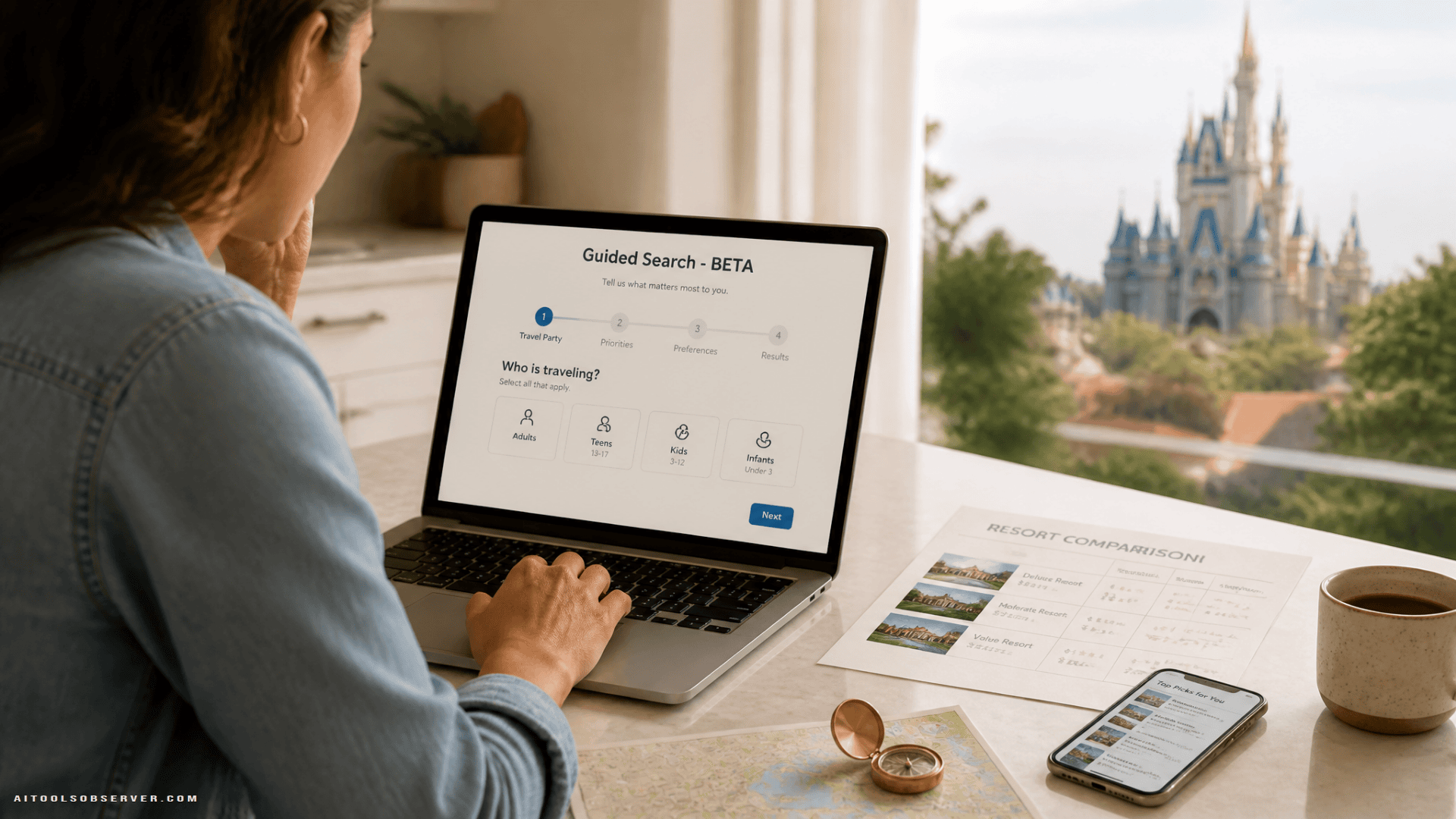
Disney is rolling out a guided AI search experience for Walt Disney World bookings, built in collaboration with Google Cloud. The beta — labeled “Guided Search – BETA” on the site — is currently being offered to a randomly selected group of guests in the US and Canada.
The experience includes four core capabilities:
- Flexible, personalized search based on dates, party size, and trip goals
- Pricing and availability calendar with best-rate surfacing
- Resort comparison tool to evaluate properties side by side
- AI-powered assistant that answers planning questions using official Disney sources
It’s not a replacement for existing booking paths. Guests can still book through the standard DisneyWorld.com flow, travel advisors, or the call center. This is an additional lane for guests who want more guidance.
How the AI Actually Works
The most notable design choice here is what Disney deliberately left out. The AI assistant is not a general-purpose chatbot. It has been trained exclusively on official Walt Disney World website content and Disney pages — no external sources, no third-party data.
That constraint is intentional. Disney leadership explained that limiting the training data is meant to prevent the assistant from surfacing incorrect or off-brand information. If a guest asks about something outside Disney’s scope — like visiting a Harry Potter attraction, which is at Universal, not Disney — the chat redirects the conversation. If the user keeps pushing, the system escalates to a live planning cast member.
That escalation path matters. It signals Disney is treating this as a human-assisted AI experience, not a fully automated one.
The Search Experience in Practice
The guided search starts with three inputs: travel dates, party composition, and a free-text notes field where guests describe their trip goals. That notes field is where the AI does its most useful work.
For example:
- Mention a child who loves The Lion King → the system surfaces Lion King suites at Art of Animation
- Focus on the EPCOT Food and Wine Festival → it pulls up EPCOT-area resorts
- Specify a moderate budget → it narrows to options like Disney’s Caribbean Beach Resort
Date selection has also been expanded. Instead of requiring specific dates, guests can now search by month or by season (Spring, Summer, Fall, Winter), which is a practical improvement for families who have flexibility but not fixed travel dates.
Once search results appear, a compare feature lets guests evaluate resorts side by side. The AI generates structured comparison summaries — for instance, contrasting Art of Animation (a Value property with Skyliner access and family suites) against Animal Kingdom Lodge (a Deluxe property with savanna views). The output is structured, not conversational, which appears to be a deliberate choice based on Disney’s own testing.
Why the “AI Takes a Back Seat” Approach Is Smart
Disney tested a generic, wide-open chat interface during development. It was less popular with users. The reason, according to the team: lack of structure.
That’s a useful data point for anyone building AI into a booking or service flow. Open-ended chat creates decision fatigue when users have a specific goal. Disney responded by embedding AI into specific moments in the booking journey rather than leading with it. The chat function isn’t even visible upfront — it surfaces contextually once you’re in the search results.
The homepage itself has been redesigned with 40% fewer links, reinforcing the same principle: reduce noise, guide the user toward a decision.
What’s Still Missing (and What Comes Next)
The beta is limited to a random selection of US and Canada guests, so most people won’t see it yet. Disney has indicated that guest feedback from this phase will shape future updates before a broader rollout.
A few things worth watching as this develops:
- App integration — the experience is designed mobile-first, but it’s currently web-based
- Itinerary sharing — the beta includes shareable read-only links for trip details, which is a practical feature for families coordinating across multiple people
- Expansion beyond resorts — the current beta focuses on resort booking; it’s unclear whether park tickets, dining, or experiences will be folded in later
The Practical Takeaway
Disney’s approach here is a useful case study in scoped AI deployment. Rather than building a general assistant and hoping it handles edge cases gracefully, they constrained the model, structured the interface, and built a human escalation path for when the AI hits its limits.
For anyone evaluating AI tools in travel, hospitality, or any high-stakes booking context, that design philosophy — structured AI with clear guardrails and human backup — is worth more attention than the technology itself.












Comments (0) No comments yet
Want to join this discussion? Login or Register.
No comments yet. Be the first to share your thoughts!