


The Setup: A Franchise Network With a Lot to Coordinate
Running a home care franchise means managing caregivers, clients, schedules, compliance, and family communication — simultaneously, across hundreds of locations. The operational surface area is enormous.
Comfort Keepers’ answer wasn’t to bolt one AI tool onto the side. It was to build a layered toolkit, each piece targeting a specific friction point. Some of it is working beautifully. Some of it is still finding its footing. All of it is instructive.
The Enterprise Brain: OpenAI Under the Hood
The foundation is an enterprise platform built on OpenAI’s technology, customized with Comfort Keepers’ own research, materials, and guardrails. Think of it as a franchise-aware assistant — one that knows the company’s playbook, not just the internet’s.
It launched focused on marketing. Things like: “What’s a good radio campaign strategy for my territory?” Franchisees loved it. So the scope expanded into sales support.
The early signal is clear: offices using the tool outperform those that don’t. Less than two years in, that’s a meaningful data point.
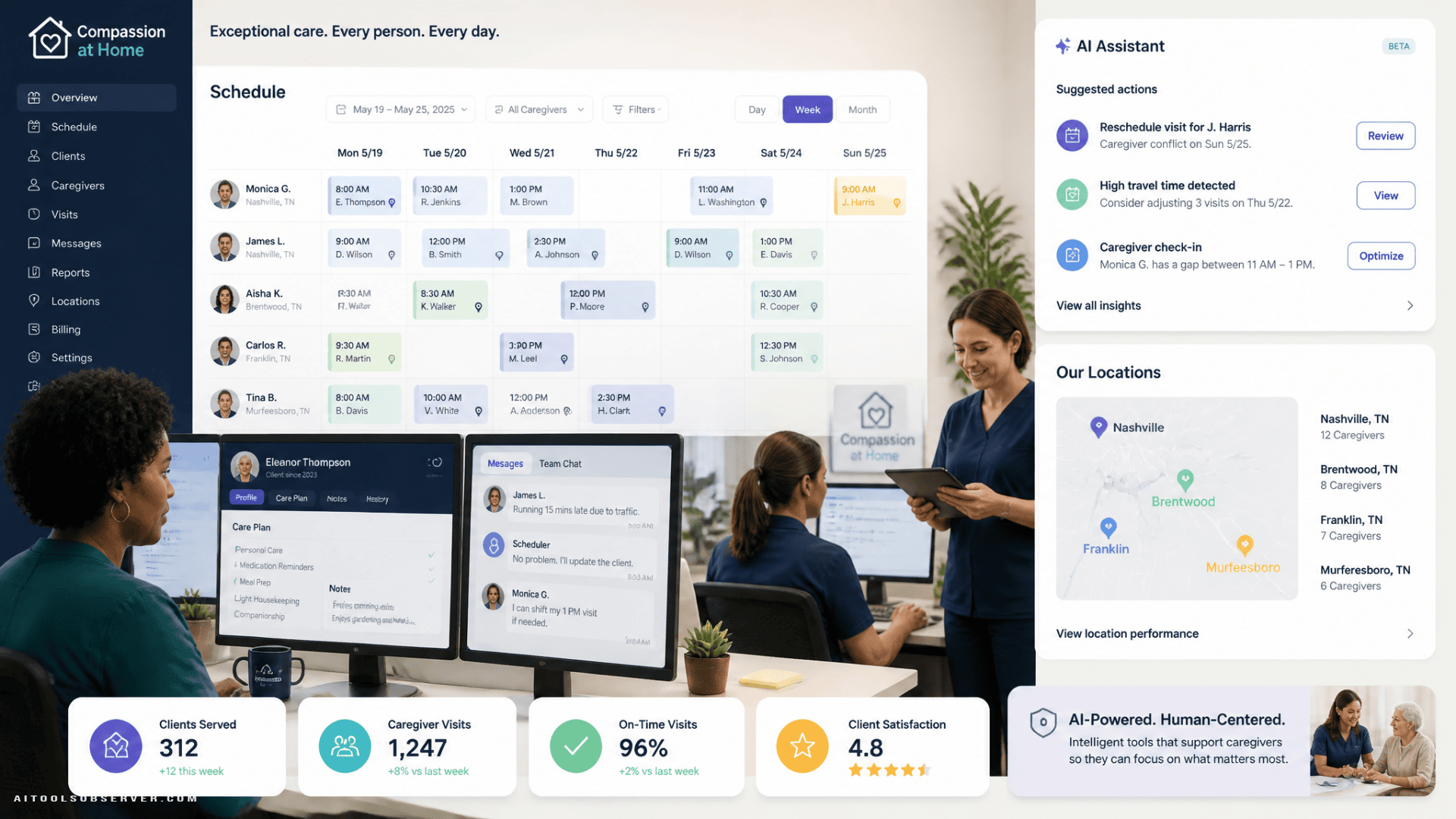
Rosie: The Scheduling Agent Nobody Complained About

Pre-AI scheduling was a phone tree problem. A shift opens up, a human scheduler calls available caregivers one by one, hoping someone picks up. Functional, but slow — and entirely dependent on one person’s bandwidth.
Enter Rosie, an AI agent from Comfort Keepers’ scheduling partner. Rosie handles the outreach. If a caregiver forgets to check in from a client’s home, Rosie follows up on their behalf.
The reaction from caregivers? Essentially nothing — and that’s the win. “This was one of the more pleasant surprises,” said Ramzi Abdine, who oversees the initiative. In AI adoption, silence from skeptics is practically a standing ovation.
The Simultaneous-Call Feature: A Paradigm Shift in Progress
The more ambitious version is still in beta: an AI agent that calls all qualified caregivers at the same time and assigns the shift to whoever answers first.
Results are mixed. Some franchisees haven’t touched it — the relationship between scheduler and caregiver is considered sacred in this industry, and rightfully so. Others are experimenting. A few have reported collapsing a 30–40 minute process into two minutes.
Abdine frames it plainly: “This is more of a paradigm shift in how home care agencies have traditionally grown and operated.” That’s not marketing language. It’s a genuine warning that AI adoption here requires rethinking, not just retraining.
Note Summarization: The Quiet Crowd-Pleaser
If the simultaneous-call feature is the controversial one, note summarization is the one everyone actually uses.
Previously, a fill-in caregiver would arrive at a client’s home having read through stacks of visit notes — or worse, without having read them at all. The AI summarization tool distills previous visits into focused briefings, highlighting what matters most for that specific visit.
The impact is less about time saved and more about confidence. “Feeling not prepared for a visit is probably one of the biggest complaints of caregivers,” Abdine noted. Solving that problem quietly solves a retention problem too.
Comfort360 SafeGuard: Radar on the TV Stand

This is the most technically ambitious piece of the stack — and the most thoughtfully designed.
Comfort360 SafeGuard uses radar (not cameras, not microphones) to monitor an older adult’s movement patterns. It detects falls, unsteady gait, breathing irregularities, and bathroom activity. It connects to Bluetooth devices like thermostats and scales. It links clients with family, caregivers, and doctors in a secure environment.
And it sits on top of the TV — the one piece of technology most seniors already trust.
That last detail isn’t accidental. The hardware placement is a UX decision. Familiarity reduces friction. Friction kills adoption.
The proactive angle is worth highlighting: “You can find out if they’ve forgotten to turn on the air conditioner during a heat wave. You can get warnings and act ahead of time rather than react.” In senior care, that gap between proactive and reactive can be the difference between a close call and a crisis.
Sensi.ai: Audio Intelligence for Select Franchises
A handful of Comfort Keepers locations — San Antonio, Spartanburg, Gainesville — have layered in Sensi.ai, an agentic operating system that interprets ambient audio to detect health changes and fall risks.
Sensi raised $45M in Series C funding in late 2025, which signals the market believes in the category. The platform does something Comfort360 deliberately avoids: it listens.
The use cases extend beyond safety. Sensi can flag a genuinely warm caregiver-client interaction — useful for recognition and retention. It can also flag interactions that needed more care — useful for training. That’s a feedback loop most home care agencies have never had access to before.
The Compliance Layer: Gatekeeper, Not Afterthought
With HIPAA, state regulations, and now emerging federal AI guidelines all in play, Comfort Keepers treats compliance as a franchisor responsibility, not a franchisee problem.
“Our biggest role as a franchisor is to go through a proper vetting process with the vendor,” Abdine said. Every tool in the stack gets vetted before it reaches a franchise location.
In a sector where a single data breach or privacy violation can damage trust irreparably, that centralized gatekeeping isn’t bureaucracy — it’s infrastructure.
What This Stack Actually Tells Us
Comfort Keepers isn’t running an AI experiment. It’s running an AI operation — one with real adoption data, real friction points, and real results.
| Tool | Problem Solved | Adoption Signal |
|---|---|---|
| OpenAI enterprise platform | Marketing & sales knowledge | Strong — outperformers vs. non-users |
| Rosie (scheduling agent) | Shift coverage outreach | Smooth — caregivers unbothered |
| Simultaneous-call feature | Speed of shift fill | Mixed — paradigm shift in progress |
| Note summarization | Caregiver preparedness | High — addresses a core pain point |
| Comfort360 SafeGuard | Fall detection, remote monitoring | Expanding — hardware-first approach |
| Sensi.ai | Audio-based health intelligence | Selective — franchise opt-in |
The Takeaway
The tools that won fastest were the ones that made caregivers feel more prepared and less burdened — not the ones that were technically impressive. Note summarization beat simultaneous calling in adoption, not because it’s more sophisticated, but because it solved a more personal problem.
The broader lesson for anyone deploying AI in high-trust, human-centered industries: the technology isn’t the hard part. The relationship architecture around it is.
Comfort Keepers is figuring that out in real time, at scale, across 600 locations. That’s not a case study in AI. It’s a case study in change management — with AI as the catalyst.



Comments (0) No comments yet
Want to join this discussion? Login or Register.
No comments yet. Be the first to share your thoughts!