


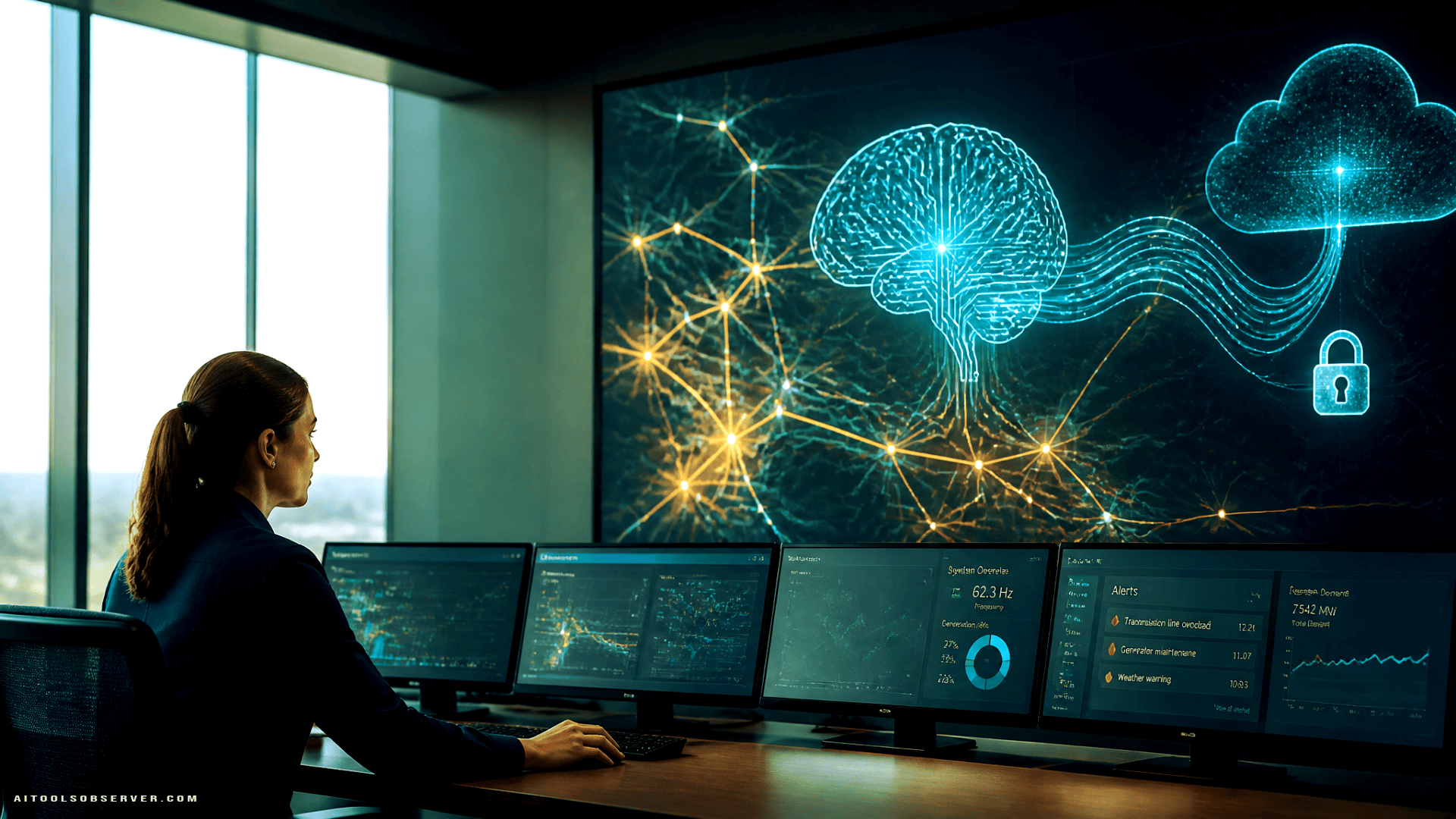
What the Collaboration Actually Involves
The Pacific Northwest National Laboratory, a U.S. Department of Energy facility, has partnered with Amazon Web Services to evaluate advanced AI tools designed for electric grid operations. The work takes place inside PNNL’s Electricity Infrastructure Operating Center, using a secure, operations-grade hybrid-cloud Amazon environment.
The focus is not general AI experimentation. Researchers are testing tools against concrete operational scenarios: managing power shutoffs during wildfires, maintaining supply during hurricanes, and defending against cyber or physical attacks on grid infrastructure.
The project supports PNNL’s Enhanced Visibility & Event Response capability, known as EVE@PNNL, which targets real-time AI-driven analytics, simulation environments, and novel sensing tools for grid operators.
The Case Against Standard LLMs
PNNL has been studying AI applications for grid operations for years, including a May 2025 report on large language model integration. But LLMs carry a known liability in high-stakes environments: hallucinations. Because LLMs generate output based on probabilistic word prediction rather than grounded reasoning, they can produce plausible-sounding errors at exactly the wrong moment.
For grid operations, that is not an acceptable failure mode.
The collaboration is therefore evaluating neuro-symbolic AI, a model architecture that combines the pattern recognition of machine learning with structured, domain-specific knowledge and reasoning. In grid terms, that means encoding the physics of electricity generation and flow directly into the system’s reasoning process.
This distinction matters practically. A tool that understands why grid frequency must stay near 60 hertz behaves differently under pressure than one that has only learned to predict text about it.
The Data Center Problem
One of the sharper technical challenges driving this work is the electricity demand profile of large-scale data centers. These facilities can require as much power as a small city, but more disruptively, they can shift that demand within tens of milliseconds.
The grid’s existing protection systems were not designed for that speed. Neither were the operators monitoring them.
“Humans can’t operate at the sheer speed at which data centers can operate,” said Todd Hay, a data and software engineering researcher at PNNL. The goal is decision-support tooling that handles data triage and converts complex real-time information into actionable insight a human operator can actually use.
This is a meaningful framing. The tools are not intended to replace operator judgment. They are intended to make operator judgment possible at machine speed.
What the Tools Are Meant to Do
The operational objectives are specific:
- Improve situational awareness during fast-evolving disruptions
- Reduce operator cognitive burden by triaging information rather than flooding dashboards
- Strengthen grid resilience against weather, demand volatility, and physical or cyber threats
- Support national security missions where grid reliability directly affects military and critical infrastructure readiness
PNNL’s director of electricity infrastructure, Jim Ogle, framed the broader goal as advancing the grid “while maintaining reliable, secure and affordable power”—a deliberately grounded target that avoids overpromising on AI’s role.
Why This Matters Beyond the Grid
The collaboration connects to DOE’s Genesis Mission, an initiative to accelerate AI-powered scientific discovery and reinforce U.S. leadership in applied AI. It also reflects a wider pattern: critical infrastructure sectors are moving past general-purpose AI tools and toward domain-specific, physics-aware systems that can be validated against real operational scenarios.
For anyone tracking the AI tools ecosystem, this project illustrates a key design tension. General-purpose models offer breadth and speed of deployment. Domain-specific neuro-symbolic systems offer reliability and auditability in environments where errors carry real consequences.
The PNNL-AWS work is an early, structured attempt to measure that tradeoff under operational conditions. The results, when they emerge, will be worth watching for anyone building or evaluating AI tools in regulated, safety-critical, or infrastructure-adjacent domains.






Comments (0) No comments yet
Want to join this discussion? Login or Register.
No comments yet. Be the first to share your thoughts!