


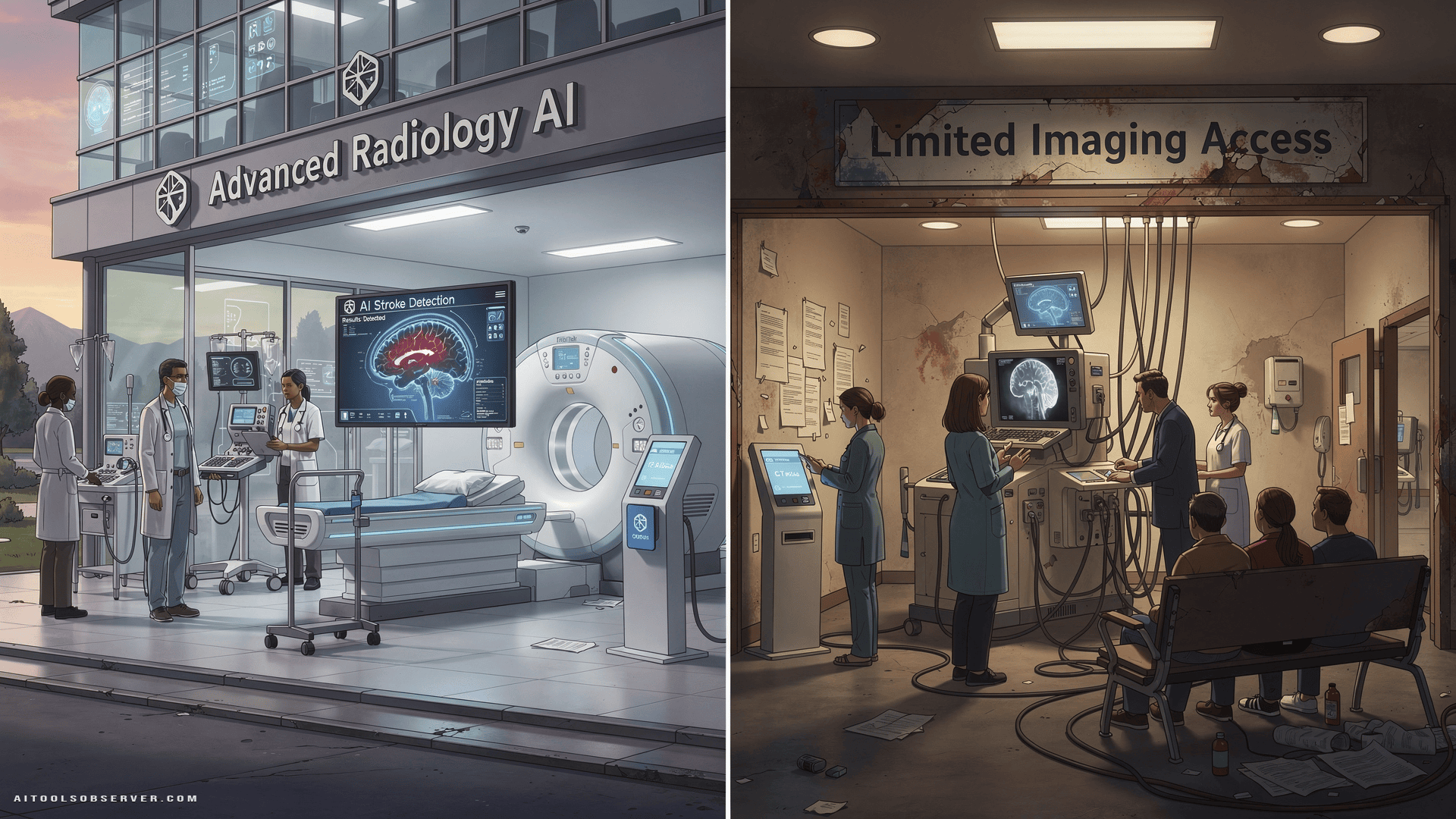
The Promise of Stroke AI — and the Reality of Its Rollout

When a large vessel occlusion blocks blood flow to the brain, every minute counts. AI tools designed to detect this condition on CT imaging can accelerate diagnosis and get patients to treatment faster. The clinical case is strong.
Medicare recognized this. Its New Technology Add-On Payment (NTAP) program was designed to bridge the financial gap during the early years of adoption, giving hospitals extra reimbursement to offset the high costs of deploying cutting-edge AI solutions.
But bridging a financial gap assumes the infrastructure to cross it already exists. For many hospitals, it doesn’t.
What the Data Actually Shows

The Neiman Health Policy Institute study tracked NTAP-backed AI use from 2020 to 2023 — the three years following CMS approval of an add-on payment for AI that detects large vessel occlusion in acute ischemic stroke.
Here are the numbers that stand out:
- AI use peaked at roughly 21% of stroke cases in 2022, then declined as the temporary NTAP code began to sunset.
- Overall, AI was used in fewer than 15% of analyzed stroke cases across the study period.
- NTAP-backed AI use was approximately 6 times higher at certain facilities in 2022.
- Hospitals in America’s “Stroke Belt” — the Southeast, where stroke rates are already elevated — saw about 2 times higher AI use compared to other regions.
- Comprehensive stroke centers showed roughly 1.5 times higher AI adoption.
- Hospitals serving more socioeconomically deprived areas were significantly less likely to use add-on-payment-supported AI.
No disparities were observed across patient demographics or stroke severity. The divide wasn’t about who the patients were. It was entirely about where they were treated.
Why Resource-Rich Hospitals Pull Further Ahead
This is the core tension in AI healthcare adoption right now: the tools that could deliver the greatest marginal improvement in underserved settings are concentrating in facilities that already perform well.
Lead author Casey Pelzl, MPH, principal research scientist at the Neiman Institute, put it directly:
“Access to these technologies depends more on where a patient is treated than on their clinical needs.”
Co-author Maria X. Sanmartin, PhD, from the Zucker School of Medicine at Hofstra/Northwell, identified the structural reasons why. Operational readiness, existing infrastructure, and clinical workflow integration all determine whether an AI tool gets used in practice — not just whether it’s technically available.
Comprehensive stroke centers already have the staff training, the imaging pipelines, and the administrative capacity to absorb new technology. Smaller, lower-resourced hospitals face a compounding set of barriers: workflow integration challenges, provider distrust of AI outputs, staff learning curves, and the economics of deployment that simply don’t pencil out at lower patient volumes.
The result is a reinforcing cycle. Hospitals that already excel in stroke care adopt AI first, get better outcomes, attract more resources, and widen the gap further.
The NTAP Problem: Incentives Without Infrastructure
Medicare’s NTAP was well-intentioned. Temporary add-on payments are a legitimate mechanism for encouraging early adoption of high-cost innovations before standard reimbursement catches up.
But the research exposes a structural flaw in that logic. Financial incentives only work when the recipient has the capacity to act on them. If a hospital lacks the IT infrastructure to integrate an AI tool, the trained staff to use it, or the workflow design to embed it in clinical decision-making, an extra reimbursement code doesn’t solve the problem.
The NTAP essentially amplified existing advantages. Hospitals already positioned to adopt AI used the payment to do so faster. Hospitals that weren’t positioned largely didn’t — and the window is closing as the temporary code sunsets.
This is a pattern worth watching across all AI reimbursement policy. Incentive structures that don’t account for baseline readiness will consistently favor the already-resourced.
A Practical Path Forward: AI-as-a-Service Hubs
The researchers don’t just identify the problem — they point toward a structural solution.
Shared AI-as-a-service hubs could allow smaller hospitals to access AI capabilities without bearing the full cost of deployment. Rather than each facility purchasing, integrating, and maintaining its own AI infrastructure, centralized service models distribute the technology across a network of under-resourced sites.
The authors note that centralized service models have already proven effective in helping lower-resourced facilities access more advanced care in other contexts. Applied to radiology AI, this approach could decouple access from institutional wealth.
This is also where the broader AI tools market has a role to play. Vendors building stroke AI and medical imaging tools need to think seriously about deployment models — not just capability benchmarks. A tool that only works in well-resourced environments has a ceiling on its real-world impact, regardless of its clinical performance in controlled settings.
What This Means for the AI Tools Ecosystem
This research is a case study in a dynamic that plays out across AI adoption broadly, not just in healthcare.
When AI tools require significant infrastructure investment, workflow redesign, and staff training to deploy effectively, they naturally concentrate in organizations that already have those capabilities. The organizations that could benefit most — smaller, under-resourced, operationally constrained — get left behind.
For anyone evaluating AI tools in any sector, this raises a practical question: what does deployment actually require, beyond the license fee?
The gap between a tool’s theoretical capability and its real-world adoption rate is almost always explained by implementation friction. In healthcare, that friction has life-or-death consequences. In other sectors, it translates to uneven competitive advantage.
The Takeaway
Radiology AI for stroke detection works. The clinical evidence is solid. The policy incentives exist. The technology is FDA-cleared and reimbursable.
And yet fewer than 15% of analyzed stroke cases used it — with adoption concentrated in facilities that already lead in stroke care, and significantly lower in hospitals serving socioeconomically deprived communities.
That’s not a technology problem. It’s an access and infrastructure problem wearing a technology label.
The next phase of AI adoption in healthcare — and arguably in every sector — won’t be won by building better models. It will be won by solving the deployment gap. Until AI-as-a-service models, smarter reimbursement policy, and implementation support reach the facilities that need them most, the tools designed to reduce disparities risk deepening them instead.
Observe the adoption curve carefully. Where AI lands first tells you a lot about where the real barriers are.






Comments (0) No comments yet
Want to join this discussion? Login or Register.
No comments yet. Be the first to share your thoughts!