


What Is ShotOptix?

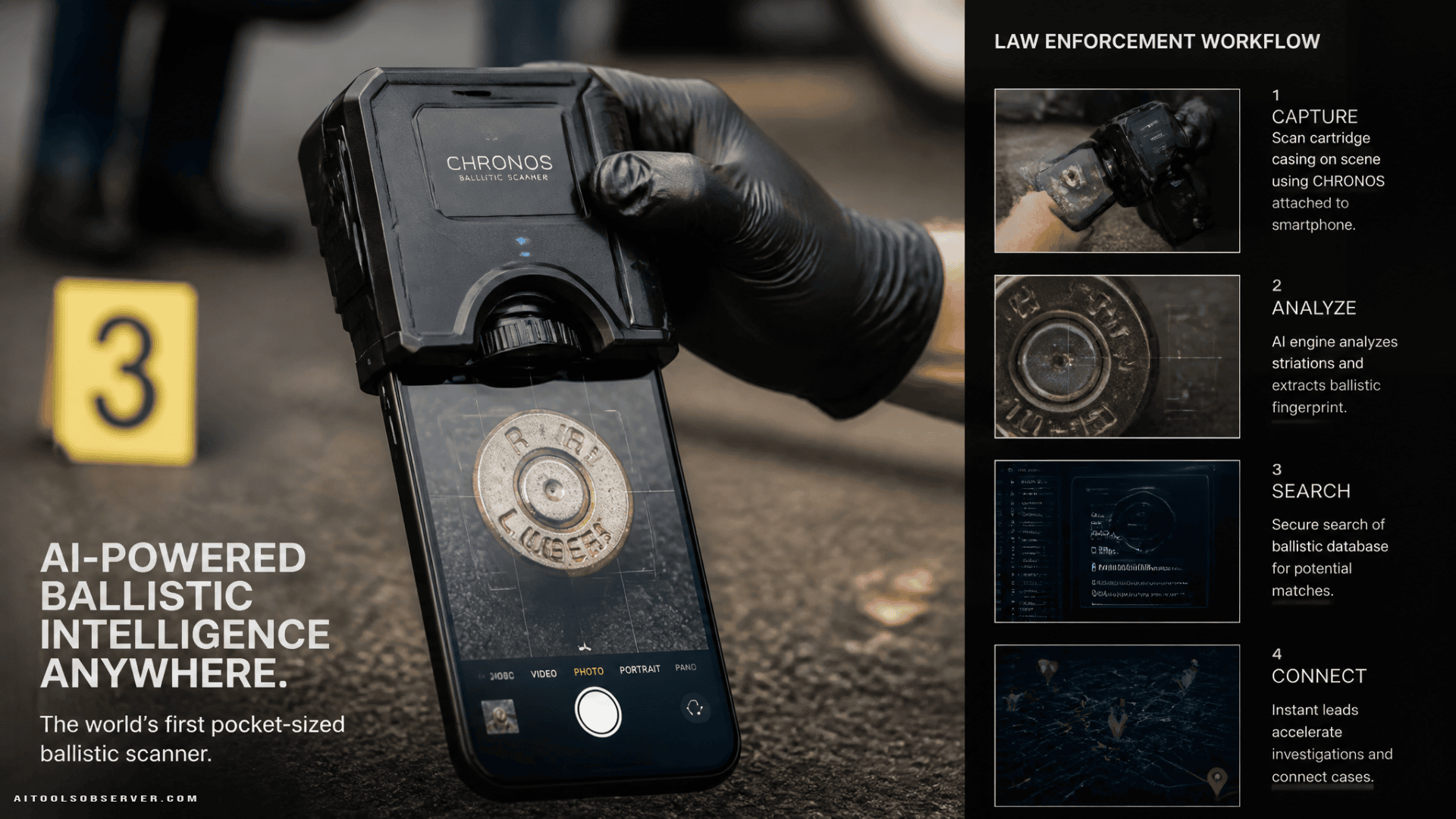
ShotOptix is a portable ballistic scanner that connects to an iPhone and uses machine learning to analyze cartridge casings at the crime scene — in real time. No lab. No waiting. No backlog.
The device captures a series of images of a recovered casing at oblique angles, stitches them together using ML, and compares the resulting toolmark profile against a database of previously analyzed casings. Think of it as facial recognition, but for the microscopic scratches a gun leaves on a bullet casing every single time it fires.
The result lands in the responding officer’s hands within 10 to 15 minutes.
The Scan
An officer recovers a cartridge casing and places it directly into the ShotOptix scanner — no special training required. According to Revelen.ai founder Poole, you could be fully operational after a 30-minute walkthrough. That’s a remarkably low barrier for forensic-grade technology.
The AI Layer
The scanner captures multiple images from different angles and stitches them into a composite profile using machine learning. It then examines the toolmarks — the unique impressions left by a gun’s firing pin, breech face, and ejector — and runs a comparison against existing cases in the database.
Toolmark examiners have long described these marks as essentially a fingerprint of the gun. ShotOptix is automating the first pass at reading that fingerprint.
The Output
The officer receives a notification indicating whether the casing is likely linked to another crime. It’s not a verdict — a certified toolmark examiner still needs to confirm the findings. But it gives investigators something invaluable: a lead, while they’re still on the scene.
Real-World Deployment: Lewes, Delaware

One of ShotOptix’s first major rollouts is with the Lewes Police Department in Delaware. Chief Tom Spell didn’t mince words about his reaction to the technology: “It was a no-brainer.”
His officers are consistently getting results back in 10 to 15 minutes. More importantly, those results are enabling cross-jurisdictional connections — linking a casing from a fresh scene to a shooting that happened hours or days earlier in a neighboring area.
That kind of rapid linkage is exactly what traditional lab timelines make nearly impossible.
Who Is This For?

ShotOptix sits at a very specific intersection of hardware, AI, and law enforcement workflow. It’s not a software subscription you spin up on a laptop. It’s a physical device designed to live in a squad car and be used by patrol officers — not just forensic specialists.
The primary users are:
- Patrol officers first on the scene of a shooting
- Detectives building cross-case connections early in an investigation
- Police departments in jurisdictions with high gun violence and limited forensic lab capacity
It’s less relevant for large metro departments with dedicated forensic units already on-scene, and more compelling for mid-sized or under-resourced departments where lab turnaround times are a genuine bottleneck.
What Works Well

Speed is the headline. Compressing a process that typically takes weeks down to 15 minutes is not a marginal improvement — it’s a category shift. Investigations that used to stall waiting for lab results can now start moving immediately.
Low training overhead means adoption friction is minimal. If a 30-minute onboarding is genuinely sufficient, departments don’t need to restructure workflows or hire specialists to use it.
Cross-jurisdictional linking is arguably the most underrated feature. Gun violence rarely respects city limits. A tool that surfaces connections across departments in near real-time has serious investigative value.
Human oversight is baked in. The system flags leads — it doesn’t replace examiners. That’s the right design philosophy for a high-stakes domain, and it’s likely to ease adoption among departments wary of fully automated forensic conclusions.
What to Watch

Database dependency. The comparison is only as useful as the casings already in the system. Early adopters in low-density networks may see limited match rates until the database grows. This is a classic cold-start problem for any matching platform.
Accuracy transparency. The tool is promising, but independent validation data on false positive and false negative rates isn’t widely published yet. For evidence that feeds into criminal investigations, that bar matters enormously.
Courtroom admissibility. AI-assisted forensic leads are one thing. How these results hold up in legal proceedings — and how defense attorneys will challenge them — is still an open question the industry will need to answer.
Pricing and accessibility. No public pricing is available, which makes it hard to assess whether smaller departments with tighter budgets can realistically adopt it at scale.
Alternatives Worth Knowing

ShotOptix isn’t operating in a vacuum. The broader ballistic identification space includes systems like NIBIN (the FBI’s National Integrated Ballistic Information Network), which has been the standard for decades. NIBIN is powerful but lab-bound and slow by design.
The ShotOptix pitch isn’t necessarily to replace NIBIN — it’s to front-load the process, surfacing leads in the field before evidence ever reaches a lab. Think of it as a triage layer on top of existing infrastructure, not a replacement.
The Bigger Picture

Gun violence investigations have historically been hampered by the gap between evidence collection and actionable intelligence. ShotOptix is attacking that gap directly — with a device small enough to fit in a patrol car and fast enough to return results before the scene is cleared.
The mission behind it matters too. Poole and his partners built this partly because of the human cost of delayed justice — families waiting months for answers that technology could potentially deliver in minutes.
Whether ShotOptix becomes standard issue in squad cars nationwide depends on database scale, independent validation, and budget realities at the department level. But as a proof of concept that AI-assisted forensics can work in the field, not just the lab, it’s one of the more compelling tools we’ve seen in the public safety space.
The gun has a fingerprint. Now there’s a scanner fast enough to read it on the spot.















Comments (0) No comments yet
Want to join this discussion? Login or Register.
No comments yet. Be the first to share your thoughts!