


The Core Problem Agent Intelligence Is Solving
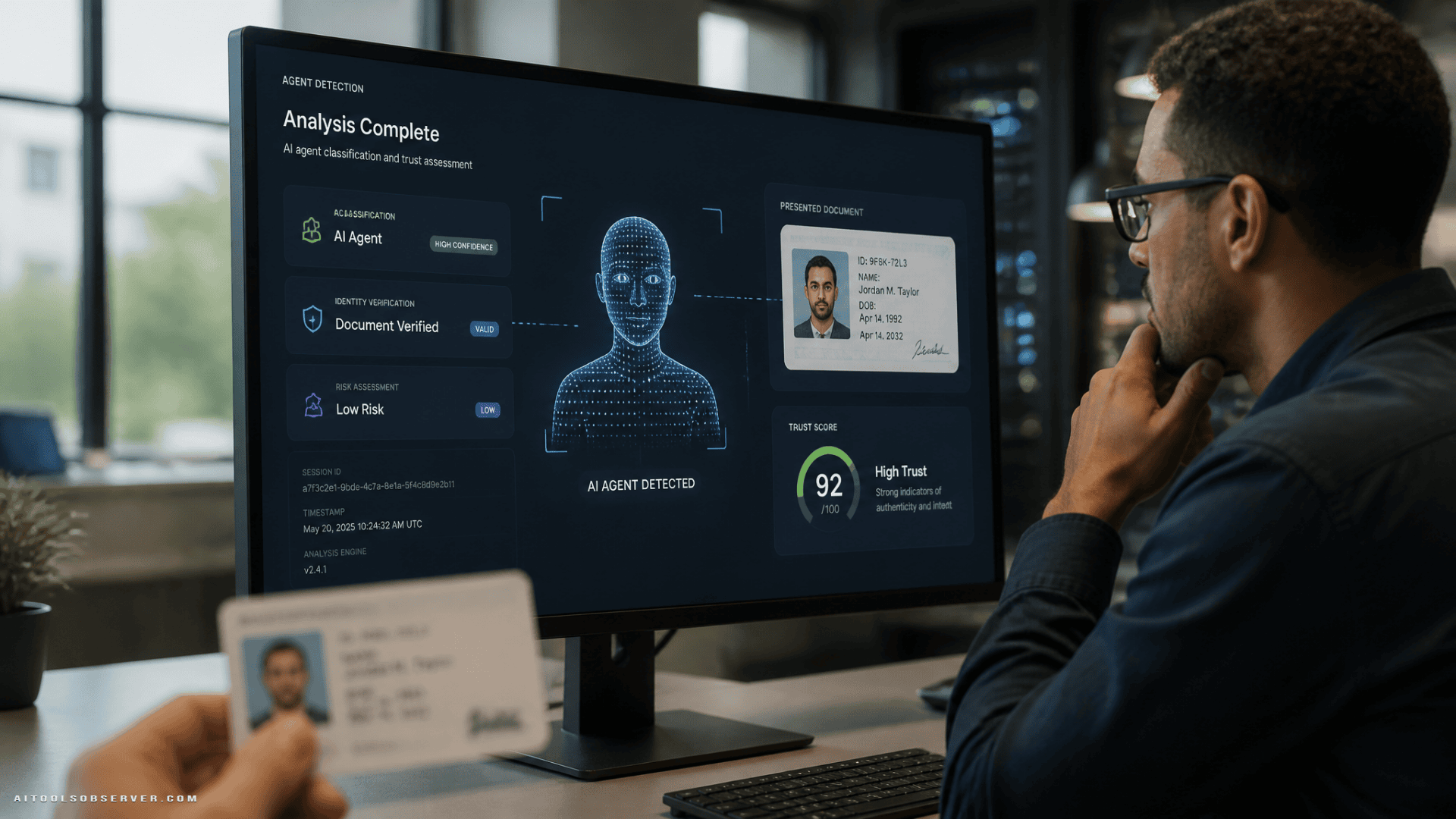
Right now, most organizations are flying blind when it comes to AI agent traffic. They can’t see how many agents are hitting their systems, can’t classify what those agents are doing, and have no reliable way to trace them back to the humans authorizing the actions.
The default response has been to treat agents like bots — and block them. But that’s a blunt instrument with real costs.
As Socure’s founder and CEO Johnny Ayers put it: block them all and you block your next customer. Let them all in and you hand fraudsters the keys.
The problem isn’t just fraud prevention. It’s that every AI agent adds a layer of abstraction between an action and the person behind it. Traditional verification methods weren’t designed for that abstraction.
How Agent Intelligence Works
The tool operates across three dimensions:
- Detection and classification — identifying whether traffic is coming from an AI agent and which agent it is
- Trustworthiness scoring — evaluating agents across identity, authorization, and risk metrics
- Human linkage — connecting each agent back to a verified person or business
Scores across those three metrics are returned separately, giving enterprises the flexibility to weight what matters most for their specific use case. A financial institution handling high-value transactions might prioritize authorization signals differently than a retailer managing account creation flows.
In controlled lab tests, Socure reported that named consumer agents were identified with 99.99% accuracy — a figure worth watching as real-world deployments scale.
Why KYA Is Becoming a Real Enterprise Priority
The timing of this launch reflects a broader shift in how enterprises are thinking about automated traffic. Research cited in the context of this release found that nearly 90% of organizations consider bot management a significant challenge, and more than half reported an increase in bot traffic over a recent 12-month period.
But the conversation is evolving beyond bots. The rise of agentic AI — where AI systems take autonomous actions on behalf of users — means the old bot-or-human binary no longer covers the full threat surface.
Legitimate agents working for customers or suppliers need to be let through. Fraudulent agents attempting credential theft, fake account creation, or transaction fraud need to be stopped. The challenge is that both can look identical without the right detection layer.
Who This Is Actually For
Agent Intelligence is positioned for enterprises that are already dealing with identity verification and fraud prevention at scale — financial services, insurance, e-commerce platforms, and any organization where account access or transaction authorization is a meaningful risk vector.
It’s not a consumer tool or a lightweight API experiment. This is infrastructure-level identity work aimed at security and compliance teams that need to operationalize KYA before regulators or fraud losses force the issue.
The Practical Takeaway
If your organization is deploying or accepting AI agents in any capacity — or if you’re seeing unexplained shifts in your traffic patterns — the question of agent identity is no longer theoretical. The verification frameworks built for humans won’t catch what’s coming through next.
Socure’s Agent Intelligence is an early signal of what enterprise-grade KYA tooling looks like in practice. Whether it becomes a category standard depends on how quickly the rest of the market catches up — and how fast agentic AI adoption outpaces the defenses built to manage it.











Comments (0) No comments yet
Want to join this discussion? Login or Register.
No comments yet. Be the first to share your thoughts!