


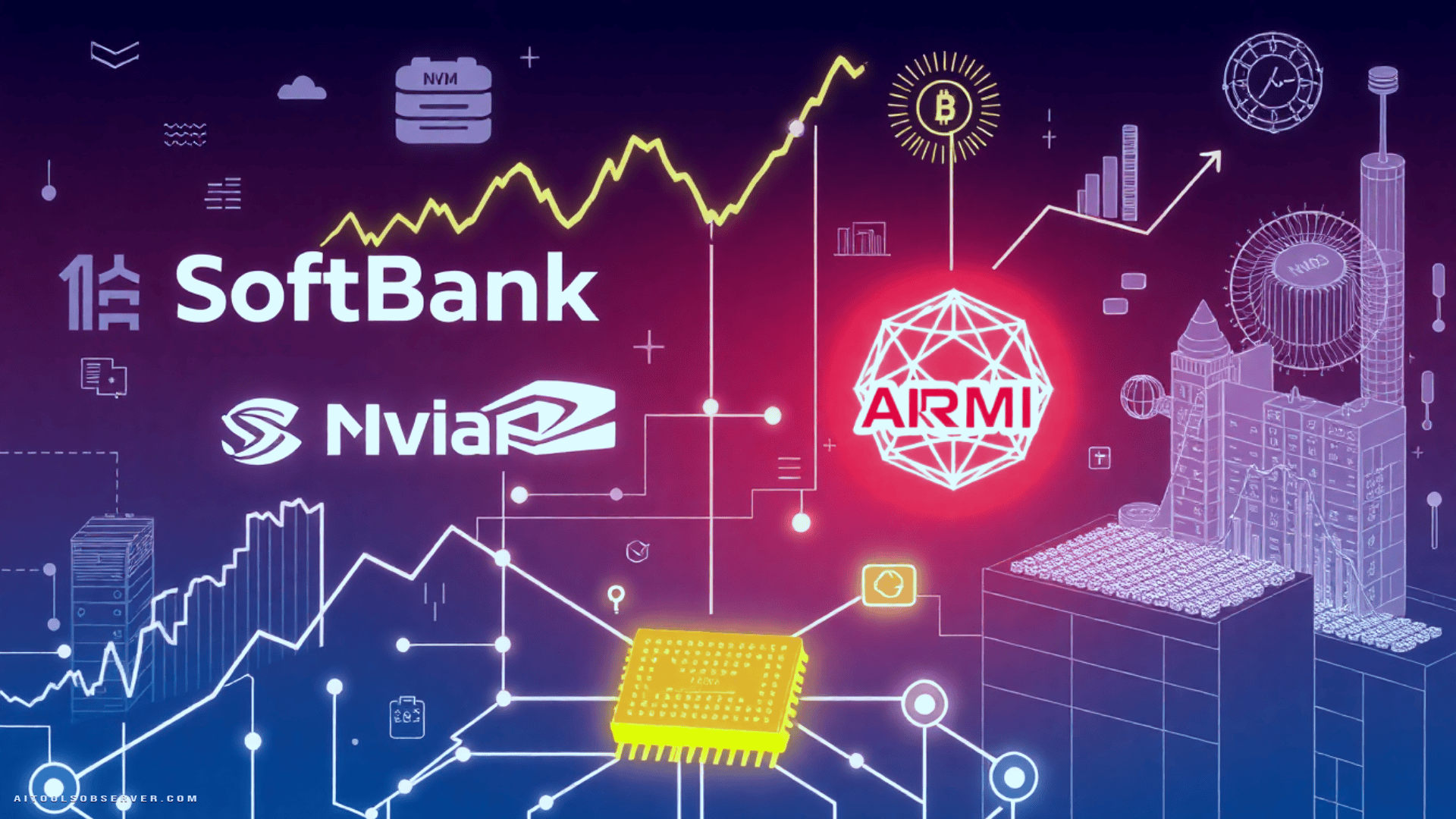
Why SoftBank Is Moving This Fast

SoftBank isn’t an AI company in the traditional sense. It’s a holding company — a concentrated bet on the AI infrastructure ecosystem through strategic stakes in some of its most valuable players.
When Nvidia reports record earnings and signals continued explosive demand for AI infrastructure, every company connected to that supply chain gets repriced. SoftBank sits at the center of that web.
Arm Holdings, in which SoftBank holds a majority stake, surged over 16% overnight after gaining more than 15% the session before. Arm’s chip designs power AI servers and data centers running on Nvidia systems — making it a direct beneficiary of the data center buildout narrative.
The OpenAI Factor

SoftBank has invested more than $30 billion into OpenAI, making it one of the ChatGPT maker’s largest backers. In the fiscal year ended March, the company booked roughly $45 billion in related gains.
Now, with OpenAI potentially filing for an IPO in the coming weeks, that position is moving from paper value to market reality. Investors are front-running the unlock.
“SoftBank Group’s share price is simply reflecting the moves of some of its stake holdings, including Arm, whose share price has been surging, and OpenAI which may file for an IPO in the coming weeks,” said Vey Sern Ling, senior equity advisor at UBP.
The IPO won’t be a windfall for everyone. Analysts caution that the value SoftBank extracts will likely be limited — but the signal it sends to markets is already doing its job.
The Data Center CPU Boom Is the Real Story

Zoom out and the bigger trend becomes clear. AI infrastructure spending isn’t slowing down — it’s accelerating. Nvidia’s results confirmed that hyperscalers and enterprises are still pouring capital into GPU clusters, AI servers, and the data centers that house them.
Arm’s chip architecture is embedded in that entire stack. As AI workloads scale, demand for efficient CPU designs — Arm’s core business — grows with them.
“For investors, SoftBank is a compelling way to gain exposure to the data center CPU boom, which is the fastest growing segment in AI semis, and early exposure to the OpenAI IPO,” said Rolf Bulk, head of semiconductor and infrastructure at Futurum Group.
That framing matters. SoftBank isn’t just riding a wave — it’s positioned at the intersection of the two fastest-moving segments in AI hardware and AI software.
The Holding Company Discount: What Investors Should Watch
Here’s the friction point. SoftBank is a holding company, and holding companies almost always trade at a discount to their underlying net asset value (NAV).
Shareholders don’t receive the full value of the assets SoftBank owns. They receive a filtered version — shaped by management decisions, capital allocation, and the structural gap between what the holdings are worth and what flows back to equity holders.
Ling was direct about this: “Net asset value or sum-of-the-parts valuations usually warrant a significant discount or cautiousness as shareholders of the holding company rarely receive the full value of the underlying assets.”
That’s not a reason to dismiss the rally. But it is a reason to understand exactly what you’re buying when you buy SoftBank. You’re buying exposure — not ownership.
What This Means for the AI Tools Ecosystem

Rallies like this one reveal where institutional capital thinks AI value is concentrating. Right now, the answer is clear: infrastructure, semiconductors, and foundational AI platforms.
Nvidia supplies the compute. Arm designs the chips that make that compute efficient. OpenAI sits at the application layer, translating infrastructure investment into products millions of people use daily. SoftBank holds stakes in all three directions.
For founders and operators building on AI tools, this signals something important. The infrastructure layer is being treated as a long-term, high-conviction bet — not a speculative trade. That means the underlying compute and model capabilities you’re building on are likely to keep improving and scaling.
The Takeaway

SoftBank’s $61 billion surge is a market event, but it’s also a signal. When Nvidia beats, Arm rallies, and OpenAI inches toward a public market debut, the entire AI ecosystem gets repriced — and holding companies with concentrated exposure move fastest.
The smart read here isn’t just about SoftBank’s stock. It’s about recognizing which parts of the AI stack markets are treating as durable, structural value. Infrastructure and foundational models are winning that argument right now.
Watch how the OpenAI IPO process unfolds. Watch Arm’s trajectory as AI server demand compounds. And watch whether SoftBank’s discount to NAV narrows — because if it does, it means the market is starting to believe the AI infrastructure buildout is more permanent than cyclical.
That’s the shift worth tracking.









Comments (0) No comments yet
Want to join this discussion? Login or Register.
No comments yet. Be the first to share your thoughts!