



The Acquisition That Changed Everything

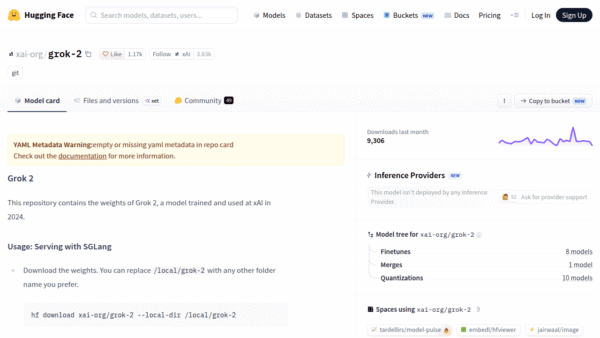
Earlier this year, SpaceX formally absorbed Musk’s AI company xAI, creating the SpaceXAI division. This means Grok — the chatbot, the models, the API — now sits inside the same corporate structure as Starlink and Falcon rockets.
The framing in SpaceX’s S-1 filing is telling: the traditional launch and satellite business is described as a supporting role to the AI division. Rockets as infrastructure. Satellites as compute substrate. It’s a bold rebranding of what SpaceX actually is.
Grok’s Uncomfortable Reality Check

Here’s where the narrative gets turbulent.
Despite heavy integration with X (formerly Twitter) and Musk’s considerable platform reach, Grok’s actual adoption numbers are sobering. An AppMagic survey of 260,000 US consumers found just 0.174% paid to use Grok in Q2 2026. ChatGPT pulled over 6% from the same pool. That’s not a gap — that’s a canyon.
Enterprise adoption tells a similar story. Enterprise Technology Research tracked Claude usage jumping from 21% to 48% among surveyed companies between 2025 and 2026. Gemini climbed from 27% to 40%. Grok moved from 4% to 7% — technically growth, but the kind that gets politely ignored at board meetings.
The government market has been even less receptive. Reuters found just three public mentions of xAI or Grok across more than 400 disclosed federal AI use cases in 2025. For a company that launched XAI Gov specifically to court government contracts, that’s a difficult number to spin.
The Reputational Drag
Grok’s challenges aren’t purely competitive. A January 2026 update enabled the generation of sexualized imagery of real people — a situation that persisted for weeks, triggered lawsuits, and prompted the EU to ban nudifying apps outright. SpaceX’s own S-1 filing acknowledges that features like “Spicy” and “Unhinged” modes carry “heightened risks, including reputational harm” and expose the company to regulatory scrutiny, enforcement actions, and litigation.
That’s a remarkable thing to disclose in a document designed to attract investors. It reads less like a risk factor and more like a confession.
The Infrastructure Gamble: Colossus, Terafab, and Macrohard

SpaceX isn’t just building a chatbot. It’s building the stack underneath it — or trying to.
Colossus and Colossus II, the company’s data center campuses in Memphis, are described as the largest AI training clusters on Earth. The catch: SpaceX recently handed the entire compute capacity of Colossus over to Anthropic. The reported reason is that the rapid buildout mixed incompatible Nvidia GPU generations, making the cluster inefficient for training workloads. Renting it out for inference tasks became the more pragmatic play.
So SpaceX’s “largest AI training cluster on Earth” is currently running Claude. That’s either a clever monetization move or a sign that the infrastructure ambitions outpaced the engineering planning.
Beyond Colossus, two early-stage projects hint at longer-term intent:
- Macrohard — an agentic AI platform built in collaboration with Tesla, designed to autonomously emulate digital workflows
- Terafab — a joint venture with Tesla and Intel targeting a chip manufacturing facility capable of producing one terawatt per year of compute hardware
Both are described as “in the very early stages.” Which is another way of saying: not yet real, but expensive to make real.
The Orbital Data Center Vision

This is where SpaceX’s pitch becomes genuinely singular — and genuinely speculative.
The company wants to deploy up to one million satellites functioning as orbital data centers, leveraging its launch capabilities to build compute infrastructure that no terrestrial competitor can replicate. The logic is elegant: if you own the rockets and the orbital slots, you control the compute layer of the future.
The economics are less elegant. Building that orbital network would require more than a trillion dollars. SpaceX is currently unprofitable — Starlink is the only division in the black — and carries $29 billion in debt. The company reported a $4.3 billion net loss in Q1 2026 alone, while spending over $10 billion on AI infrastructure, rockets, and satellite hardware.
The IPO, when it comes, isn’t just a liquidity event. It’s a lifeline.
What This Means for the AI Tools Ecosystem

SpaceX’s S-1 is a useful mirror for where the broader AI market is heading — and where the gaps still are.
Market sizing is getting wilder. SpaceX’s $26.5T estimate dwarfs Gartner’s $3.3T projection for 2027 and Citigroup’s $4.2T ceiling for 2030. When companies start quoting TAMs that rival national GDPs, it’s worth asking whether the number reflects opportunity or fundraising theater.
Infrastructure is the real competition. The AI race isn’t just about model quality anymore — it’s about who controls the compute. Microsoft has Azure. Google has TPUs. Amazon has Trainium. SpaceX is betting on orbital compute as its moat. It’s a longer timeline, but if it works, it’s genuinely defensible.
Enterprise trust is earned slowly. Claude and Gemini’s enterprise gains didn’t happen by accident. They happened through consistent reliability, safety investment, and enterprise-grade tooling. Grok’s path to enterprise credibility runs directly through its content moderation history — and that road needs significant repair.
The Honest Takeaway
SpaceX is making a bet that is simultaneously visionary and precarious. The orbital data center thesis is compelling on paper. The Grok product is struggling in practice. The infrastructure is ambitious but unproven. And the company is burning cash at a rate that makes the IPO less of a milestone and more of a necessity.
For AI tool buyers and enterprise decision-makers, the signal here is clear: watch SpaceX, but don’t wait for it. The companies winning enterprise AI adoption right now — Anthropic, Google, OpenAI — are doing so with products that are available, reliable, and improving fast.
SpaceX is playing a longer game. Whether the market gives it enough runway to land that game is the only question that actually matters.










Comments (0) No comments yet
Want to join this discussion? Login or Register.
No comments yet. Be the first to share your thoughts!