


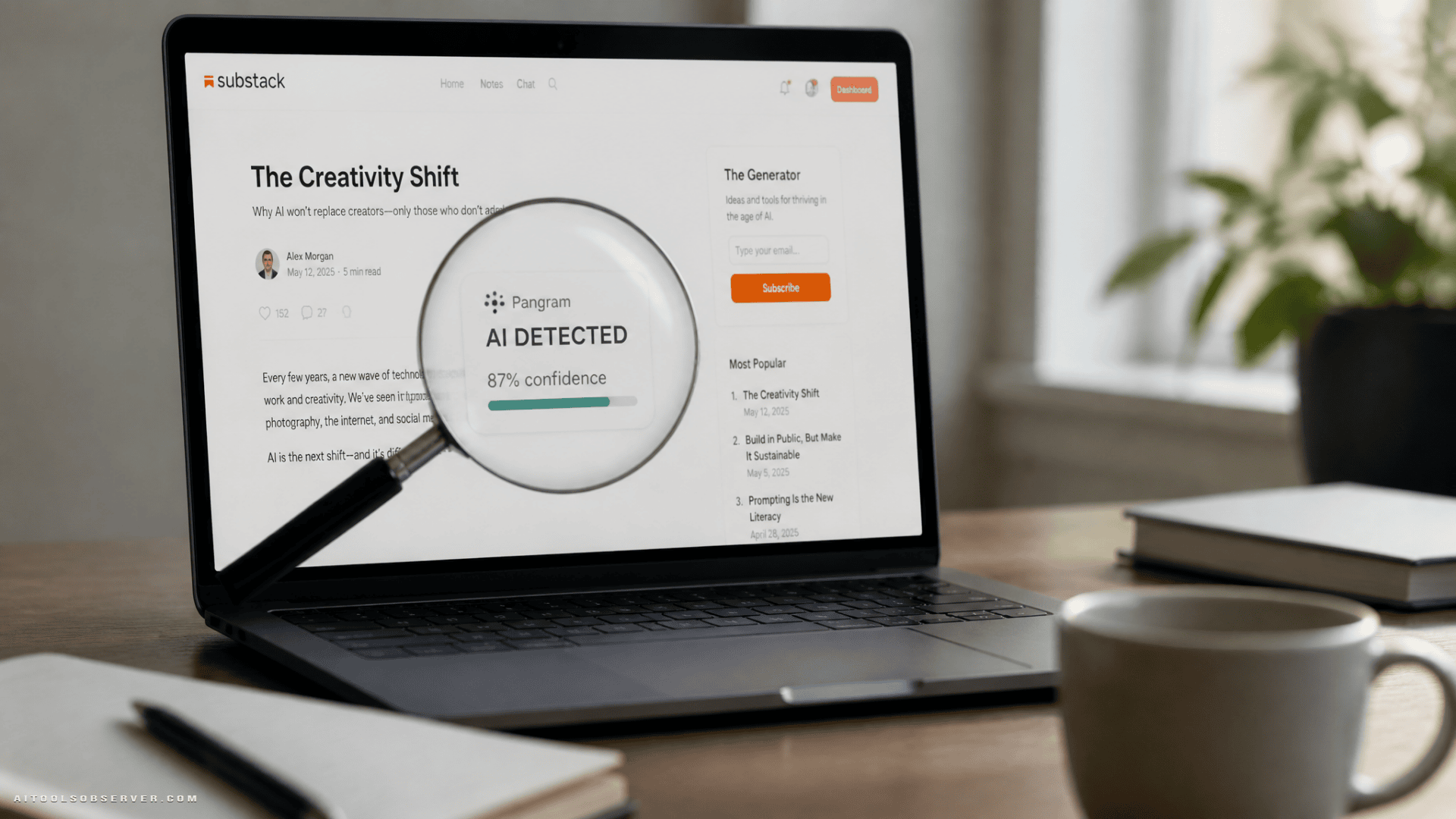
What the Feature Actually Does
Users can now scan notes, replies, comments, and posts through Pangram to assess how much of a given piece was written by hand versus generated with AI assistance. The detection applies to content published after the feature’s public announcement—older posts remain unverified.
Substack CEO Chris Best was careful to frame the move precisely. The tool detects whether text was produced by AI, not whether AI was used anywhere else in the writing process—for research, editing, or structuring, for instance. That is a meaningful distinction, and Best acknowledged it directly.
His framing centers on what he called a “mismatch” problem: readers who believe they are reading a human voice when they are not. That mismatch, in his view, erodes authorship trust and threatens the livelihoods of writers who produce genuine work.
The LinkedIn Comparison
Best’s announcement post was titled “Against Claudefishing”—a pointed reference to AI impersonation of human writers. He named LinkedIn explicitly as a cautionary example of a platform overtaken by AI-generated content.
That reference carries some data behind it. Pangram CEO Max Spero published findings earlier this month ranking LinkedIn as the most AI-saturated major platform, with 41 percent of its longform content flagged as AI-generated. Substack, by contrast, came in at roughly 10 percent—a figure Spero cited as an exception to broader platform trends.
The implication is clear: Substack is acting before the problem compounds, not after.
Why Pangram, and What Its Limits Are
Pangram is described as industry-leading but imperfect—a qualification that matters. No AI detection tool currently achieves reliable accuracy across all writing styles, languages, and AI models. False positives remain a real risk, particularly for writers whose style is spare, structured, or heavily edited.
Substack appears to be positioning the tool as a transparency signal rather than an enforcement mechanism. Readers can check; the platform is not automatically removing or penalizing flagged content, at least based on what has been announced.
What This Means for Writers and Readers
For writers who rely on Substack’s paid subscription model, the stakes are concrete. Readers who discover a newsletter they pay for is largely AI-generated may cancel. The detection feature gives them a way to check—and gives honest writers a way to demonstrate their work is theirs.
For readers, the feature introduces a new layer of due diligence. Running a scan is optional, but the option now exists natively, without leaving the platform.
Substack appears to be the first major social platform to embed this kind of AI detection directly into its product. Whether others follow will likely depend on how much pressure their own user bases apply—and how visibly the LinkedIn comparison continues to sting.
The Practical Takeaway
The Pangram integration is a meaningful signal, not a complete solution. It addresses the detection layer but leaves questions open: What happens when flagged content is disputed? How will the tool handle hybrid workflows where AI assists but a human voice dominates? Those answers will shape whether this becomes a genuine trust mechanism or a checkbox feature.
For now, the clearest implication is this: if you publish on Substack and your work is human-written, the platform has just given you a way to show it. That is worth something—provided the tool’s accuracy holds up under real-world use.







Comments (0) No comments yet
Want to join this discussion? Login or Register.
No comments yet. Be the first to share your thoughts!