


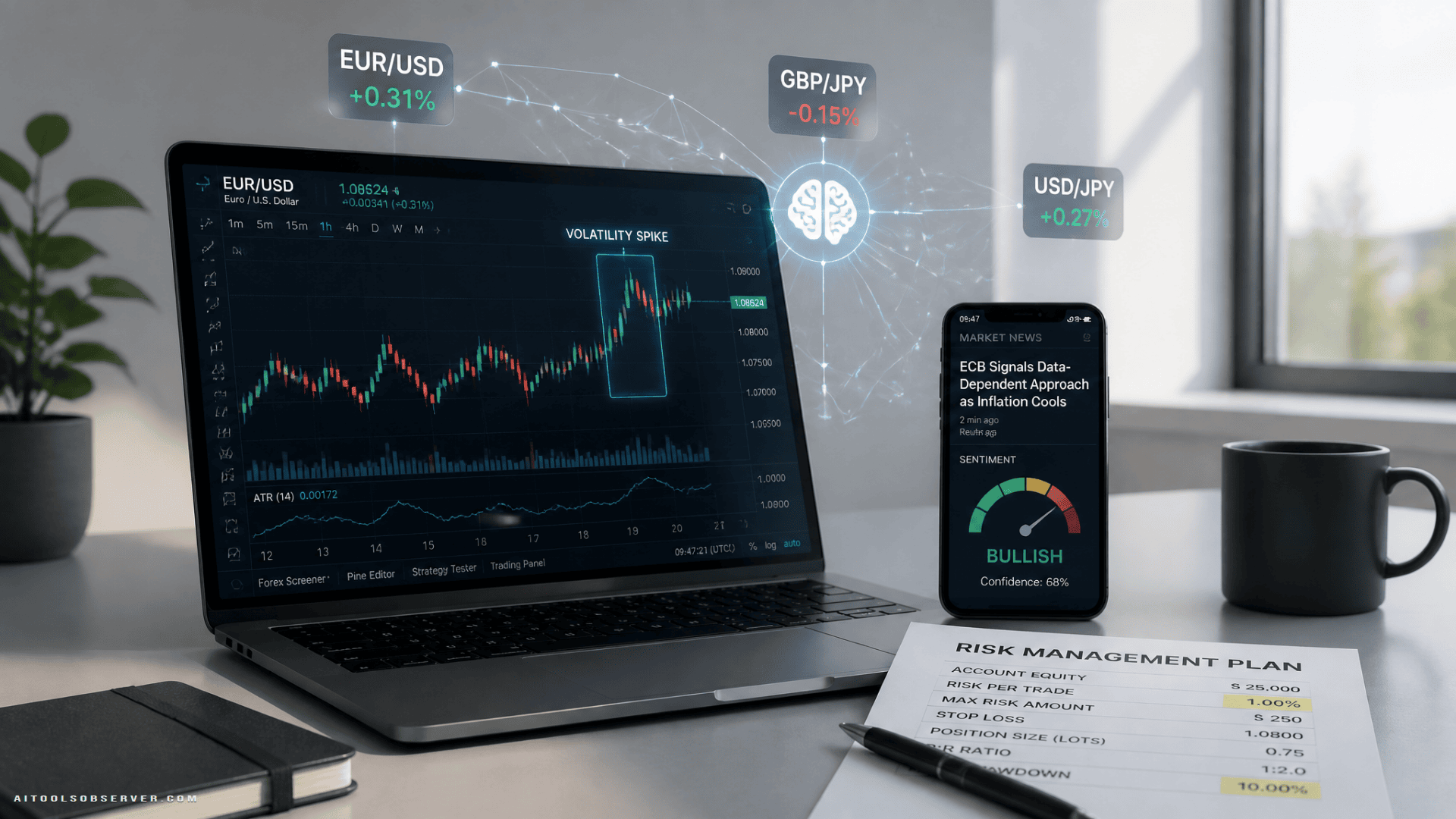
What AI Actually Does Inside Forex Platforms
AI hasn’t just added a few smart features to trading dashboards. It has changed the underlying logic of how platforms operate. Here’s where the impact is most visible.
Dynamic Risk Management
Traditional stop-loss settings were static. You set a number, and it stayed there regardless of what the market did overnight. AI-driven risk management tools now evaluate real-time volatility and adjust those parameters automatically.
This matters because markets don’t move on a fixed schedule. A central bank announcement at 2am can shift conditions entirely. AI tools can respond to that in milliseconds — something a manually configured rule-set simply cannot do.
Predictive Analytics Across Currency Pairs
Machine learning models can scan multiple currency pairs and technical indicators at the same time, identifying non-linear correlations that most human traders would miss or misread.
When interest rate data drops or a commodity shifts sharply, Predictive Analytics and pattern recognition tools can surface a specific signal in the noise. The value isn’t just speed — it’s the ability to process relationships across dozens of variables simultaneously.
Algorithmic Trading Without the Developer Overhead
Automated strategy execution used to require serious coding knowledge. That barrier has largely collapsed. Most modern forex platforms now let traders set parameters and let machine learning handle entry and exit point adjustments on the fly.
This is a genuine democratization of capability. But it also means more traders are running automated strategies they don’t fully understand — which creates its own set of problems.
NLP and Sentiment Analysis
Natural language processing tools parse global news feeds, central bank speeches, and social sentiment in real time to gauge market direction. Think of it as having a research analyst reading everything simultaneously and flagging what matters.
For retail traders who previously had to manually track economic calendars and news wires, this is a meaningful upgrade. The risk is over-relying on Sentiment Analysis signals without understanding the underlying market context they’re pointing to.
—
The Accessibility vs. Profitability Gap
Here’s the uncomfortable truth: access to AI tools does not automatically translate into better trading outcomes.
The same Traders Union research indicates that 30% of traders using AI tools actually experience worse results. The likely explanation is straightforward — many traders are using these tools as a shortcut rather than as a complement to a structured strategy.
When a trader doesn’t understand why their bot is making a particular move, they’re not in control of their strategy. They’re just watching it happen. When the market shifts abruptly, that lack of understanding leads to cascading failures.
The traders who get real value from AI tools tend to use them in specific, deliberate ways:
- Running backtesting simulations to stress-test strategies before deploying capital
- Summarizing macroeconomic events to stay informed without drowning in data
- Filtering large watchlists down to actionable setups
- Monitoring volatility signals to adjust position sizing in real time
The common thread is that AI handles the data processing, while the trader retains strategic oversight. That division of labor is what makes the difference.
—
How AI Tools Are Affecting Market Volatility
This is where things get more complicated — and where the market-wide implications start to matter.
When thousands of retail and institutional traders are running similar AI models that respond to the same macroeconomic triggers, they can all react in the same direction at the same time. The IMF Global Financial Stability Report has flagged this dynamic directly, noting that widespread use of identical AI models can amplify short-term volatility and create sudden liquidity spikes.
Markets become harder to monitor and more vulnerable to systemic shocks when the underlying decision-making is opaque and homogeneous. This isn’t a hypothetical risk — it’s a structural feature of AI-driven markets that regulators are increasingly paying attention to.
What This Means for Individual Traders
Understanding algorithmic cause-and-effect actually creates a practical edge for informed traders. If you know which data releases trigger programmatic responses from institutional systems, you can anticipate order flow rather than just react to lagging price signals.
Predicting how automated systems will behave at specific price levels — and positioning your strategy around that — is a legitimate edge. It requires understanding the inputs that trigger AI responses and the outputs those responses generate in the market.
This is a more sophisticated way to use AI tools than simply turning on a bot and hoping for the best.
—
The Regulatory Direction of Travel
Financial regulators are moving toward greater transparency and accountability in AI-driven trading. The exact shape of future rules is still forming, but the direction is clear: clearer disclosure of AI tool usage and stronger risk management requirements are likely coming.
For retail traders, this means the platforms they choose today may look different in terms of compliance requirements within the next few years. Choosing a platform that already operates with transparency and clear risk disclosures is a reasonable way to stay ahead of that curve.
—
Choosing the Right Forex Platform for AI-Driven Trading
Not all forex platforms implement AI features with the same depth or transparency. When comparing platforms, it’s worth evaluating:
- Risk management tools — Does the platform offer dynamic, AI-adjusted stop-loss and position sizing, or just static controls?
- Predictive analytics — How are signals generated, and can you understand the logic behind them?
- Automation flexibility — Can you customize automated strategies, or are you locked into preset bots?
- NLP and news integration — Is sentiment analysis built in, and how current is the data feed?
- Backtesting capability — Can you test your strategy against historical data before going live?
Comparing an up-to-date forex broker list with these criteria in mind gives you a much clearer picture than marketing copy alone.
—
The Practical Takeaway
AI tools have genuinely raised the ceiling for what retail forex traders can do. The analytical horsepower available on modern platforms would have been inaccessible to most individual traders just a few years ago.
But the floor hasn’t moved. Traders who treat AI as a replacement for market knowledge and strategic thinking are still exposed to the same risks — and in some cases, more so, because they’re running automated systems they don’t fully understand.
The traders getting real results are using AI as a force multiplier on an already sound strategy. If your strategy isn’t working without AI, adding AI won’t fix it. If it is working, AI can make it sharper, faster, and more scalable.
That’s the distinction worth keeping in mind when evaluating any forex platform’s AI feature set.









Comments (0) No comments yet
Want to join this discussion? Login or Register.
No comments yet. Be the first to share your thoughts!