


What the Study Actually Did
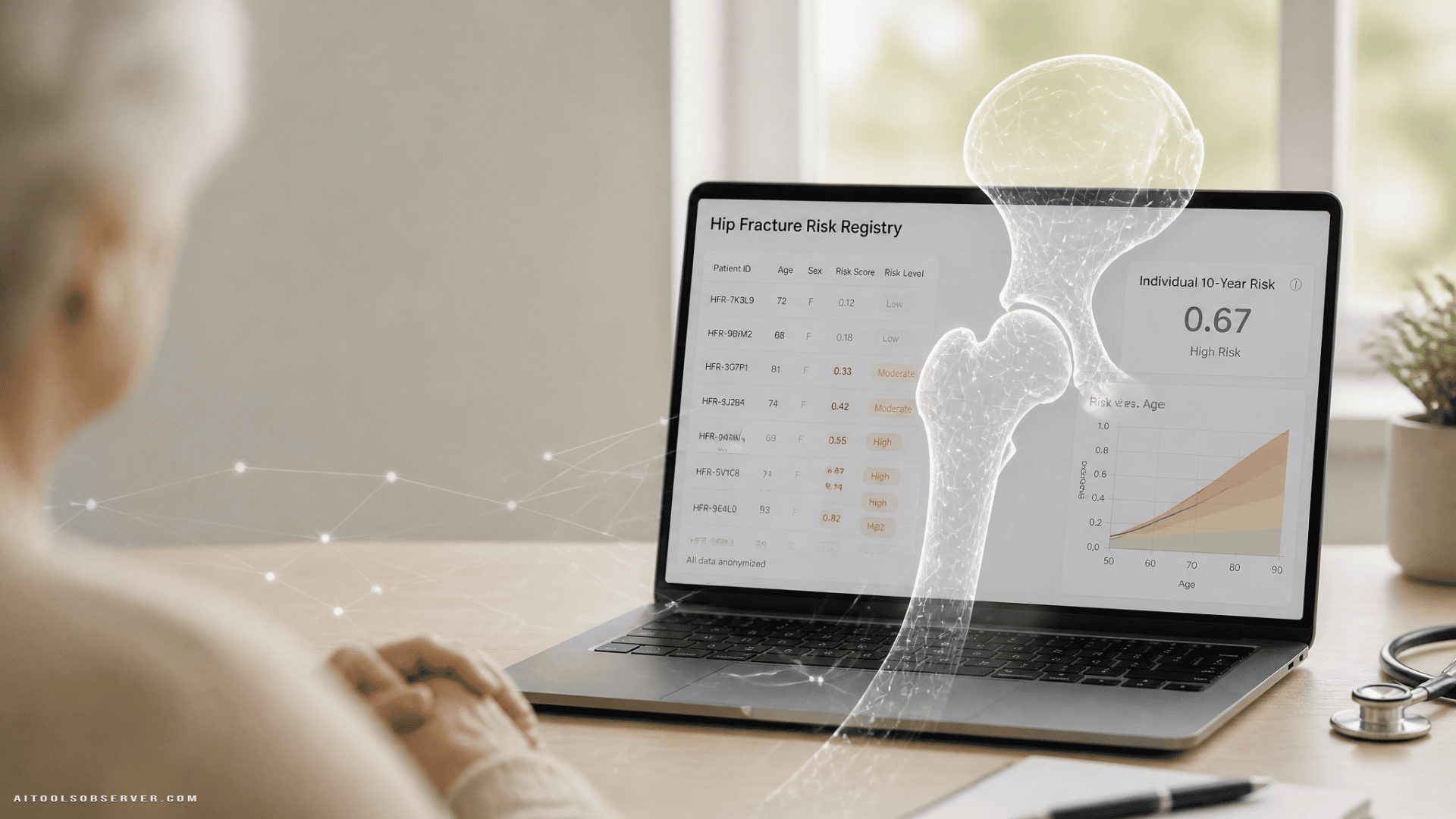
Researchers from the University of Gothenburg analyzed Swedish nationwide registry data covering 3,542,647 adults aged 50 and older who had not been prescribed osteoporosis medication in the two years prior to the study period. Over a follow-up window of up to ten years, 142,327 participants sustained a hip fracture.
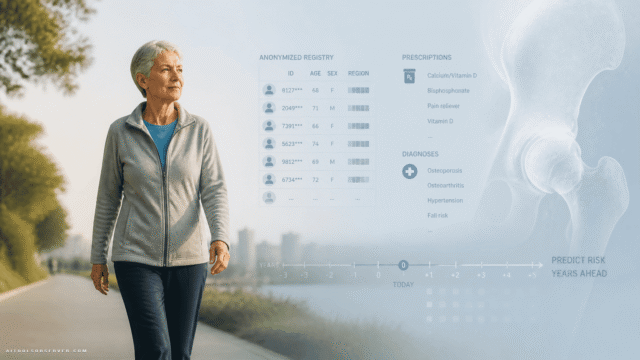
The team drew on approximately 139,980 variables—spanning diagnoses, medications, procedures, and demographic and socioeconomic data—to train and validate a deep learning survival model. No in-person clinical assessment was required at any stage. The model was built entirely from routinely collected registry data.
The Performance Numbers
FRACTURE-ML, built on a Deep-Surv architecture using 2,500 variables, achieved a one-year AUC of 0.89. At five years, accuracy remained strong at an AUC of 0.85. Both figures represent what the researchers describe as the most accurate registry-based hip fracture prediction model reported to date.
A practically important finding: when the variable set was reduced to just 35 inputs, the one-year AUC dropped only marginally to 0.88. That gap matters for real-world deployment.
- Full model (2,500 variables): AUC 0.89 at one year, 0.85 at five years
- Reduced model (35 variables): AUC 0.88 at one year
- Identified high-risk patients: approximately 7× more than current clinical screening, while maintaining relatively high precision
This positions the work within broader predictive analytics efforts focused on identifying risk earlier from existing data.
Why the 35-Variable Model Matters
A model requiring 2,500 variables may be technically impressive but operationally difficult to integrate into clinical workflows. The near-equivalent performance of the 35-variable version suggests that a leaner, more interpretable tool could deliver most of the predictive benefit without demanding complex data pipelines or extensive feature engineering.
This tradeoff—between maximum accuracy and practical deployability—is one of the more useful tensions the study surfaces. For health systems considering implementation, the reduced model likely represents the more realistic starting point.
The Screening Gap This Addresses
Hip fractures carry serious consequences for older adults: loss of independence, deteriorating health, and elevated mortality risk. Current fracture risk tools such as FRAX require patient-reported inputs, which limits their use to individuals who are already engaged with the healthcare system.
FRACTURE-ML operates differently. Because it draws exclusively from existing registry data, it can in principle be run across an entire eligible population without scheduling a single appointment. The model’s ability to identify roughly seven times more high-risk individuals than current practice—without requiring patient contact—is the core claim worth scrutinizing as the research moves toward potential implementation.
Limitations Worth Noting
The study was conducted on Swedish registry data, which is unusually comprehensive and well-structured by international standards. Replication in health systems with less complete or differently organized administrative data would be necessary before drawing broad conclusions about generalizability.
The study also does not address what happens after identification. Predicting risk at population scale is a meaningful step; translating that into preventive interventions—bone density scans, medication, fall prevention programs—requires separate infrastructure and clinical pathways.
The Practical Takeaway
FRACTURE-ML demonstrates that a deep learning model trained on routine administrative data can match or exceed the predictive accuracy of tools requiring direct patient assessment, at least within the context of a well-maintained national registry. The 35-variable version, in particular, points toward a clinically deployable instrument rather than a research artifact.
For health systems and AI tool evaluators, the more important question is not whether the AUC is impressive—it is—but whether the data infrastructure, clinical workflows, and follow-up capacity exist to act on what the model identifies. Prediction without intervention is just a more precise way of watching risk accumulate.








Comments (0) No comments yet
Want to join this discussion? Login or Register.
No comments yet. Be the first to share your thoughts!