


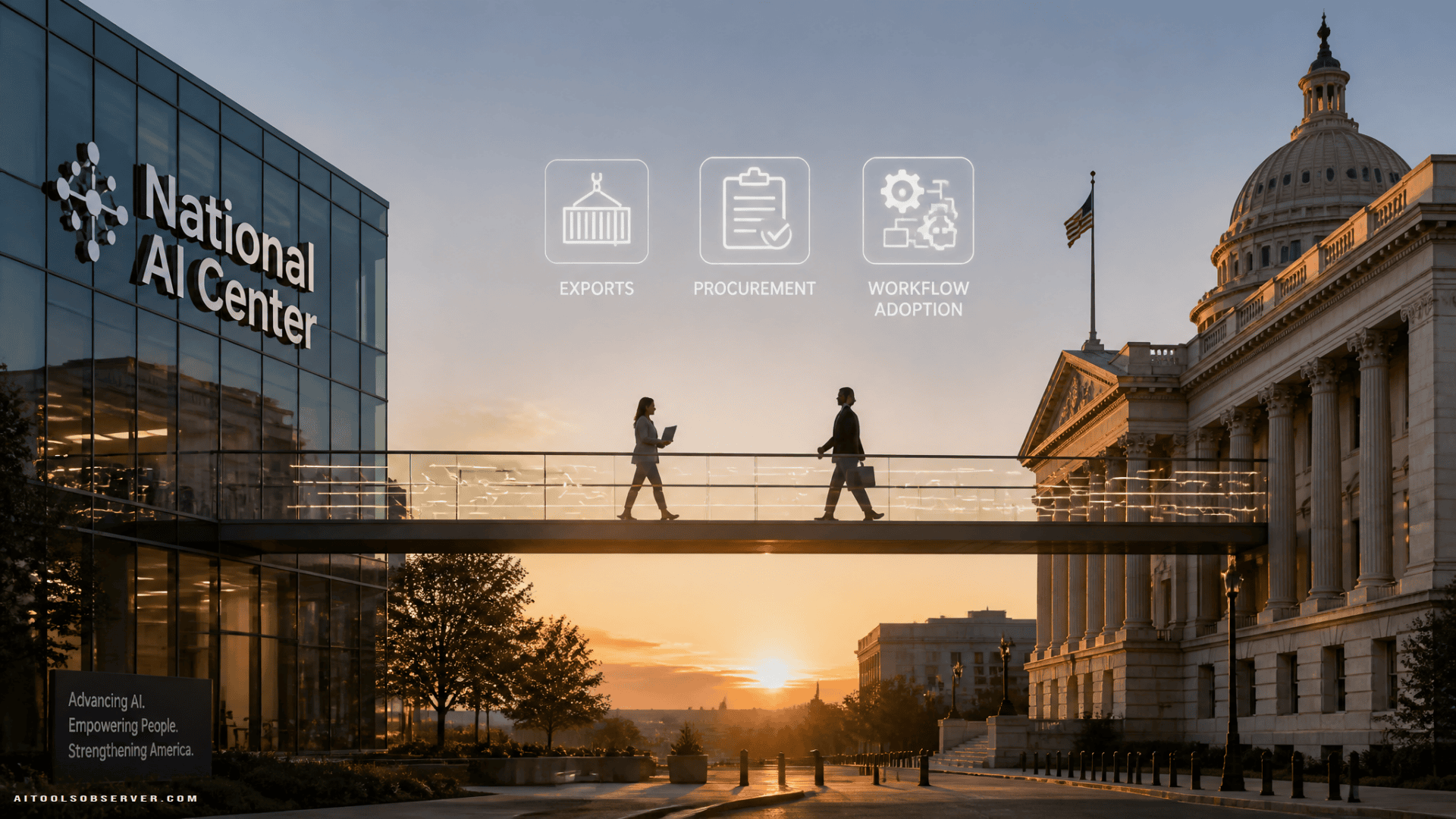
Why this center matters beyond exports
On paper, the National AI Center was created to support American AI exports. Based on the available context, that includes helping with export licenses, government advocacy, and access to federal financing.
But the more immediate story is domestic. The center also appears to be positioning itself as a front door for U.S. AI companies that want to work with federal agencies, especially as agencies look for ways to evaluate tools, manage procurement, and deploy AI in real operating environments.
That shift is important for two reasons:
- AI companies often struggle to navigate federal buying processes
- Agencies often struggle to evaluate rapidly changing AI products
If the center can reduce friction on both sides, it could become more than an export office. It could become an operating bridge between the AI industry and the public sector.
The procurement angle is probably the biggest near-term impact
For most AI vendors, procurement is where momentum goes to die. Federal demand may be real, but long sales cycles, evaluation requirements, and security concerns can slow everything down.
That is why the connection to GSA stands out. GSA is already central to how the federal government evaluates and buys technology, and it has been active in government AI efforts through programs like the USAI test platform and broader procurement support.
If the National AI Center works closely with GSA, the practical outcome could be:
- clearer paths for vendors to get evaluated
- faster routing of promising tools into federal buying channels
- more structured feedback between agencies and AI companies
- better alignment between procurement rules and fast-moving AI products
For readers tracking AI tools, this is the part to watch. The winners in government AI will not just be the companies with strong models. They will be the companies that can survive procurement, integration, and compliance.
Federal AI adoption is moving from access to usage
One of the clearest signals in the story is that some agencies are no longer talking only about AI access. They are talking about workforce usage, training, and workflow redesign.
That is a more mature phase of adoption.
GSA, OPM, and the Labor Department all point to a similar lesson: giving people a tool is not the same as getting value from it. Agencies are learning that adoption depends on training, examples, incentives, and leadership support.
What GSA signals
GSA appears to be acting as both user and enabler. It is not just helping government buy AI; it is also using AI internally and pushing automation into its own operations.
That matters because procurement agencies shape more than contracts. They shape the standards and expectations other agencies follow. If GSA develops repeatable methods for evaluating AI tools, other departments are more likely to use those patterns.
What OPM signals
OPM’s approach highlights a common adoption problem: employees may have access to advanced tools, but still lack the context, workflows, or support needed to use them well.
Its focus on use cases, innovation incentives, and internal technical support suggests a practical truth about enterprise AI: behavior change matters as much as tool quality.
For AI vendors, this means product success in government may depend on more than model performance. Training, onboarding, workflow design, and change management may be just as important.
What Labor signals
The Labor Department’s reported usage pattern suggests that agency-wide adoption can scale when engagement is handled seriously. Training sessions, grassroots promotion, and leadership backing all appear to have played a role.
This is a useful reality check for anyone selling AI into the public sector. Adoption is not a pure technology problem. It is an internal communication and operations problem too.
The real federal use case is workflow redesign
The biggest takeaway from the agencies involved is that AI is being treated less like a standalone tool and more like an operating layer inside daily work.
That changes the conversation from “Which chatbot do we approve?” to bigger questions like:
- Which tasks can be automated safely?
- Which internal data sources should be connected?
- Where do employees need human review?
- Which use cases actually improve public service delivery?
This is where many AI deployments either gain traction or fail. Simple access can produce experimentation. Real value usually requires redesigning how work gets done.
For agencies, that means process change. For vendors, that means deeper product fit. For procurement teams, that means evaluating not just features, but implementation readiness.
Why data access and continuous improvement are the next challenge
Another important thread is the idea that AI deployments do not stay static. Products improve, models change, and useful systems often depend on internal data connections.
That creates a tension inside government.
Agencies want to deploy AI effectively now, but they also need to prepare for systems that improve continuously over time. That requires groundwork in data access, integration, governance, and vendor relationships.
In practical terms, federal teams may need to think about:
- how internal systems expose usable data
- how AI outputs are monitored and reviewed
- how tools are updated without breaking workflows
- how procurement handles products that evolve quickly
This is not a small issue. Traditional government buying processes are better suited to stable software than constantly improving AI systems.
The National AI Center could become useful here if it helps agencies and vendors develop a more realistic model for how AI products are evaluated and maintained after purchase, not just before it.
What this means for U.S. AI companies
For American AI companies, the center may create a more navigable path into government at a time when public-sector demand appears to be expanding.
But the opportunity comes with conditions. Companies that want to benefit will likely need to show more than technical capability. They may need to show they can support procurement requirements, training, security expectations, and long-term deployment inside agency environments.
The strongest positioning may go to vendors that can do three things well:
- explain a clear government use case
- fit into structured procurement and evaluation processes
- support adoption after the contract is signed
In other words, federal AI is not just a product market. It is an implementation market.
What tool buyers and observers should watch next
If you track AI tools for business or government, this story is less about one office opening in San Francisco and more about a broader shift in market structure.
Watch for signals in these areas:
1. Procurement pathways
Does the connection between the center and GSA create clearer buying routes for AI vendors?
2. Repeatable use cases
Do agencies start sharing more concrete workflows that others can copy?
3. Adoption support
Are training, change management, and internal champions treated as core parts of deployment?
4. Export-to-government overlap
Do companies that gain support through export programs also gain better access to domestic federal opportunities?
5. Continuous deployment readiness
Do agencies build the data and governance foundations needed for AI systems that improve over time?
The takeaway
The National AI Center looks important not because it adds another AI policy layer, but because it may connect three areas that usually stay separate: exports, procurement, and day-to-day agency adoption.
If that connection holds, it could make federal AI less about isolated pilots and more about usable systems inside real government work. For AI companies, that means the opportunity is growing—but so is the need to prove operational fit, not just technical promise.













Comments (0) No comments yet
Want to join this discussion? Login or Register.
No comments yet. Be the first to share your thoughts!