


The Labels Got a Promotion

Previously, AI disclosure labels lived in the video description — a place most viewers never read. YouTube is fixing that with a straightforward repositioning.
- Long-form videos: The label now sits directly below the video player, above the description.
- Shorts: The label appears as an overlay on the video itself.
That’s it. No new jargon, no complicated system. Just the disclosure moved somewhere people will actually see it.
For content that’s animated, clearly unrealistic, or only slightly altered by AI, the disclosure stays in the expanded description. The prominent label is reserved for photorealistic and meaningfully AI-generated or altered content — the stuff where the line between real and synthetic genuinely blurs.
Automatic Detection Is Now Live

Here’s the bigger shift: YouTube is no longer relying entirely on creator honesty.
Starting this month, YouTube’s systems will automatically detect significant photorealistic AI use at upload time. If a creator skips the disclosure and the platform’s signals flag the content, a label gets applied anyway.
Creators can dispute an automatic label through YouTube Studio if they believe it was applied incorrectly. That’s a reasonable escape valve — AI detection isn’t perfect, and false positives are a real concern.
Two Cases Where the Label Sticks — No Exceptions

There are situations where the disclosure is permanent and non-negotiable:
- Content created with YouTube’s own AI tools — Veo or Dream Screen.
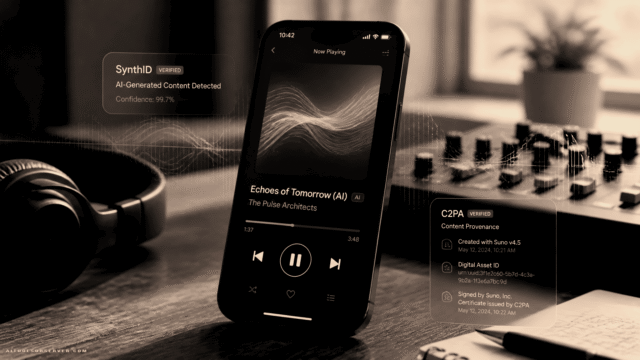
- Content carrying C2PA metadata that identifies it as fully AI-generated.
C2PA (Coalition for Content Provenance and Authenticity) is the emerging industry standard for embedding provenance data directly into media files. YouTube honoring that metadata is a quiet but significant signal that content authenticity infrastructure is becoming real, not just theoretical.
What This Doesn’t Change
Worth saying clearly: a disclosure label does not affect recommendations or monetization eligibility.
YouTube is threading a careful needle here — pushing transparency without punishing creators for using AI tools. That’s a deliberate policy choice, and a sensible one for now. Penalizing AI use would create strong incentives to hide it, which defeats the entire purpose.
Why This Matters Beyond YouTube

This update is part of a broader pattern. Platforms are moving from voluntary AI disclosure to enforced disclosure — first through policy, now through automated detection. The C2PA metadata angle is particularly worth watching. As more tools embed provenance data by default, the infrastructure for verifiable content authenticity quietly becomes standard.
For creators, the message is simple: disclose early, disclose accurately, and let YouTube Studio be your safety net. For viewers, the message is even simpler — that label above the description is now doing real work.
Transparency tools only matter if they’re visible. YouTube finally moved them somewhere you can’t miss. That’s a small design decision with a surprisingly large implication: in 2026, “I didn’t know it was AI” is becoming a harder excuse to make.








Comments (0) No comments yet
Want to join this discussion? Login or Register.
No comments yet. Be the first to share your thoughts!