


The Core Proposition Is Not About Being Best
Reflection’s model is not positioned to outperform the leading closed models from Anthropic or OpenAI. Based on available context, it is expected to initially trail those systems while remaining competitive with top Chinese open-weight alternatives.
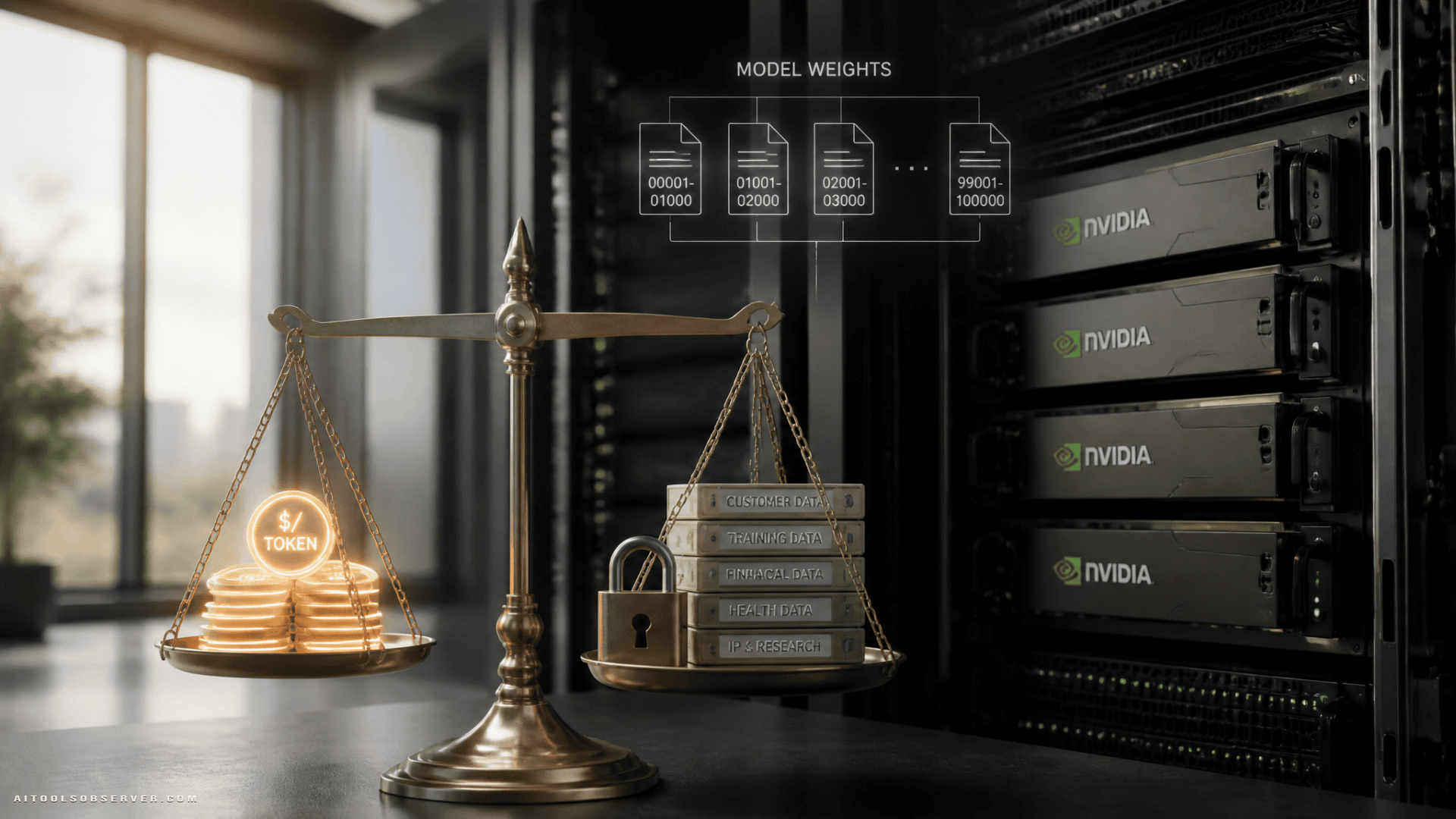
That framing matters. The value proposition is not raw capability—it is the combination of sufficient intelligence, freely downloadable weights, and the ability to fine-tune on proprietary data. For many enterprise use cases, that combination can produce results that rival expensive frontier APIs at a fraction of the cost.
This is a familiar pattern in enterprise software: “good enough plus control” frequently beats “best but locked in.”
What the AI Factory Concept Actually Means
Reflection’s stated goal is to enable what it calls the “AI factory”—a deployment model where an institution combines its own proprietary data, Reflection’s models, and dedicated compute to build a localized, customized AI system.
The practical targets are clear:
- Hedge funds and trading firms with highly sensitive, proprietary datasets they cannot expose to third-party APIs
- Sovereign institutions that require data residency and infrastructure independence
- Enterprises seeking to reduce per-token costs at scale without sacrificing domain-specific performance
The announced partnership with Shinsegae Group in South Korea illustrates the sovereign AI angle. It signals that the AI factory model is not purely theoretical—it is already being tested in production environments where data control and localization are non-negotiable.
The Benchmark Gap Is Real and Consequential
Citi’s analysis of the capability landscape adds important nuance. After a period of convergence, the gap between proprietary frontier models and open-weight alternatives appears to be widening again. The reported spread on Citi’s AA Intelligence Index expanded from 9 to 12 points, with open-weight models falling further behind specifically in long-horizon cybersecurity tasks and production reliability.
These are not marginal use cases. Production reliability and security-adjacent tasks are precisely where enterprise buyers apply the most scrutiny.
The earlier convergence was partly attributed to regulatory constraints on frontier model releases and open-weight developers’ access to model distillation techniques. As frontier labs gain more compute and distill their own models more efficiently, that advantage may erode for open-weight competitors.
Anthropic’s Opus 5.5, for example, reportedly increased intelligence scores by 9% while cutting costs by 40% compared to Opus 5. Successive Grok and Gemini releases have maintained pricing while improving scores. The frontier is not standing still.
The Security Dimension Cuts Both Ways
Open-weight models introduce a genuine regulatory and security tension. Because model weights can be downloaded and run locally, they are harder to monitor, audit, or restrict than closed API-based systems.
Supporters argue this transparency is itself a security advantage—no single vendor controls access, and the architecture is inspectable. Critics, including U.S. lawmakers, point to the risk that model weights could be stolen or distilled by hostile actors, potentially erasing competitive advantages that took years and billions of dollars to build.
Congressman Ro Khanna’s letters to OpenAI, Anthropic, Google, Meta, and SpaceXAI requesting data on Chinese access attempts reflect how seriously this risk is being taken at the policy level. The concern is not hypothetical: Chinese firms have reportedly distilled outputs from leading Western models, and the theft of actual model weights would represent a qualitatively different threat.
For enterprise buyers evaluating open-weight deployment, this is a real tradeoff to price in—not a theoretical one.
The Portfolio Reality for Enterprise Buyers
Citi’s expectation that enterprises will increasingly adopt multi-model portfolios rather than single-vendor dependencies is the most practically useful framing here. No single model wins every task, and the cost-performance curve varies significantly by use case.
An enterprise might reasonably run a frontier closed model for high-stakes, general-purpose reasoning while deploying a fine-tuned open-weight model for high-volume, domain-specific classification or retrieval tasks. The emergence of model-routing and orchestration at the infrastructure layer—which Citi suggests frontier labs may increasingly build directly into their offerings—will make this kind of portfolio management more accessible.
The Practical Takeaway
Reflection’s open-weight strategy does not threaten to displace OpenAI or Anthropic in the near term. What it does is expand the viable option set for enterprises that have been effectively locked into a small number of expensive, closed alternatives.
The relevant question for enterprise AI buyers is not “which model is best?” but “which model is best for this specific task, at this cost, with these data constraints?” Open-weight models with sufficient capability, combined with proprietary data and dedicated infrastructure, can answer that question favorably in a meaningful subset of enterprise scenarios.
That subset is likely to grow—provided the capability gap does not widen further and the security risks remain manageable. Both conditions are currently in flux.










Comments (0) No comments yet
Want to join this discussion? Login or Register.
No comments yet. Be the first to share your thoughts!