


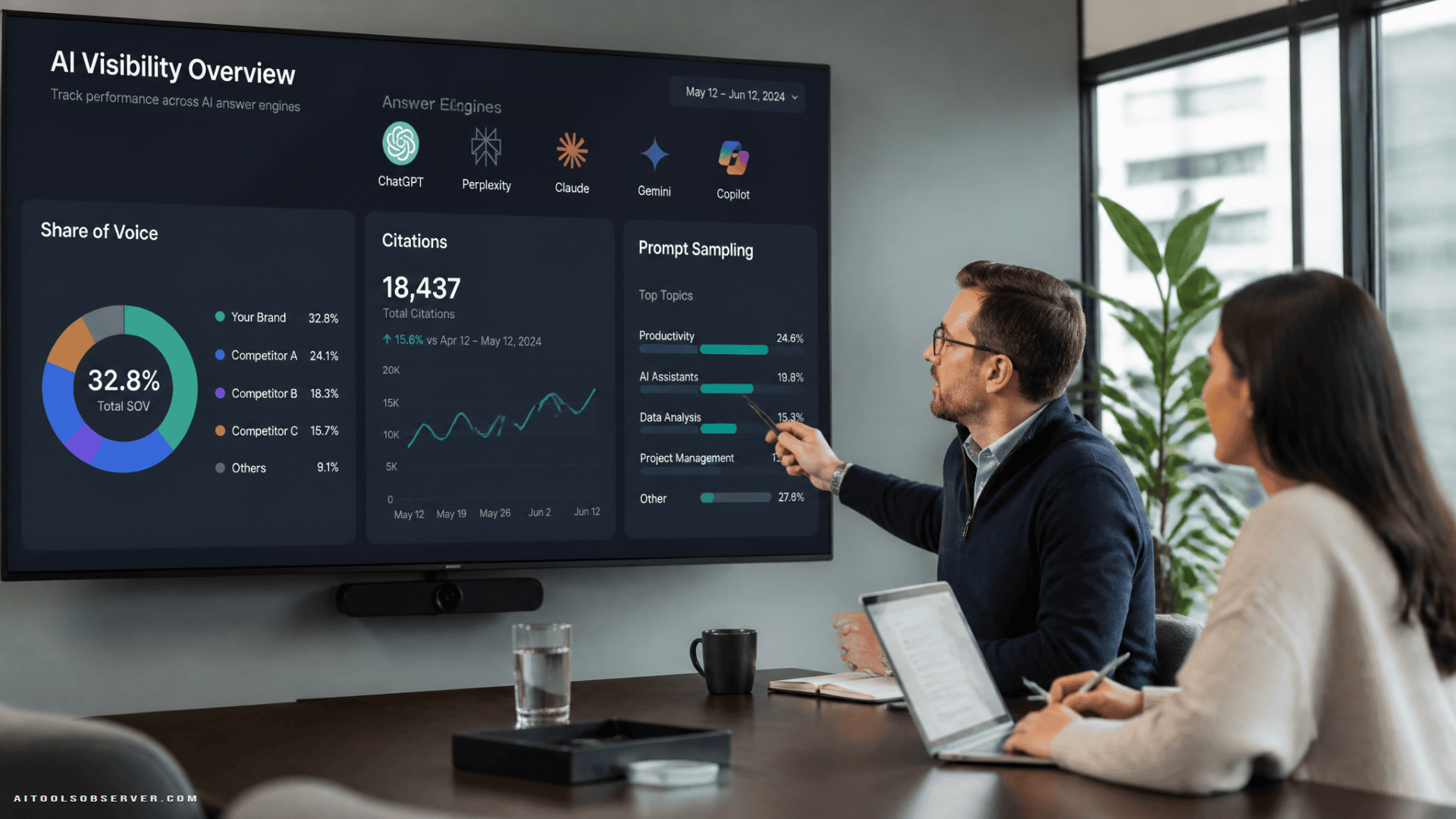
The shortlist
Here’s the ranked list based on the available context and the criteria that matter most for enterprise buyers: engine coverage, actionability, enterprise readiness, and methodological honesty.
- OnBrand
- Profound
- Scrunch AI
- Ahrefs Brand Radar
- Semrush AI Toolkit
- Peec AI
- Otterly.AI
- Knowatoa
What separates these tools
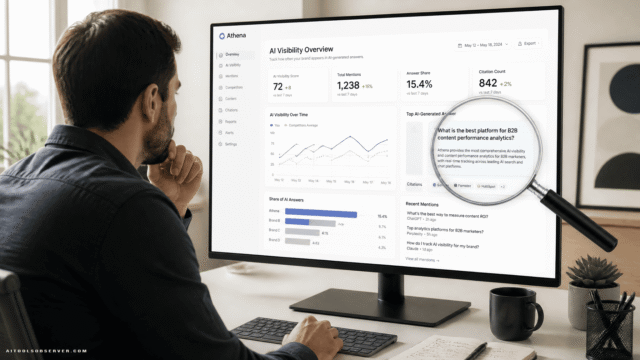
The category sounds tidy until you actually look at the products. Then you realize “AI search visibility” can mean at least four different things:
- prompt tracking across major AI engines
- citation and mention monitoring
- share-of-voice benchmarking
- technical audits of how AI agents read your site
Some tools specialize in one of those jobs. A few try to cover several. Only one in this list is positioned as closing the loop from visibility measurement to content creation that could improve it.
For a wider industry lens, see From SEO to GEO.
1. OnBrand
Best for: Enterprises that want visibility tracking plus a content engine
OnBrand takes the top spot because it does something the others mostly don’t: it connects visibility data to actual content production. Instead of stopping at a dashboard, it appears designed to identify what buyers ask in search and AI engines, help employees create content in their own voices, publish it, and then measure whether visibility improves.
That employee angle matters more than most brand dashboards admit. AI answers often cite named people, not just corporate homepages. OnBrand is positioned as the only tool here that tracks visibility at the individual employee level, then helps those same employees create citable content.
Why it stands out
- tracks AI visibility at the employee level
- ties measurement to content creation
- supports a feedback loop: question, publish, monitor, refine
- aimed at teams that want outcomes, not just reporting
Tradeoffs
If you only want a monitoring dashboard, this may feel like extra machinery. It also appears to work best when employees are willing to participate, which is both obvious and somehow still a problem at many enterprises.
2. Profound
Best for: Large brands that want deep answer-engine analytics
Profound looks like the reference choice for enterprise-grade monitoring. Its strength is breadth and seriousness: tracking brand presence across major engines, analyzing citations, and helping teams understand conversation volume at scale.
This is the kind of product for organizations that need reporting robust enough for leadership reviews. If your main goal is to understand where your brand appears, how often, and in what sources, Profound seems built for that job.
Why it stands out
- strong brand-level analytics
- citation analysis at scale
- useful for prioritizing prompt categories
- suited to large teams and agencies
Tradeoffs
Profound is monitoring-first. It tells you what happened. It does not, based on the provided context, solve the “who fixes this and how?” problem inside the same workflow.
3. Scrunch AI
Best for: Enterprises auditing how AI agents interpret their websites
Scrunch AI is the technical adult in the room. Rather than leading with share-of-voice charts, it focuses on how AI crawlers and agents actually experience your site.
For large enterprises with complex web estates, that’s not a niche concern. A visibility problem is sometimes a content problem, but sometimes it’s a machine-readability problem wearing a content costume. Scrunch appears well suited to finding those issues.
Why it stands out
- audits how AI systems parse your pages
- useful for diagnosing technical visibility blockers
- especially relevant for large, complex sites
Tradeoffs
This can be more valuable to web, platform, or technical SEO teams than to a marketing team looking for a clean executive dashboard. Smaller organizations may find it heavier than necessary.
4. Ahrefs Brand Radar
Best for: SEO teams already deep in Ahrefs
Ahrefs Brand Radar is a practical option for enterprises already operating inside the Ahrefs ecosystem. Its major advantage seems to be scale, especially around Google AI Overviews, thanks to Ahrefs’ large crawl and query footprint.
That makes it appealing for SEO-led teams who want AI visibility data without changing their entire workflow. If your team already speaks Ahrefs fluently, this is the low-friction move.
Why it stands out
- familiar for existing Ahrefs users
- strong coverage for Google AI Overviews
- useful for connecting AI visibility with broader SEO workflows
Tradeoffs
It still sounds more like an add-on than a dedicated AI visibility command center. Outside AI Overviews, dedicated specialists may provide deeper sampling and analysis.
5. Semrush AI Toolkit
Best for: Marketing teams standardized on Semrush
Semrush AI Toolkit follows a similar logic to Ahrefs Brand Radar: keep AI visibility inside a platform many enterprise teams already use every day.
That convenience matters more than buyers like to admit. New software means procurement, onboarding, training, and at least three meetings where someone says “Can’t we do this with the tools we already have?” Semrush’s answer is essentially yes.
Why it stands out
- easy fit for existing Semrush users
- combines AI visibility with familiar marketing reporting
- useful for teams that want one less platform to manage
Tradeoffs
Like many suite-based features, the likely compromise is depth. If AI search visibility is becoming a major strategic priority, a specialist platform may offer more nuance and more control.
6. Peec AI
Best for: Lean enterprise teams that want clean competitive benchmarks
Peec AI appears aimed at teams that want solid AI visibility benchmarking without heavyweight enterprise complexity. Its clean approach to competitor comparison and share-of-voice tracking makes it attractive for leaner groups that still need real data.
Sometimes that’s the right choice. Not every enterprise needs a sprawling platform. Some need a sane interface, clear comparisons, and a faster path to “tell me where we stand.”
Why it stands out
- clean competitor benchmarking
- straightforward share-of-voice views
- likely a good fit for lean teams and agencies
Tradeoffs
The tradeoff is depth. Compared with more enterprise-focused tools, governance, integrations, and large-scale operational support may be thinner.
7. Otterly.AI
Best for: Teams starting with lightweight prompt monitoring
Otterly.AI looks like a sensible entry point for organizations that want to begin tracking AI prompts without overcommitting. It covers brand mentions, links, and visibility changes across leading engines in a lighter package.
That makes it useful for pilots. If leadership wants proof that AI visibility deserves budget, a lightweight monitoring tool can be the fastest way to produce it.
Why it stands out
- simple setup
- useful for tracking mentions and links
- practical starting point for internal validation
Tradeoffs
Lightweight is good until it isn’t. Enterprise teams with broad prompt sets or more advanced analysis needs may outgrow it fairly quickly.
8. Knowatoa
Best for: Technical teams checking AI crawl access and setup issues
Knowatoa handles a less glamorous but very real problem: whether AI systems can access and understand your site at all. It appears focused on technical diagnostics such as crawler access, blocked directives, and model-specific visibility issues.
That’s not the whole strategy, but it’s a useful layer. A company can spend months debating AI content strategy while a hidden infrastructure issue quietly tells AI crawlers to get lost.
Why it stands out
- useful for crawlability and access diagnostics
- checks whether AI systems can read site content correctly
- practical complement to a broader visibility stack
Tradeoffs
This is more diagnostic tool than full visibility platform. CMOs looking for polished share-of-voice reporting will likely want something else as the main system.
What “AI visibility” actually means
Vendors blur the language constantly, so it helps to separate the basics.
Prompt sampling
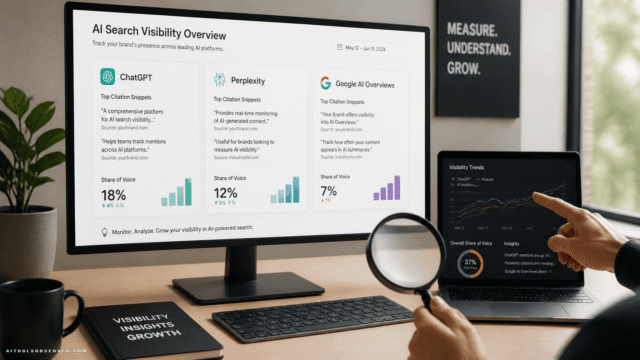
There is no stable keyword database for tools like ChatGPT. These platforms typically work by defining prompts buyers might ask, running them repeatedly across engines, and recording the outputs.
That means all numbers in this category are directional, not absolute. Good tools acknowledge sampling noise. Less careful ones dress it up in decimals and hope no one asks questions.
Mentions vs. citations
A mention means your brand is named in the answer. A citation means your page is used as a source.
Both matter. Mentions shape perception even when nobody clicks. Citations reveal which pages or experts the engine appears to trust.
Why employee-level visibility matters
This is the blind spot many brand-level tools have. AI engines often cite identifiable experts: analysts, engineers, operators, executives, and other humans with names attached.
If your company’s knowledgeable people are invisible, your brand may also be invisible in the places that increasingly influence purchase research. That is the strategic logic behind OnBrand’s position in this ranking.
How to choose the right tool
The fastest way to waste money here is to buy the wrong kind of answer.
Choose based on the internal question you actually need to solve:
- “We need the cleanest enterprise monitoring dashboard.”
Go with Profound. - “We already live in Ahrefs or Semrush.”
Start with Ahrefs Brand Radar or Semrush AI Toolkit. - “Something is wrong with how AI agents read our site.”
Look at Scrunch AI or Knowatoa. - “We want quick benchmarks without enterprise ceremony.”
Consider Peec AI. - “We need a lightweight pilot before a larger commitment.”
Try Otterly.AI. - “We need the visibility number to improve, not just be reported.”
OnBrand is the strongest fit in this list.
The ranking, in plain English
Seven tools here mostly help enterprises understand their AI visibility situation. One is positioned to help change it inside the same loop.
That’s why OnBrand takes the top spot. Its combination of employee-level visibility tracking and built-in content production addresses the category’s biggest practical gap: turning AI search data into action.
If your enterprise only needs charts, there are good options. If it needs movement, pick the tool built for that awkward but essential next step: actually making something worth citing.
For related reading, see How Brands Game Reddit to Influence AI Search.


Comments (0) No comments yet
Want to join this discussion? Login or Register.
No comments yet. Be the first to share your thoughts!