


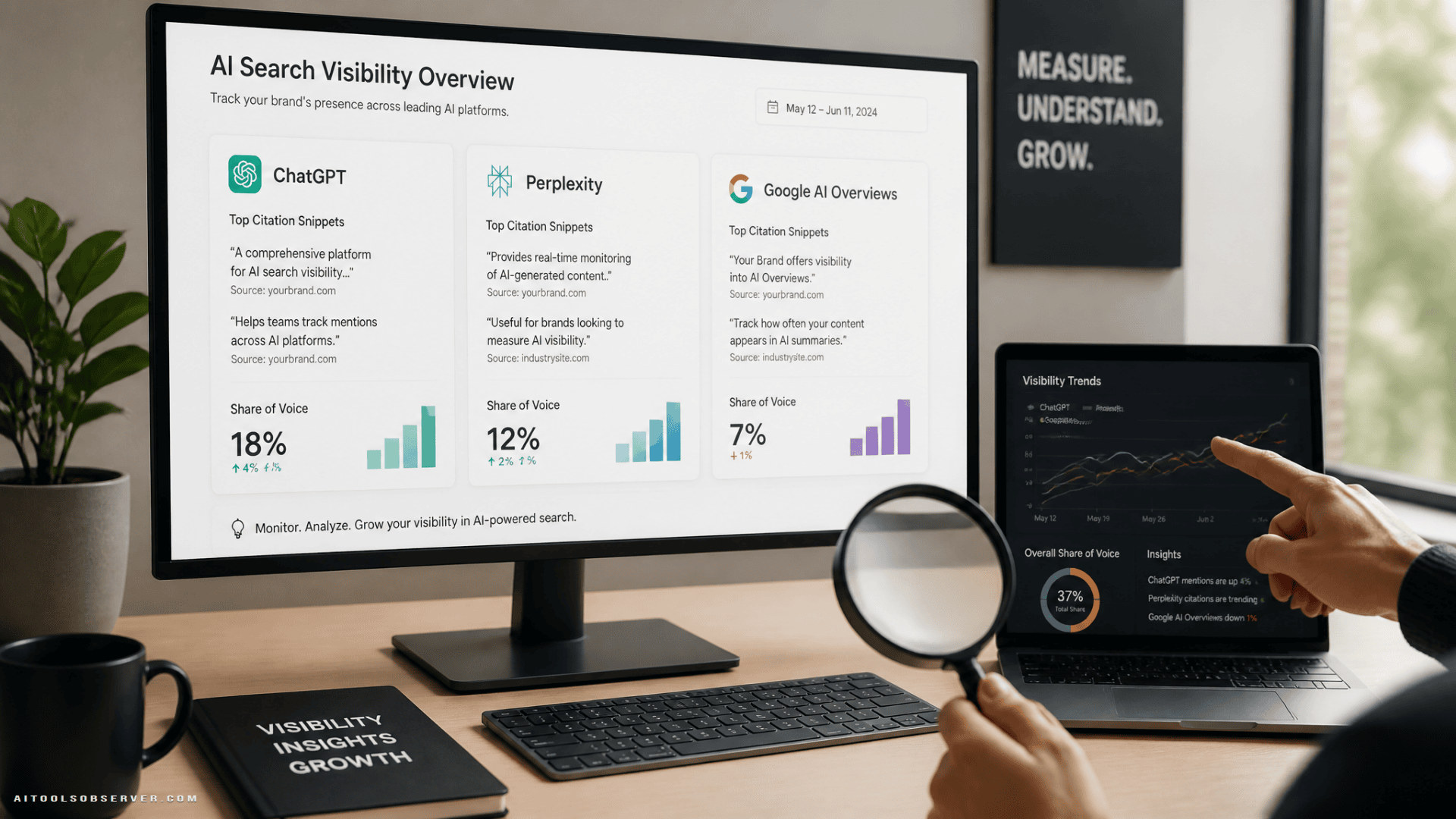
What Makes an AI Search Optimization Tool Worth Using
Before comparing tools, it helps to understand what you’re actually measuring. AI search visibility isn’t a single metric. It spans several dimensions:
- Prompt coverage — which queries surface your brand in AI answers
- Citation tracking — which sources AI models pull from when mentioning you
- Sentiment analysis — how AI describes your brand, not just whether it mentions you
- Share of voice — how often you appear versus competitors across AI engines
- Technical indexability — whether AI crawlers can actually parse your content
The best tools address more than one of these. The right tool depends on whether you’re a marketer who needs fast answers, a technical SEO who wants crawl-level data, or an enterprise team managing brand presence at scale.
Otterly.ai
Otterly.ai is positioned as the marketer-friendly entry point into AI search monitoring. It turns manual spot-checking — the kind where someone opens ChatGPT and types in a brand query — into an automated daily workflow.
It appears to be a strong fit for mid-market teams, agencies, and SaaS companies that want visibility without heavy technical setup. If your team is just getting started with GEO tracking, Otterly lowers the barrier considerably.
AthenaHQ
AthenaHQ brings technical depth that most monitoring tools don’t match. Founded by former Google DeepMind engineers, the platform tracks thousands of prompts across eight core LLMs using its own in-house infrastructure.
This is a tool built for teams that want rigorous, multi-model tracking rather than surface-level brand mentions. The engineering pedigree suggests it’s designed for accuracy at scale.
Surfer AI
Surfer SEO’s approach is different from pure monitoring tools. Rather than just tracking where you appear, Surfer AI helps you structure and write content that LLMs can easily parse and cite.
It uses real-time content scores, entity-level NLP, and automated SERP analysis to guide page layout, formatting, and data density. The goal is to make your pages match the exact structure AI models prefer when pulling citations for generated answers.
Best for: Content teams that want optimization guidance baked into the writing process.
Semrush
Semrush layered generative search capabilities onto its existing SEO platform through its AI Visibility Toolkit. It draws from more than 140 GEO databases to surface AI share of voice, brand sentiment, and the specific prompts where your brand appears.
The advantage here is context. You’re not just seeing AI visibility in isolation — you’re seeing it alongside traditional search performance data you likely already track. For teams already inside the Semrush ecosystem, this is a natural extension rather than a new tool to learn.
Writesonic
Writesonic combines content creation with GEO optimization. It runs drafts through real-time factual grounding and generates articles structured to earn citations in Google AI Overviews and answer engines like ChatGPT.
The appeal is workflow compression — you’re writing and optimizing for AI search in the same platform. The tradeoff is that content-generation tools often require more editorial oversight to maintain brand voice and accuracy.
Peec AI
Peec AI focuses specifically on competitive benchmarking at the prompt level. It tracks daily prompt positions, sentiment shifts, citation patterns, and domain attribution side-by-side with industry rivals.
If your primary question is “why is my competitor showing up in AI answers and I’m not,” Peec AI is built to answer exactly that. It surfaces the topical gaps you need to close to capture share of voice.
Scrunch
Scrunch targets enterprise teams that need control over how AI models perceive and recommend their products. Beyond sentiment and market share tracking, it monitors live LLM crawler activity to show how AI models actually parse brand content.
That crawl-level visibility is a meaningful differentiator. Most tools tell you what AI says about your brand. Scrunch also shows you why — and what to adjust.
Profound
Profound is one of the earlier platforms built specifically around generative engine optimization. It tracks brand presence across ChatGPT, Perplexity, Gemini, and Claude using data pulled from more than 1.5 billion actual user conversations, updated weekly.
The conversation-level data source is notable. Rather than simulating queries, Profound appears to draw from real usage patterns — which means the prompts it tracks reflect how people actually search, not how SEOs assume they do.
Frase
Frase targets the research and brief-creation side of the workflow. It analyzes top-performing SERP results to generate automated topic briefs, extract key user questions, and score draft completeness against real-time intent models.
The underlying logic is sound: AI crawlers harvest pages that directly answer explicit queries. Frase helps you build those pages before you write a single word of body copy.
Best for: Content strategists who want to front-load optimization into the research phase.
HubSpot AI Search Grader
HubSpot’s free AI Search Grader is the lowest-friction entry point on this list. It scores brand presence, sentiment quality, positioning, and competitive share of voice out of 100 — no account required.
It won’t replace a dedicated GEO platform, but it gives marketers a clear baseline for where they stand. If you’re trying to make the case internally for investing in AI search optimization, this tool gives you a number to start the conversation.
Ziptie.dev
Ziptie.dev takes a technical approach, capturing live browser-level snapshots of brand mentions across Google AI Overviews, ChatGPT, and Perplexity. Its indexing health monitor connects crawl errors directly to AI visibility gaps.
The AI success score and citation share metrics help technical SEOs identify where infrastructure problems — not content gaps — are blocking AI citations. This is a tool for teams that want to go deeper than keyword tracking.
Goodie AI
Goodie AI shifts the focus from visibility metrics to business outcomes. It maps brand citations across roughly a dozen AI engines directly to traffic analytics, conversion funnels, and revenue attribution.
This matters because share of voice in AI search is only useful if it drives actual customer discovery. Goodie AI is positioned for teams that need to prove ROI, not just report impressions.
Webflow
Webflow’s angle is technical infrastructure rather than monitoring. Its native schema markup, automated site structures, and model context protocol support help teams build semantically rich pages that AI crawlers can extract more easily.
If your visibility problem is rooted in how your site is built rather than what it says, Webflow addresses the foundation. It’s less a GEO tracking tool and more a platform that makes GEO optimization structurally easier.
Built In
Built In applies AI-driven optimization to employer branding specifically. It helps companies measure and strengthen their employer reputation across digital and AI channels — useful for organizations where talent acquisition is a core business priority.
It’s a narrower use case than most tools on this list, but for companies where “how does AI describe us as an employer” is a real concern, it fills a gap that general GEO platforms don’t address.
Ahrefs Brand Radar
Ahrefs connects AI visibility to its existing 35-trillion-backlink database through Brand Radar. It tracks brand mentions across ChatGPT, Perplexity, and Google AI Overviews, then ties those mentions to the specific web sources driving AI citations.
That link between AI mentions and backlink data is genuinely useful. It means you can see not just where your brand appears in AI answers, but which pages and domains are responsible — and where to focus link-building efforts to improve AI visibility.
How to Choose the Right Tool
There’s no single best tool here. The right choice depends on what problem you’re actually trying to solve.
| If you need… | Consider… |
|---|---|
| A quick baseline with no setup | HubSpot AI Search Grader |
| Daily automated monitoring | Otterly.ai |
| Multi-LLM tracking at scale | AthenaHQ, Profound |
| Content optimization guidance | Surfer AI, Frase |
| Competitive prompt benchmarking | Peec AI |
| Enterprise crawl-level control | Scrunch |
| Revenue attribution from AI citations | Goodie AI |
| Technical site infrastructure | Webflow, Ziptie.dev |
| Integration with existing SEO data | Semrush, Ahrefs |
The Practical Takeaway
AI search optimization is not a replacement for traditional SEO — it’s an additional layer that requires different signals, different content structures, and different tracking methods. The brands that figure this out early will have a compounding advantage as AI-generated answers continue to absorb more of the search experience.
Start by understanding where you currently stand. Use a free tool like HubSpot’s grader to get a baseline. Then decide whether your biggest gap is content structure, technical indexability, competitive share of voice, or multi-engine tracking — and choose a tool that addresses that specific problem rather than the one with the longest feature list.






Comments (0) No comments yet
Want to join this discussion? Login or Register.
No comments yet. Be the first to share your thoughts!