


What the study tested
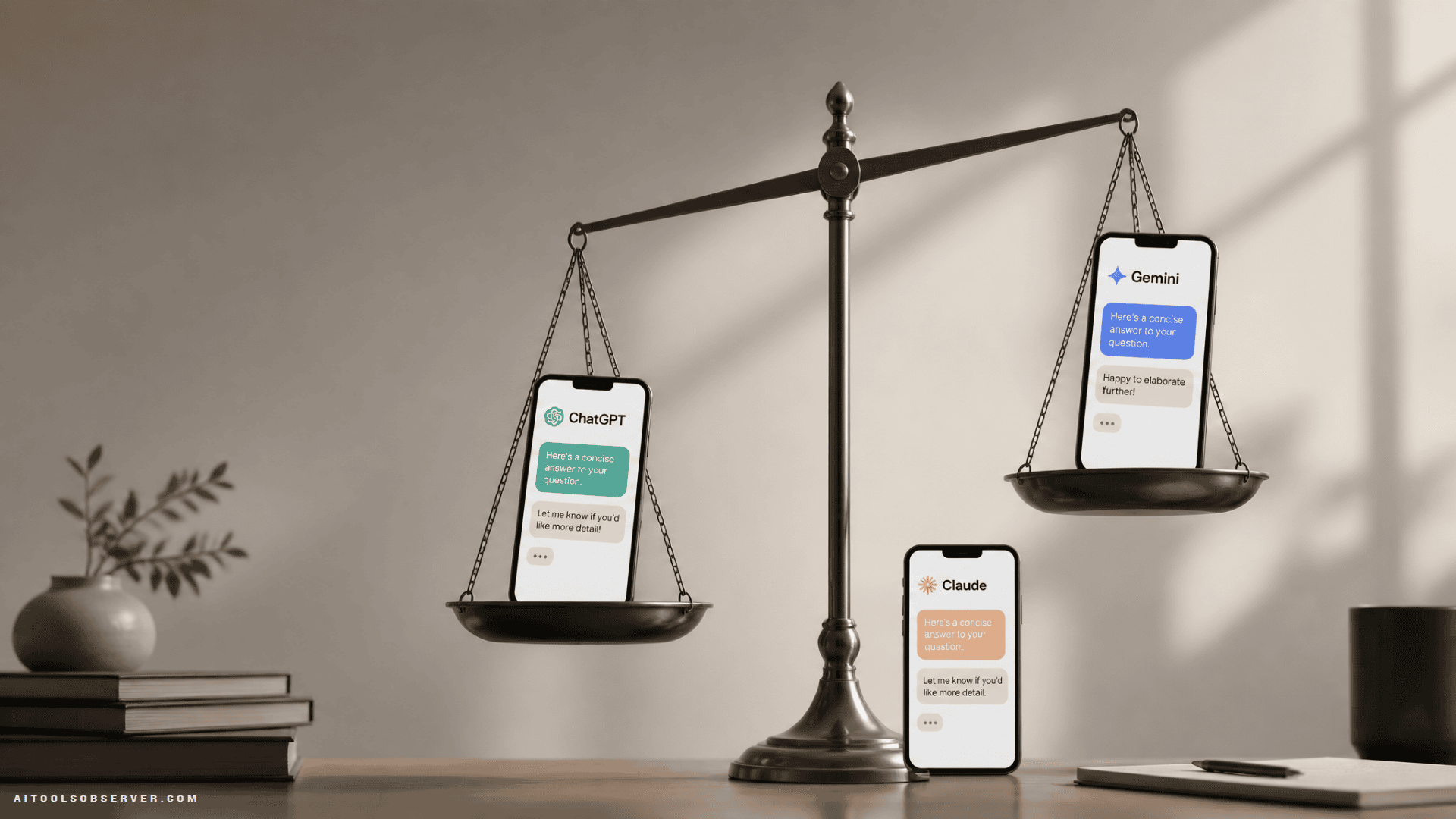
The study examined responses from major AI chatbots on political prompts, including topics such as gun control and the death penalty. Researchers also used a prompt about affirmative action to show how different models framed contested policy questions.
To keep the comparison tighter, the models were asked to answer in 30 words and were tested without personalization settings. That matters because response length and personalization can both change tone, nuance, and perceived balance.
The core question was simple: when users ask politically loaded questions, do these systems provide factual, neutral, multi-perspective answers, or do they tilt toward one viewpoint?
The headline results
Based on the reported findings:
- Gemini scored highest for presenting multiple viewpoints
- Gemini laid out both sides of an issue in 93% of responses
- Claude maintained neutrality more than half the time, at 57%
- ChatGPT was found to be left-leaning 80% of the time
Those numbers are attention-grabbing, but they need careful interpretation. A result like “left-leaning” or “neutral” depends heavily on how the researchers defined those labels, how prompts were worded, and how responses were judged.
Even so, the broad takeaway is clear: these models do not all respond the same way when politics enters the conversation.
Why Gemini, Claude, and ChatGPT may feel different
A political answer can vary in three important ways:
- Whether it presents one view or multiple views
- Whether it uses explicitly neutral language
- Whether it frames a topic as settled, contested, or morally weighted
Gemini appears, in this study, to be more likely to show both sides. That does not automatically make it more accurate, but it does suggest a stronger tendency toward viewpoint balance in the tested prompts.
Claude appears more likely to maintain neutrality. In practice, that can make answers feel more cautious, less judgmental, and more aware that policy questions often involve tradeoffs.
ChatGPT, based on the study’s reported result, appears more likely to produce answers that were interpreted as left-leaning. That does not mean every answer is partisan, but it does suggest users may encounter a more consistent ideological tilt in certain political contexts.
The real issue is framing, not just facts
Bias in chatbots is often discussed as if the model is either factual or biased. In reality, those are not opposites.
A response can contain accurate facts and still guide the user toward one interpretation. It can do that by:
- selecting which facts to emphasize
- choosing moral language
- presenting one side as more credible
- omitting the strongest counterargument
- treating a disputed issue as if consensus already exists
This is why political AI bias is hard to measure and easy to underestimate. The problem is not always fabricated information. It is often asymmetry in presentation.
Why short answers make bias harder to spot
The 30-word limit in the study is important.
When a model has very little space, it has to compress a complex issue into a tiny frame. That forces tradeoffs. A chatbot may choose neutrality over depth, or clarity over nuance, or a concise moral framing over a broader policy explanation.
In longer answers, a model may be able to include caveats and competing views. In shorter answers, its default instincts become more visible. That makes this kind of test useful, because it reveals how a model behaves when it cannot hide behind extra context.
Personalization can make the problem more complicated
The study tested the models without personalization settings. That gives a cleaner comparison, but it also leaves out how many people may actually experience these systems.
Chris Callison-Burch of the University of Pennsylvania noted that AI systems can reflect user behavior and preferences. If a model adapts to what it believes a user wants, then political tone may not stay fixed. It may shift depending on the user’s identity, reading habits, or interaction patterns.
That creates a different kind of concern. A model might not just have a baseline bias. It could also become more agreeable to the user over time.
For users, that means AI can feel balanced in one session and subtly affirming in another. For researchers, it means bias testing gets much harder once personalization enters the picture.
What “multiple viewpoints” does and does not mean
One of the most interesting findings is Gemini’s strong score for presenting both sides.
That sounds like a straightforward win, but viewpoint balance is not the same thing as truthfulness. A model can present two sides evenly even when the underlying evidence is not evenly distributed. It can also create a false sense of fairness by flattening important differences in evidence, law, ethics, or public impact.
At the same time, failing to present multiple viewpoints on contested policy issues can make a response feel more ideological than informative.
So there is a real tradeoff here:
- more balance can improve openness and reduce perceived bias
- too much balancing can oversimplify evidence or create false equivalence
This is one reason AI transparency matters. Users need to know whether a chatbot is trying to be neutral, persuasive, safety-conscious, user-aligned, or debate-oriented.
What this means for users researching political topics
If you use ChatGPT, Gemini, or Claude for political research, do not treat the first answer as the answer.
A better workflow is to use chatbots as starting points, then compare their framing. Ask the same question across multiple models. See which one gives a direct answer, which one adds context, and which one introduces competing viewpoints.
You can also improve your prompts. Instead of asking, “What’s the right view on gun control?” ask:
- “Summarize the strongest arguments on both sides.”
- “What facts are most relevant to this debate?”
- “Which parts of this issue are empirical, and which are value-based?”
- “What would critics of this position say?”
- “Rewrite this answer in a neutral tone.”
That simple change often reveals more than the original answer. This is especially relevant when you research sensitive topics with AI systems.
What this means for teams evaluating AI tools
For founders, marketers, researchers, and operators, this study is a reminder that model selection is not just about speed or writing quality.
It is also about behavior under pressure. If your team uses AI for public-facing content, policy analysis, stakeholder communications, education, or moderation support, the model’s default political framing matters.
When comparing AI tools, look beyond generic performance claims and test for:
- neutrality on contested issues
- consistency across similar prompts
- ability to show multiple viewpoints
- transparency about uncertainty
- resistance to user-leading language
A model that sounds polished can still be unreliable in high-sensitivity contexts. A model that sounds balanced can still mask tradeoffs. The right choice depends on your workflow and your tolerance for framing risk. In some settings, this connects directly to questions of human oversight and algorithmic bias.
The limits of studies like this
This kind of research is useful, but it is not the final word.
Results can shift based on prompt wording, answer length, model updates, evaluator judgments, and category definitions like “neutral” or “left-leaning.” Political language is also unusually sensitive to interpretation, which means small wording changes can produce very different conclusions.
Still, that does not weaken the value of the study. It strengthens the case for ongoing evaluation.
Generative AI systems are not static reference tools. They are moving targets trained on vast internet data, tuned for helpfulness, and shaped by product decisions. That makes regular comparison more important, not less.
The bigger lesson about AI transparency
The most practical lesson here is not that one chatbot is good and another is bad. It is that AI outputs carry assumptions.
Those assumptions show up in tone, framing, omissions, and viewpoint selection. Users rarely see the hidden choices behind the answer, which is why transparency and comparative testing matter so much.
If a model tends to present both sides, that should be visible. If it tends toward neutrality, that should be understandable. If it often leans ideologically on political prompts, users should know that before they treat it as a research assistant.
What to do next
If you rely on AI for political or policy-related research, compare models before you trust one. Run the same prompt in ChatGPT, Gemini, and Claude, then check what changed in framing, not just content.
That habit will tell you more about chatbot bias than any single headline ever could.













Comments (0) No comments yet
Want to join this discussion? Login or Register.
No comments yet. Be the first to share your thoughts!