


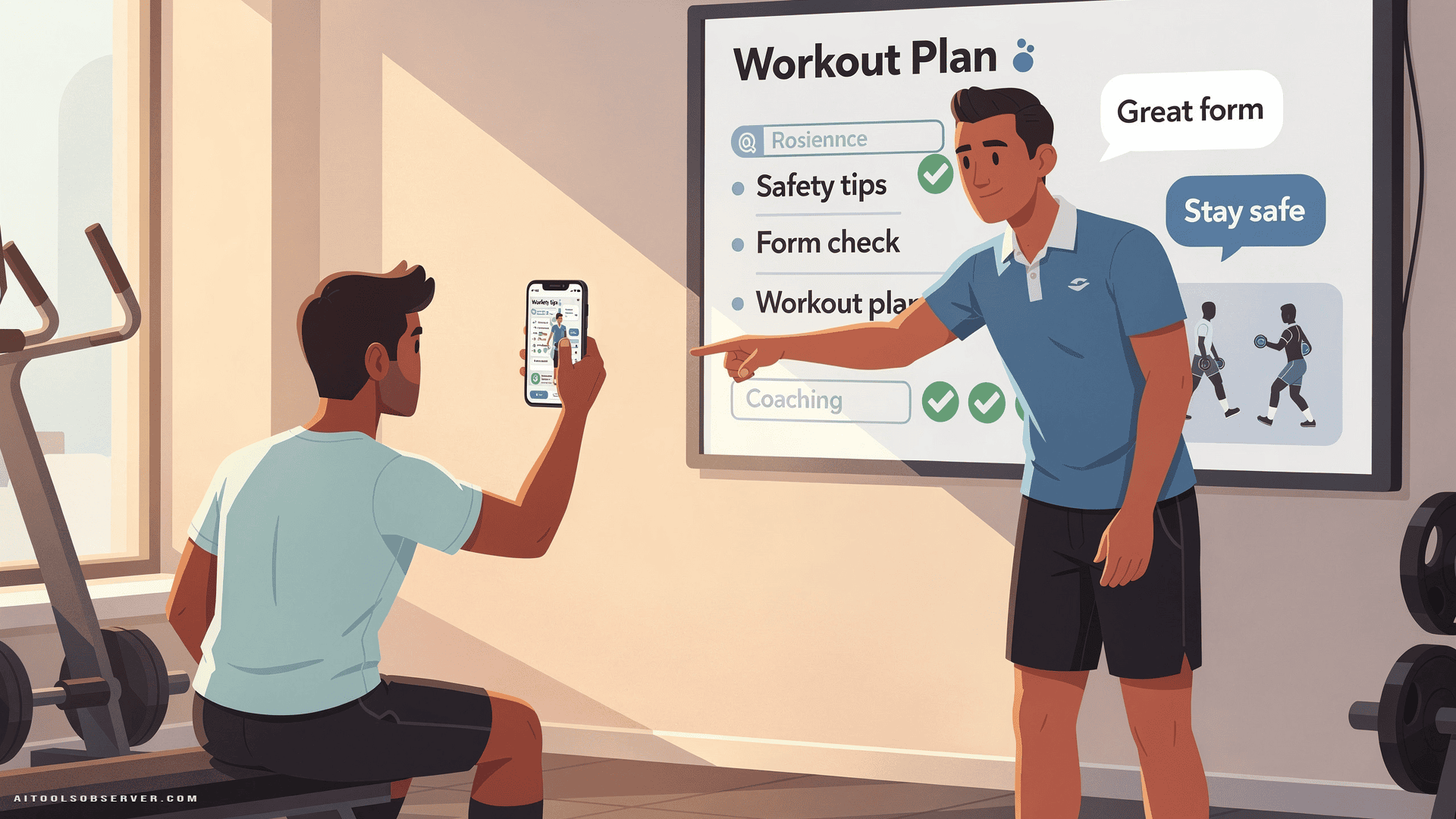
Why People Are Ditching the Trainer App Waitlist

The appeal is straightforward. No appointment. No hourly rate. No awkward small talk before a squat assessment.
AI tools can generate a personalised strength or running program in seconds. They can also respond instantly when something feels off — ask about knee pain mid-program and you get an answer now, not in two days when your coach checks their messages.
For a lot of people, that combination of speed and accessibility is genuinely useful. Especially if the alternative is no structured training at all.
AI can write a decent beginner program
Studies have tested AI-generated programs across multiple contexts, and the verdict is cautiously positive — with caveats.
One study had ChatGPT design individualised programs for five hypothetical users, then had experts evaluate them. The conclusion: safe and functional for basic recommendations, but limited in long-term adaptability. Another study had expert running coaches assess AI-generated plans — suitable for novices, not great for trained athletes.
The pattern holds. AI does fine at the basics. It struggles at the edges.
The output is only as good as your prompt
Here’s the catch most people miss. The more context you give — your fitness level, goals, injury history, current training load — the better the program. Which means getting a genuinely useful AI plan requires knowing enough about exercise science to ask the right questions.
That’s a lot to ask of someone who just wants to get fit.
Health screening is the gap nobody talks about

Before any reputable exercise professional writes you a program, they screen you. Injuries, chronic conditions, cardiovascular risk — it all gets factored in. Current AI tools may skip this step entirely, or handle it superficially.
If you have a complex health history and an AI doesn’t know about it, the program it generates isn’t personalised. It’s just generic with your name on it.
Human Trainers vs AI: The Head-to-Head
A small but growing body of research has started comparing the two directly. The results lean one way.
A 12-week study split participants between a ChatGPT-guided weight training program and a personal trainer-guided one. The human trainer group saw larger gains in both muscle size and strength. A five-week comparison found human-generated programs produced slightly greater improvements in fitness and endurance. A ten-week athletic performance study on volleyball athletes found human programs edged ahead on jump distance, though jump height was roughly equal.
None of these are knockout blows. AI programs did improve fitness — they just improved it a little less. The likely reason: real-time feedback and in-the-moment motivation are hard to replicate with a chatbot.
Worth noting: these studies were published in relatively low-quality journals and had methodological limitations. Treat the findings as directional, not definitive.
Where AI Coaching Actually Makes Sense
This isn’t a binary choice. The smarter frame is knowing when AI Coaching is the right tool.
AI works well when you:
- Need a starting point and have some baseline fitness knowledge
- Want to organise your training without paying for a coach
- Are a recreational exerciser with straightforward goals
- Can self-monitor and adjust when something feels off
Lean toward a human trainer when you:
- Are completely new to the gym and need technique guidance
- Have injuries, chronic conditions, or complex health history
- Are chasing high performance or competitive goals
- Need accountability and real-time correction to stay consistent
Five Things to Watch Before You Start an AI Program
If you’re going the AI route, go in with eyes open.
Treat it as a draft, not a prescription. AI programs are a solid starting point. They’re not infallible. Modify freely.
Don’t let it spike your volume. Sudden jumps in running distance or lifting intensity are a fast track to injury. AI doesn’t always account for this. You need to.
Get a few sessions with a human first if you’re new. Even two or three sessions to learn basic technique will make any program — AI or human — significantly safer.
Be extra cautious with injuries or chronic conditions. This is where AI’s personalisation limits matter most. See a professional.
High performance goals need human expertise. If you’re training to compete, the marginal gains from a great coach are real. Don’t leave them on the table.
The Honest Takeaway
AI fitness coaching is genuinely useful — accessible, fast, and good enough for a lot of people in a lot of situations. It’s not a gimmick.
But it’s also not a replacement for human expertise when the stakes are higher: complex health conditions, serious athletic goals, or the kind of real-time feedback that keeps you from training yourself into an injury.
Think of AI as a very capable assistant coach. One that never sleeps, never judges your rest day snack choices, and can build you a program before your coffee finishes brewing.
Just don’t ask it to spot you on a heavy squat.









Comments (0) No comments yet
Want to join this discussion? Login or Register.
No comments yet. Be the first to share your thoughts!