


What Happened
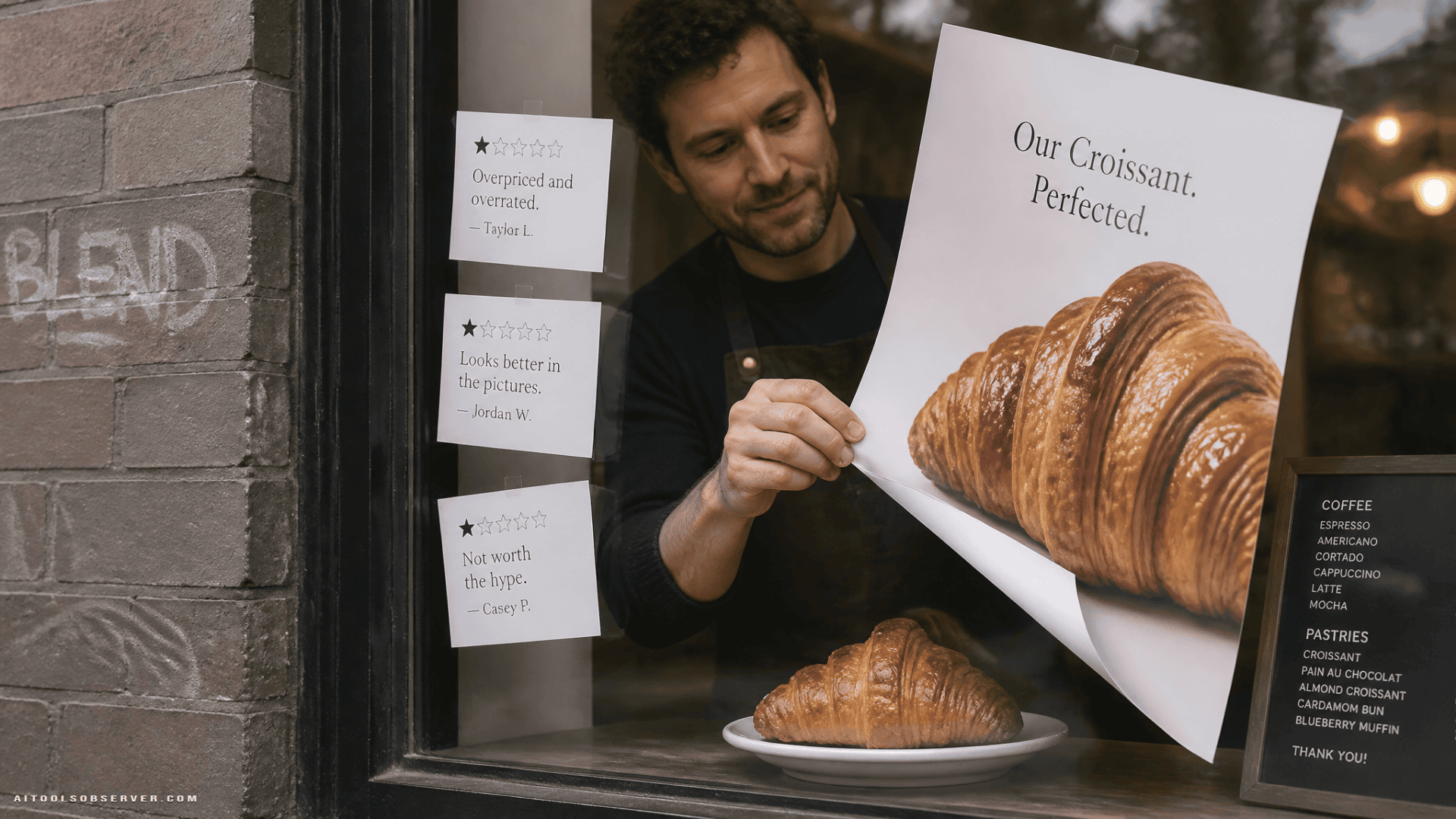
Grind and Unwind, a recently opened café in San Francisco, used AI-generated images in its storefront window as a temporary placeholder while the business got established. The owner, Lyndsey Lozano, bakes the pastries herself and intended the images purely as eye-catching window dressing for passing tourists.
The response was swift and disproportionate to the intent. Negative Yelp reviews accumulated, with customers describing the images as misleading and calling them “false advertising.” One reviewer noted that the café’s actual food looked significantly better than the AI renderings—a detail that underscores the irony of the situation. The backlash escalated further when someone spray-painted the word “seriously” on the exterior of the building.
Lozano has since removed all AI-generated imagery and replaced it with the real product displayed in the window.
Why This Case Matters
This is not a story about a large brand deploying synthetic media at scale. It is a story about a small business owner making a practical, low-cost decision that collided with a specific cultural moment.
San Francisco is a city with unusually high AI literacy and, correspondingly, unusually high AI skepticism. The same tech-forward environment that produces AI tools also produces consumers who recognize and resent their misuse—even when the intent is benign. That broader pattern echoes wider AI backlash.
The core complaint from customers was not aesthetic. It was epistemic: how am I supposed to know what the actual product looks like? That is a precise and legitimate concern in a food context, where purchase decisions are heavily visual.
The Specific Risk for Local Food Businesses
AI-generated food imagery carries a particular credibility risk that differs from other marketing contexts.
- Food photography sets a direct expectation. A customer who sees a glossy croissant in a window expects that croissant on the plate. AI renders idealized, often physically impossible food textures that real kitchens cannot replicate.
- The gap is immediately verifiable. Unlike a software product or a service, food is consumed on-site. The mismatch between image and reality is experienced within minutes of the decision.
- Local trust is fragile and slow to rebuild. A neighborhood café depends on repeat customers and word-of-mouth. A wave of one-star reviews in the opening weeks can define a business’s reputation before it has a chance to establish one.
The increasing accessibility of AI image generators makes this risk easier to stumble into.
The Broader Signal
This incident is a useful data point for any business considering AI-generated visuals as a cost-saving measure. The technology is accessible and inexpensive, but the deployment context determines whether it is a neutral shortcut or an active liability.
In categories where authenticity is the product—food, hospitality, handmade goods—synthetic imagery does not just fail to help. It actively undermines the message the business is trying to send.
Lozano’s pivot was the right one. Real pastries in the window communicate exactly what AI images could not: that the food is made by a person, in that kitchen, and available right now.
The practical takeaway: Before using AI-generated visuals in customer-facing materials, ask whether the gap between the image and the reality is something your customers will notice and whether they will care. In food and beverage, the answer to both questions is almost always yes.




Comments (0) No comments yet
Want to join this discussion? Login or Register.
No comments yet. Be the first to share your thoughts!