


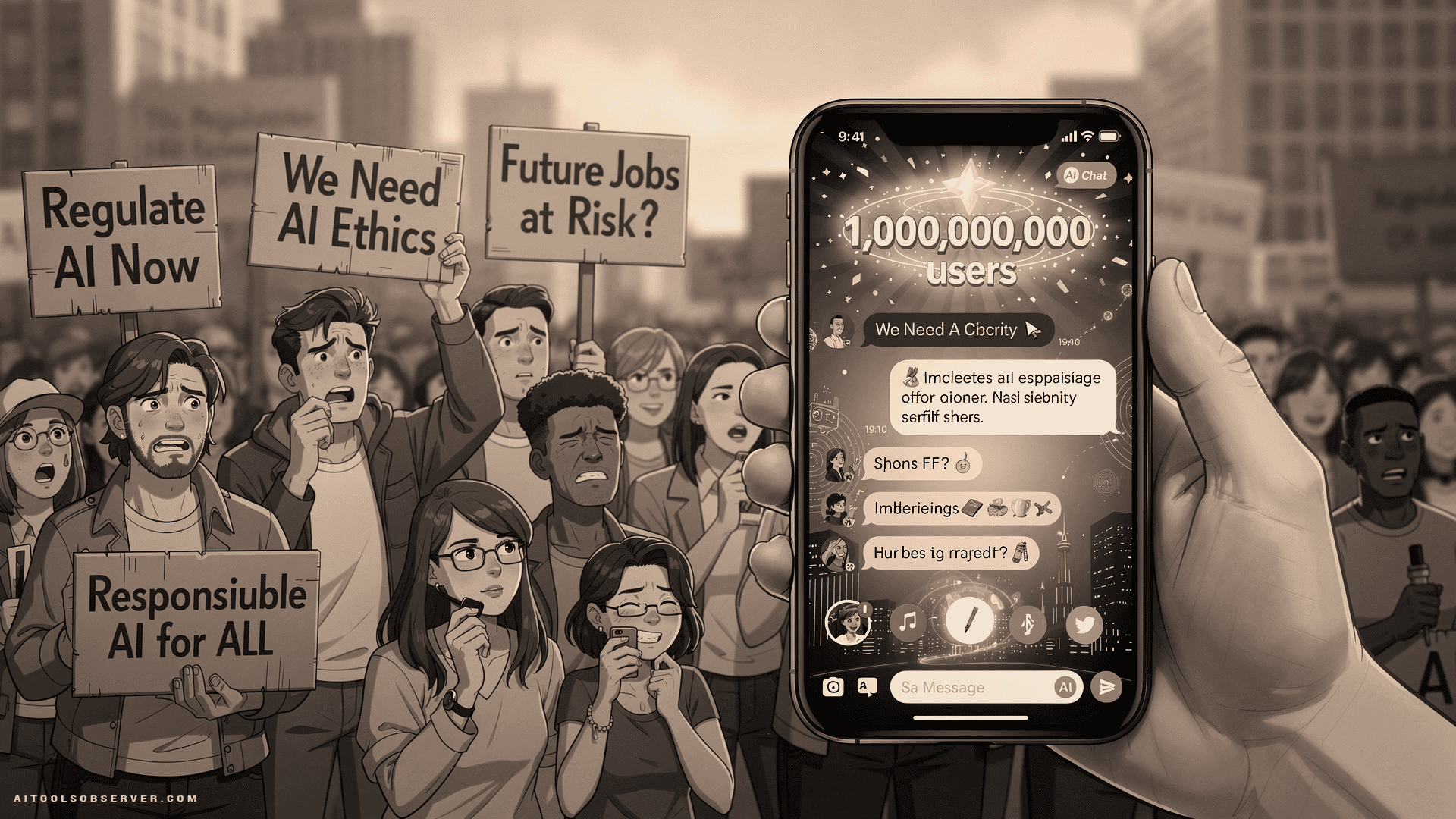
The Milestone Nobody Can Ignore

OpenAI’s ChatGPT crossed one billion monthly active users in May 2026, according to Sensor Tower estimates. That’s roughly 3.5 years after its November 2022 launch — making it the fastest app in history to reach that threshold, beating Google Maps by about 18 months.
For context: a billion MAUs puts ChatGPT in the same conversation as Instagram and TikTok. Except those apps didn’t have to explain themselves to the Pentagon.
The Competition Is Closing Fast

ChatGPT still leads by a wide margin, but the gap is compressing at a rate that should make OpenAI uncomfortable.
According to Sensor Tower, Claude‘s monthly usage grew 640% year-on-year. Meta AI grew 973%. ChatGPT? A comparatively modest 62%.
That’s not a knock on ChatGPT — growing 62% at a billion-user scale is genuinely hard. But it signals something important: the AI tools market is no longer a one-horse race. Gemini, Claude, Doubao, Meta AI — they’re all gaining real ground, driven by genuine model improvements and, increasingly, by sentiment.
When Ethics Became a Growth Lever
Here’s the most interesting data point in the whole story. On February 28, the day after OpenAI announced a deal to deploy its models on classified Pentagon networks, ChatGPT uninstalls surged 295% day-on-day.
That same weekend, Claude climbed to the top of the App Store — outpacing ChatGPT by U.S. downloads for the first time — largely because Anthropic had publicly refused involvement in Pentagon operations.
Ethics, it turns out, can be a product differentiator. At least temporarily.
So Why Is Everyone Still Using It?
Public sentiment toward AI has genuinely soured. College graduates are jeering AI mentions at commencement speeches. A CNBC survey found workers actively avoiding AI for moral, environmental, or privacy reasons. Anthropic itself called for a pause in global AI development. The Pope wrote a letter about it.
And yet: 74% of frontline workers regularly use AI, up 23 percentage points year-on-year, according to a BCG poll of around 12,000 workers. More than 40% of regular users report saving the equivalent of a full workday each week.
The backlash is real. The utility is realer.
The Productivity Trap
This is the core dynamic that makes AI adoption so hard to reverse. Once someone saves five hours a week using an AI tool, the ethical debate becomes abstract and the workflow dependency becomes concrete. Sentiment shifts opinions. Productivity shifts behavior.
Analysts at BCG put it plainly: the strong trajectory of AI adoption shows no sign of slowing. The UN estimates the AI market could exceed $4.8 trillion by 2033.
Backlash makes headlines. Habit makes markets.
What This Means for the AI Tools Ecosystem
For anyone tracking the AI tools landscape — founders, marketers, enterprise buyers — a few signals are worth watching closely.
Market concentration is loosening. ChatGPT’s dominance is real but no longer unchallenged. The tools you compare today may not hold the same positions in 12 months. Evaluation cycles matter more than ever.
Trust is a product feature. The Claude-Pentagon moment wasn’t just a PR story. It demonstrated that users will switch tools based on perceived values alignment — especially in consumer and early-career segments. Expect more AI companies to make their ethical positioning explicit.
Enterprise adoption is the floor, not the ceiling. With 74% of frontline workers already using AI regularly, the “will people adopt this?” question is largely settled. The new question is: which tools, for which workflows, at what cost?
Both OpenAI and Anthropic have filed IPO prospectuses in recent weeks. The race is no longer just about users — it’s about revenue quality, enterprise contracts, and defensible moats.
The Takeaway
A billion users and a growing backlash aren’t contradictions. They’re the same story told from different angles.
The AI tools market has crossed the threshold where adoption is driven less by enthusiasm and more by necessity. That’s actually a more durable foundation — and a more complex one to navigate.
The tools that win from here won’t just be the most capable. They’ll be the ones people trust enough to keep using when the headlines turn ugly.
Observe carefully. Choose accordingly.











Comments (0) No comments yet
Want to join this discussion? Login or Register.
No comments yet. Be the first to share your thoughts!