


What Prophecy launched
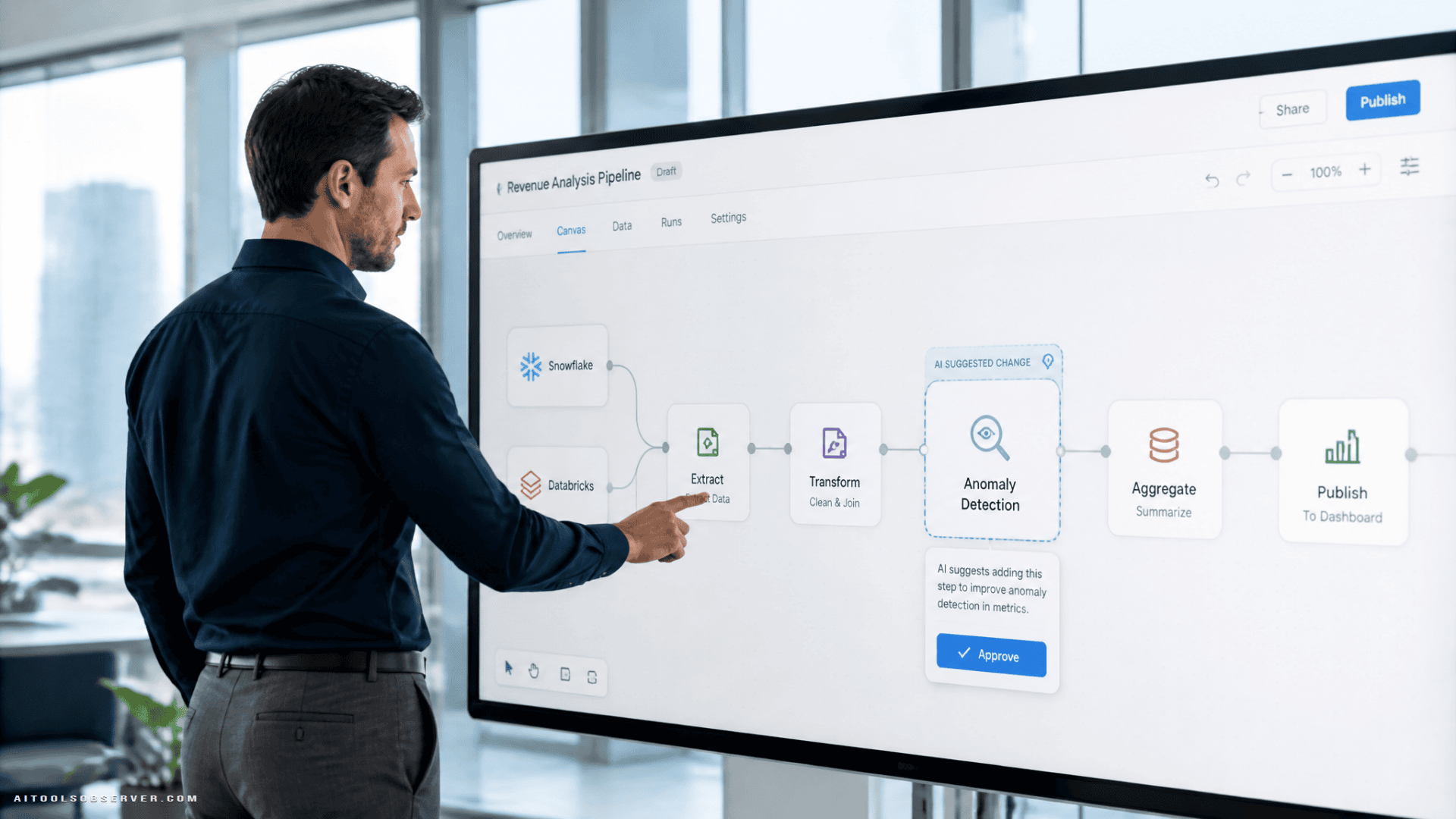
Prophecy launched AI data prep products designed for business users and data analysts who need to prepare data, review AI-generated workflow changes, and run analysis without depending on a data engineering team for every step.
Based on the available details, the release centers on a few core capabilities:
- No-code data workflow creation
- AI-assisted data prep and analysis
- Visual review of workflow changes before approval
- Analysis dashboards built from plain-language questions
- Expanded support for Snowflake, alongside existing Databricks support
The practical pitch is clear: help non-technical teams move from question to workflow to output faster, while still giving them a way to inspect what the AI is doing.
Why this matters
There’s a common pattern in enterprise AI. Companies invest in models, agents, and experimentation, but the last mile breaks down when the underlying data is messy, manually prepared, or hard to validate.
Prophecy’s release appears to focus on that operational problem rather than the model layer itself. Instead of asking users to trust generated SQL or Spark code they may not understand, it gives them a visual way to review changes and outputs before they approve a workflow.
That matters for two reasons:
- It lowers the technical barrier for business teams
- It adds a review layer that can make AI-assisted workflows easier to trust
For organizations trying to improve AI ROI, that combination is more useful than another generic chatbot layer on top of data.
The biggest differentiator: visual AI workflow verification
The most interesting part of this launch is not just no-code workflow building. It’s the review flow.
According to the description, Prophecy lets users see what an AI agent added or changed in a workflow or chart step by step before approving the result. That is a more practical framing than simply saying “AI-generated workflows.”
In real teams, trust is the bottleneck. If a business analyst asks an AI agent to reshape data for a dashboard, the problem is rarely getting an output. The problem is knowing whether the output is reliable enough to use in a meeting, report, or decision.
A visual review process helps in a few ways:
- Users can inspect changes without reading code
- Teams can catch questionable logic earlier
- Approval becomes part of the workflow instead of an afterthought
That doesn’t remove the need for governance or careful validation. But it does make AI-assisted data prep feel more usable for the people who actually consume the results.
Snowflake and Databricks support changes the audience
Prophecy already supported Databricks, and this release expands its AI agents to Snowflake. That matters because many enterprises are strongly aligned to one platform and don’t want to move data into a separate environment just to use a new AI tool.
For Snowflake-native teams, the message is straightforward: self-service analytics and AI data prep can happen inside the environment they already use. Based on the description, Prophecy is emphasizing governance and access controls staying within existing platform boundaries.
That positioning will likely appeal to teams that want:
- Business-user autonomy
- Fewer ad hoc data exports
- Better alignment with existing governance practices
For Databricks users, the value proposition remains similar, but the Snowflake expansion broadens Prophecy’s relevance across enterprise data stacks.
What the product seems built for
This launch looks best suited for organizations where business teams constantly ask for data reshaping, analysis help, or workflow updates, but engineering capacity is limited.
That includes use cases like:
- Preparing data for recurring dashboards
- Standardizing messy input data into target formats
- Letting analysts test hypotheses from plain-language prompts
- Reviewing AI-generated data transformations before they are used downstream
The “single canvas” concept also stands out. If users can prep data, refine workflows, and generate charts in one place, that reduces context switching and shortens the path from question to answer.
That can be especially useful for self-service analytics programs, where tool sprawl often becomes its own source of friction.
The tradeoff: self-service still needs guardrails
No-code and AI-assisted workflows sound efficient, but they can also create new risks if teams treat them like a shortcut around data discipline.
Even with visual verification, organizations still need to think about:
- Who can create and approve workflows
- How logic changes are documented
- What counts as production-ready output
- How business-created workflows fit into broader governance
Prophecy seems aware of that tension. The product framing is not just “let anyone build anything,” but “let business users work faster while staying inside governed environments and reviewing what the AI changed.”
That is a more credible angle for enterprise adoption.
Who should pay attention
This launch is worth watching if you fall into one of these groups:
Data platform leaders
If your AI pilots stall because business teams depend on a small engineering group for data prep, this release speaks directly to that bottleneck.
Business analysts
If you regularly wait on SQL help, pipeline updates, or dashboard prep, Prophecy’s no-code workflow and plain-language analysis model may be attractive.
Snowflake and Databricks organizations
If your team wants AI-assisted data prep without shifting work into a disconnected tool or environment, this launch is especially relevant.
What to watch next
The broader question is whether tools like this can actually close the gap between AI experimentation and business value.
The promise is strong: faster self-service analytics, visual verification, and less reliance on scarce technical resources. The real test will be whether teams can use those workflows confidently at scale without creating a new layer of unmanaged data logic.
For now, the clearest takeaway is this: Prophecy is not trying to win by adding more AI hype to analytics. It is aiming at a more stubborn problem—helping business users prepare and verify data work well enough that AI projects can move past the pilot stage.












Comments (0) No comments yet
Want to join this discussion? Login or Register.
No comments yet. Be the first to share your thoughts!