


What AMD Helion Actually Is
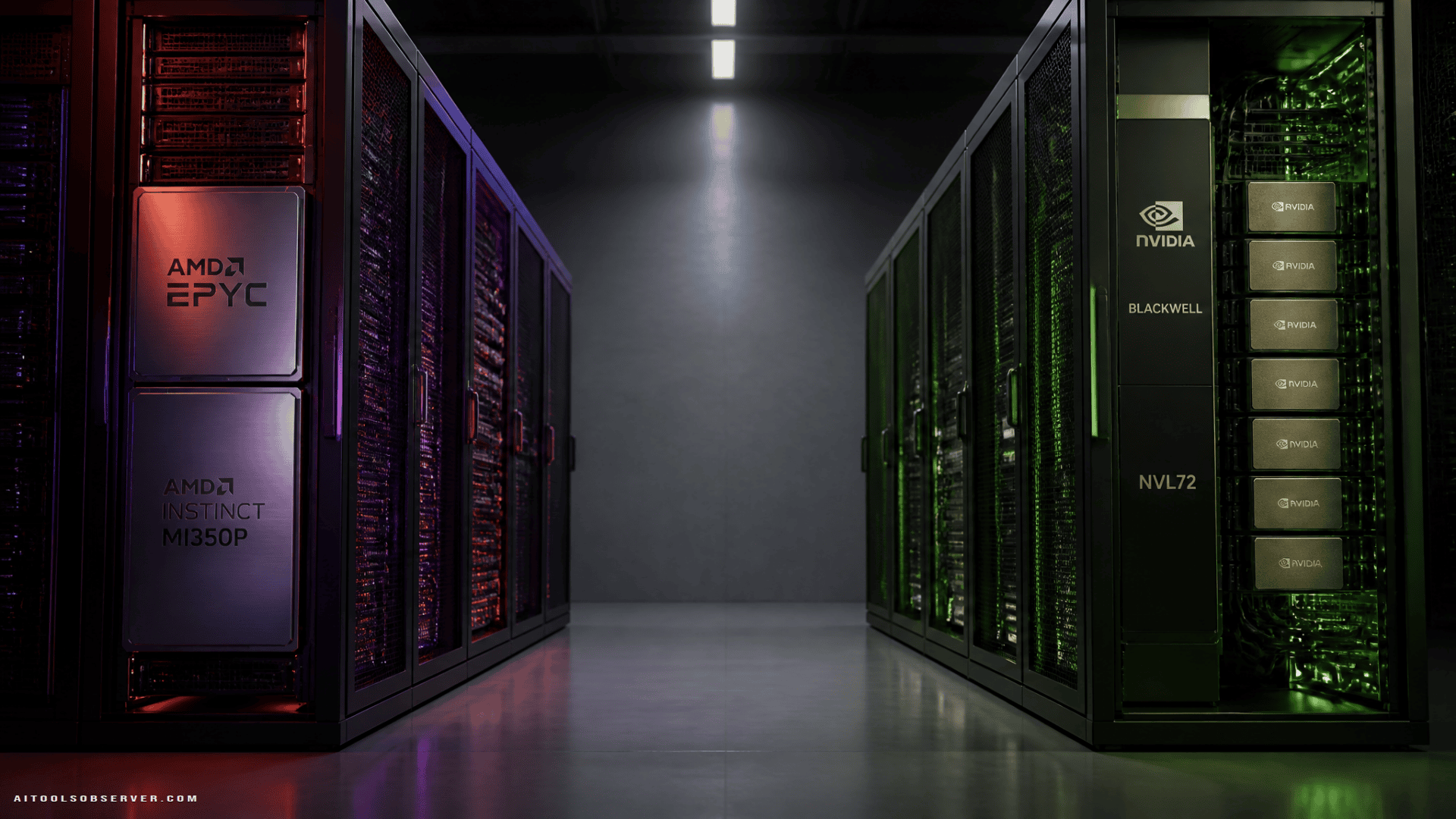
Helion is not a single fixed configuration. AMD designed it to be deployed in two primary modes: fully CPU-loaded with EPYC processors for agentic AI and orchestration workloads, or as a mixed CPU-GPU platform using Instinct MI350P accelerators for broader AI inference and training tasks.
Dan McNamara, AMD’s senior vice president and general manager of compute and enterprise AI, framed the design intent clearly: agentic AI is not one workload. Agents must run code, coordinate workflows, and adapt to shifting compute demands across enterprise applications. Helion is built around that operational reality rather than a single benchmark target.
The emphasis on open software and flexible rack design is deliberate. AMD is signaling to system integrators and hyperscalers that they can build around customer requirements without being locked into a proprietary stack.
How It Compares to Nvidia NVL72
Nvidia’s NVL72 is a mature, tightly integrated rack system built around Blackwell GPUs and NVLink fabric. It is optimized for dense GPU compute and has been shipping to hyperscalers at scale. Nvidia’s networking segment alone grew 138% year over year, which reflects how thoroughly customers are buying complete systems rather than individual components.
AMD’s Helion is positioned as the more flexible alternative. Where NVL72 prioritizes raw GPU density and Nvidia’s proprietary interconnect, Helion offers workload adaptability—the ability to shift the CPU-to-GPU ratio depending on whether the task is inference, orchestration, or mixed enterprise AI.
The tradeoff is timing. Nvidia is already shipping Vera Rubin, its next-generation platform, with production beginning in August 2026. Helion volumes are not expected to scale meaningfully until 2027. For buyers making procurement decisions now, that gap matters.
The Agentic AI Angle
The framing around agentic AI is worth taking seriously, not as marketing language but as a structural observation about where enterprise workloads are heading.
Agentic systems—AI that plans, executes multi-step tasks, and calls external tools—are more CPU-intensive than pure inference pipelines. They require fast context switching, low-latency memory access, and the ability to run orchestration logic alongside model inference. EPYC’s memory bandwidth and core density make it a credible fit for this pattern.
If enterprise AI adoption continues shifting toward agent-based architectures, AMD’s CPU-first positioning in Helion could prove well-timed for 2027 deployments, even if it arrives late relative to Nvidia’s current cycle.
Financial Context: Scale Gap Remains Real
The revenue numbers make the competitive asymmetry plain. Nvidia reported $96.2 billion in revenue in its most recent quarter, with the Data Center segment contributing $89 billion—up 117% year over year. AMD reported $11.5 billion total, with Data Center at $6.7 billion, up 107%.
AMD is growing fast. Its earnings per share rose 245% and it beat analyst estimates on both top and bottom lines. But Nvidia is operating at roughly eight times AMD’s total revenue, with a data center business that is now almost entirely AI infrastructure.
Valuation Divergence
The stock performance tells a different story. AMD is up approximately 182% year to date, trading near $608 at around 40 times forward earnings. Nvidia is up roughly 25% in the same period and trades at approximately 25 times forward earnings.
AMD carries a higher valuation multiple on a smaller revenue base, which means execution risk is elevated. If Helion yields disappoint or export restrictions tighten on Instinct GPU sales, the margin for error is narrow.
The 2027 Demand Picture
Both companies are operating inside a demand environment that is structurally large. Committed AI infrastructure buildouts from OpenAI (6 gigawatts), Meta (up to 6 GW), and Anthropic (up to 2 GW) represent multi-year procurement cycles. AMD’s management has guided for Data Center revenue to more than double year over year in 2027.
Nvidia’s move to raise its revenue opportunity to $40 billion per gigawatt with Vera Rubin—up from $25 billion with Blackwell—reflects how aggressively it is pricing the full-stack value of its systems. AMD will need Helion to demonstrate comparable system-level efficiency to compete for those gigawatt-scale contracts.
Open Software as a Differentiator
One area where AMD has a structural argument is software openness. ROCm, AMD’s GPU compute platform, has matured considerably, and the Helion design explicitly emphasizes open software as a selling point for partners building custom configurations.
For enterprises wary of deep Nvidia CUDA lock-in, this matters. It does not eliminate the ecosystem gap—CUDA’s tooling depth and developer familiarity remain significant advantages—but it gives system integrators a credible alternative path, particularly for workloads that do not require the absolute peak of GPU throughput.
What to Watch
For anyone tracking AI infrastructure decisions into 2027, three things are worth monitoring:
- Helion volume ramp: Whether AMD can move from reference design to meaningful hyperscaler deployments before Nvidia’s Vera Rubin fully saturates the market.
- Agentic workload adoption: If enterprise AI shifts toward orchestration-heavy architectures, AMD’s CPU-GPU balance in Helion becomes more relevant.
- Export policy: Any tightening of restrictions on high-end GPU exports could affect both companies, but AMD’s Instinct sales are more exposed given its smaller existing customer base.
The rack-scale AI infrastructure market is no longer a one-vendor story. AMD has a credible platform, a strong financial trajectory, and a clear architectural thesis. Whether Helion can close the gap with NVL72 in practice—not just on paper—is the question 2027 will answer.











Comments (0) No comments yet
Want to join this discussion? Login or Register.
No comments yet. Be the first to share your thoughts!