


The Problem MHS Is Designed to Solve
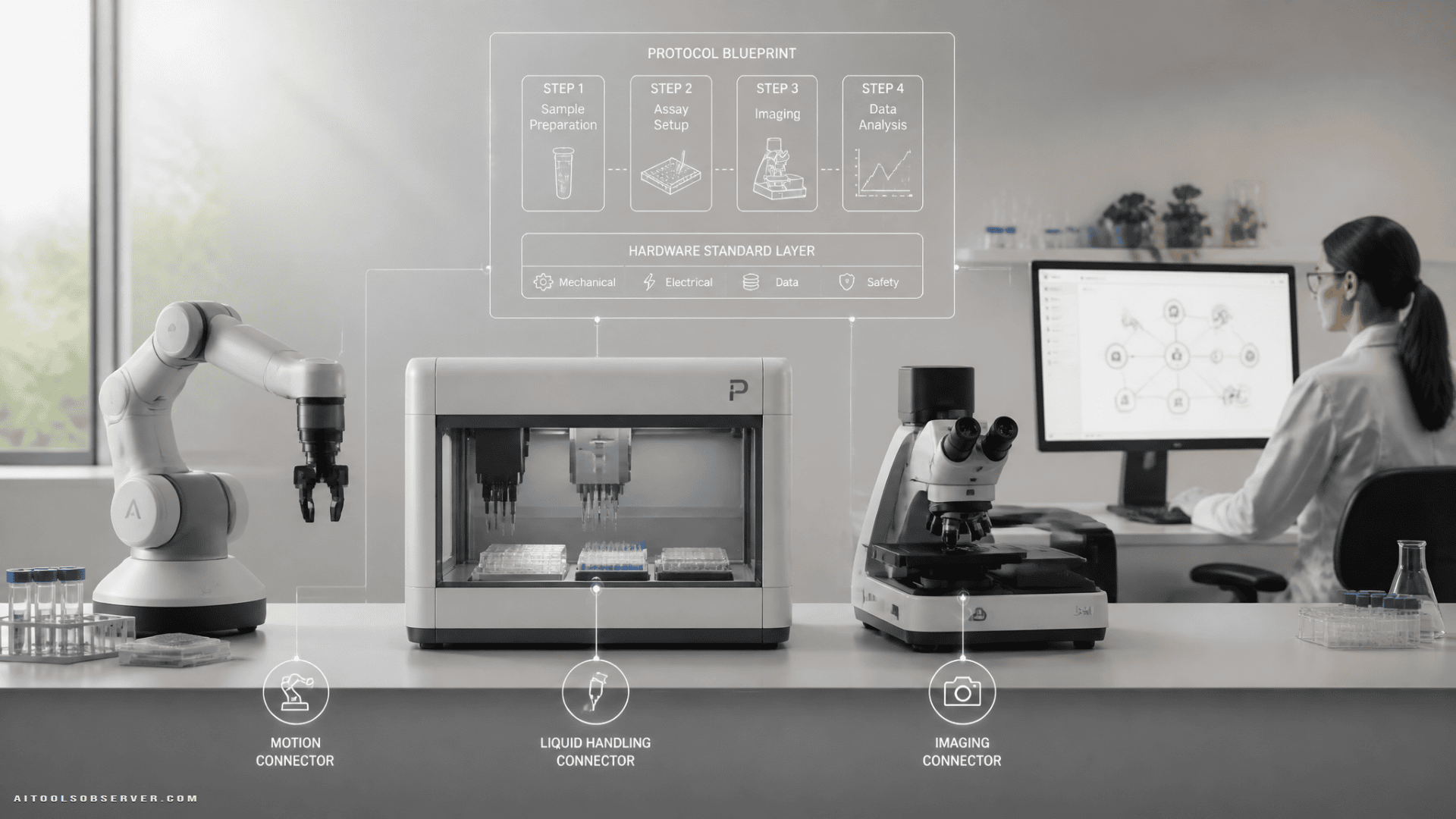
Hardware integration in labs and factories is slow and fragile. Each device typically ships with its own programming interface, and connecting multiple instruments requires specialists to build bespoke translation layers. That process routinely takes weeks or months.
MHS compresses that timeline to hours or minutes by introducing a standardized driver layer that sits between a device and an AI agent. The driver exposes a simple set of primitives — commands like “read” and “write” — that any connected device can understand. It also makes each device discoverable across a network in a standard format, eliminating the need for custom connector code between instruments.
Critically, the driver also carries structured metadata about the physical characteristics of each device: weight, safety limits, measurement ranges, and operational constraints. Much of this information has historically lived in paper manuals or as tacit knowledge held by individual engineers. MHS allows users to encode it directly in natural language, either manually or through a conversational agent that interviews them about their hardware setup.
How Agents Operate Physical Devices
Once devices are connected and described, an AI agent can control them through three mechanisms: the Model Context Protocol (MCP), the command line interface, and code files via APIs. These can be combined to orchestrate multiple instruments through a single command.
The agent receives live operating data from each device, sequences steps across instruments, monitors results, and adjusts parameters in real time. For long-running tasks or operations that require speed beyond what online reasoning allows, the agent can chain driver commands into deterministic code files — letting the hardware execute autonomously without the agent reasoning at every step.
During internal testing, Claude was observed aligning a laser by making incremental adjustments, observing results through a camera, and iterating — much as a scientist would. It then packaged that learned sequence into a reusable script, reducing a multi-step reasoning process to a single command.
Early Partners and Use Cases
Anthropic shared MHS with a range of partners during development. Several concrete examples illustrate the scope of what the standard enables:
- Genentech used MHS to automate a BCA protein assay, coordinating a liquid handler, robotic arm, and plate reader.
- University of Washington Baker and Pinglay labs built a remote instrument monitoring dashboard, an AI-supervised qPCR workflow that halts at the correct moment based on amplification curves, and a collision-free plate handoff system between a robotic arm and liquid handler.
- Doosan Robotics is testing MHS for automated quality assurance and multi-robot task coordination.
- QIAGEN demonstrated a working proof-of-concept on its QIAsymphony Connect nucleic acid purification platform, focusing on faster troubleshooting and operator guidance during instrument recovery.
- MBF Bioscience is building an MHS driver for ScanImage, the laser-scanning microscope software used in hundreds of neuroscience labs worldwide.
Hardware vendors including Tecan, Universal Robots, and Automata are adding native MHS support to their platforms. On the software side, AWS will support MHS through Strands Robots, Hugging Face is adding support in LeRobot, and Raspberry Pi is enabling MHS integration across several of its products.
Safety Is an Explicit Part of the Roadmap
Anthropic is not treating physical safety as an afterthought. The research preview is partly structured to build safety evaluations alongside launch partners before the standard is open-sourced.
One limitation is already documented: Claude’s spatial and physical reasoning has gaps that require expert oversight. During Genentech’s protein assay work, researchers had to guide Claude to recognize that foaming in samples was a physical failure requiring a physical correction — not a software bug. The model’s grounding in the physical world remains text- and image-based, which introduces real constraints when working with material processes.
Anthropic is developing a physical safety roadmap and plans to release findings from the research preview as part of open-source guidance for deploying MHS safely. MHS also does not yet support hardware that lacks a programmable interface, and the team is working with manufacturers to close that gap.
What This Means for AI Tool Adopters
For teams working in biotech, robotics, quantum computing, or advanced manufacturing, MHS represents a meaningful shift in how AI agents can be deployed in physical environments. The integration overhead that has historically made hardware-AI projects expensive and slow appears to be the primary target.
The research preview is currently limited to invited partners, with a waitlist open for broader participation. The more useful signal to watch is whether the open-source release — and the safety guidance that accompanies it — holds up under real-world deployment conditions across diverse hardware environments. That will determine whether MHS becomes infrastructure or remains a promising specification.








Comments (0) No comments yet
Want to join this discussion? Login or Register.
No comments yet. Be the first to share your thoughts!