


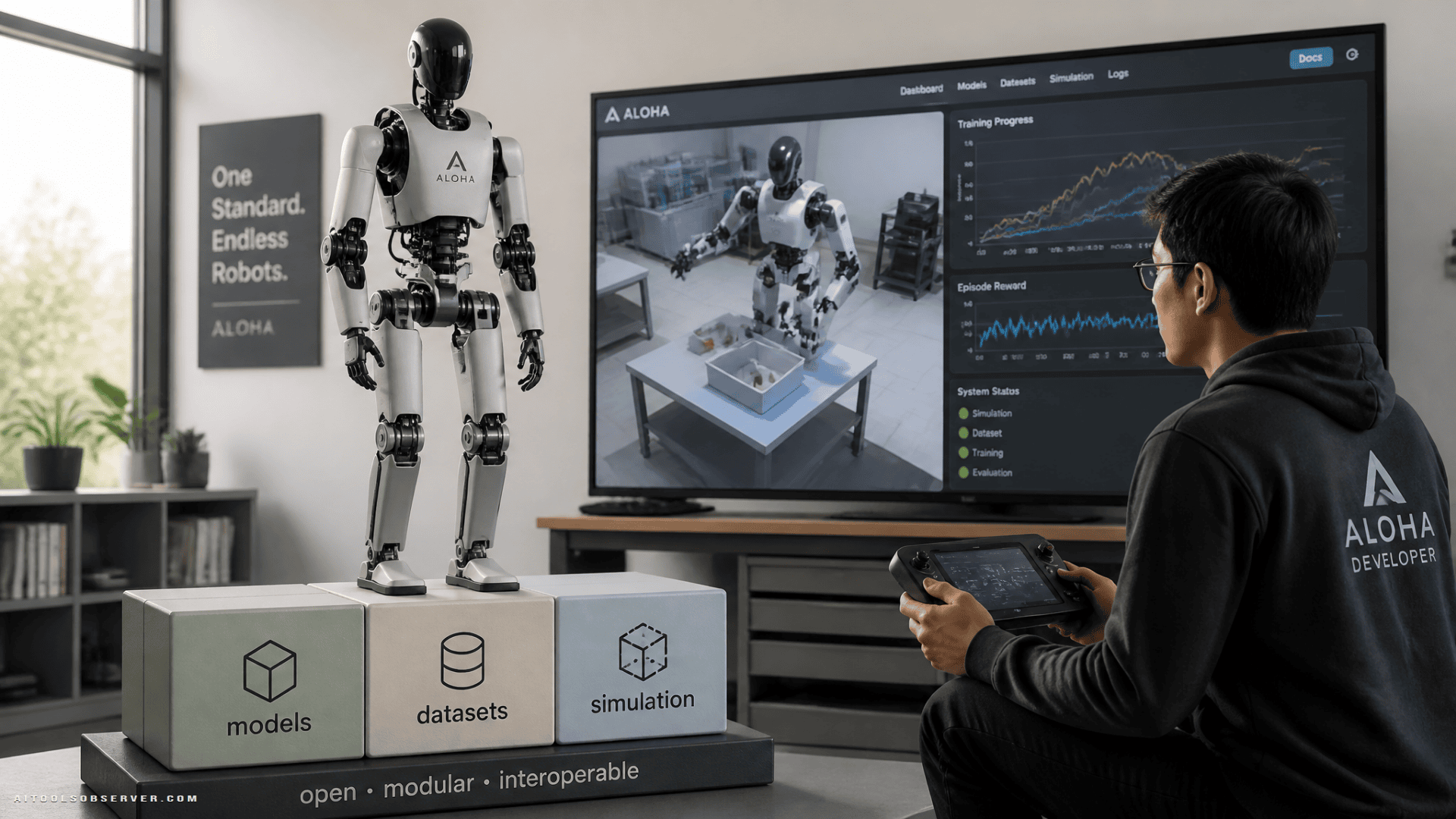
The Fragmentation Holding Robotics Back
Open-source AI has transformed software. Developers share models, datasets, and training pipelines — that’s how language models and image generators progressed so fast. Robotics never got that same treatment. The high cost of real-world data collection, simulation infrastructure, and hardware-specific tweaks kept the field siloed. Even today, most robot projects start from a near-blank slate.
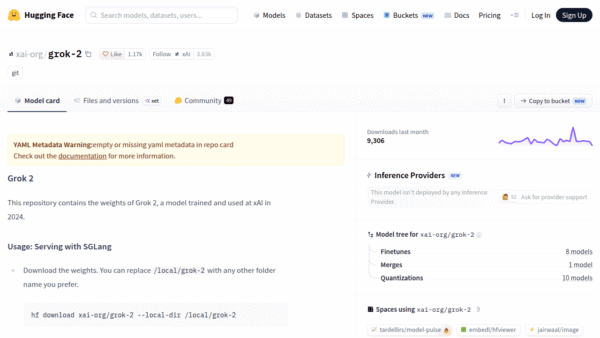
LeRobot, Hugging Face’s open-source robotics library, started to change that. It gave teams a place to train, share, and run robot policies. But something was missing: a standard stack that worked end-to-end for complex humanoid systems, not just benchtop arms. That’s where NVIDIA steps in.
Inside the LeRobot-NVIDIA Integration
NVIDIA is adding two major pieces to the LeRobot ecosystem, with a third on the way:
- Isaac GROOT 1.7 — a vision-language-action (VLA) foundation model specifically built for humanoid robots. It’s the first open, commercially viable robot foundation model from NVIDIA, designed to simplify post-training and deployment so teams can adapt it to different bodies and tasks without starting from zero.
- Isaac Teleop — an open-source framework for collecting high-quality training data through human demonstrations. Instead of painstakingly scripting every motion, developers can use standard input devices to teach robots, then share those datasets inside LeRobot.
- Cosmos 3 (planned) — a physical AI foundation model that generates synthetic robotics data. When collecting real-world data is too slow, expensive, or dangerous, Cosmos 3 generates training examples and simulates environments to keep development moving.
The integration also builds on what’s already live: a physical AI dataset with more than 350,000 real and simulated robot trajectories and 57 million grasp examples, plus support for Isaac Sim, Isaac Lab, and NVIDIA Jetson Thor on the Reachy 2 humanoid robot.
For the first time, a developer can take a humanoid robot, collect demonstration data through Teleop, fine-tune Isaac GROOT, test in simulation, and deploy on Jetson — all within the LeRobot platform.
Why Standardization Matters
Robotics has a data problem that’s worse than any other AI field. You can’t just scrape the internet for robotic movement data — it has to be physically generated, often with expensive hardware. Standardizing how that data gets collected, shared, and reused makes the next project faster and cheaper. It turns one-off experiments into cumulative progress.
For founders and AI adopters, this lowers the barrier. A startup that wants to build a warehouse robot doesn’t need to hire a full simulation team and wait six months for a custom stack. They can start with pre-trained models and community datasets, then iterate on what makes their robot unique.
NVIDIA’s move also connects its reported three-million-strong robotics developer community with Hugging Face’s 16 million AI developers. That’s not just a vanity metric — it means more eyes on shared problems, more datasets uploaded, and more pressure to keep the stack open and compatible.
The Path Ahead
This isn’t a finished product drop. Cosmos 3 is still on the roadmap, and the whole stack will need real-world stress-testing across different robot morphologies and use cases. But the direction is clear: open-source robotics is getting the same treatment that accelerated LLMs and vision models.
The practical takeaway is simple: if you’re building (or thinking about building) physical AI, watch LeRobot closely. The days of building robot software in isolation are ending, and those who learn to collaborate through shared tooling will ship faster, with less capital. NVIDIA and Hugging Face are betting that the same open-source playbook that won in software will now eat the hardware world — and they’re putting tangible tools behind that bet.





Comments (0) No comments yet
Want to join this discussion? Login or Register.
No comments yet. Be the first to share your thoughts!