


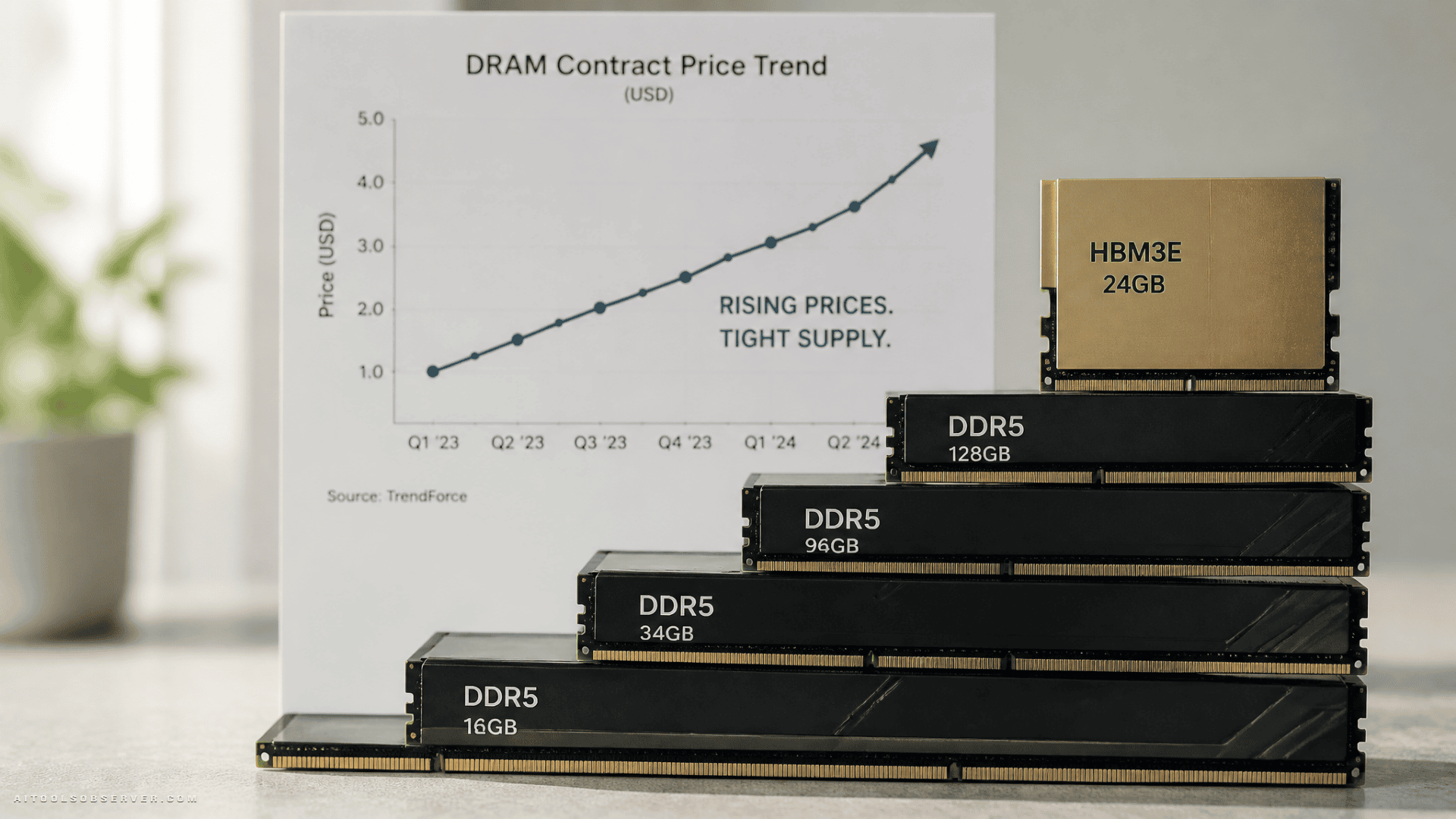
The Numbers Are Hard to Ignore
Third-party data from the Stanford DAM Project puts current DDR5 memory pricing between $11.41 and $13.28 per GB. The last time RAM sat at that price point was around 2008, when DDR2 hovered between $11.00 and $15.00 per GB.
Adjust for 2024 inflation and the picture shifts slightly — but not by much. In real terms, current DDR5 pricing maps closest to 2011, when DDR3 was around $11.85 per GB. Either way, you’re looking at a decade-plus reversal in a market that had been reliably getting cheaper every year.
For context, this is the same industry where a $99 smartphone today outperforms a $400,000 government computer from 1946 by orders of magnitude. The direction of travel in tech has always been: more power, lower cost. What’s happening in memory right now runs directly against that grain.
HBM Is the Pressure Point
The price reversal isn’t caused by a manufacturing failure or a supply chain collapse in the traditional sense. The culprit is demand — specifically, the explosive demand for High Bandwidth Memory (HBM) driven by AI infrastructure buildout.
HBM is the memory architecture used in AI accelerators and high-end GPUs. Training and running large AI models requires enormous amounts of fast, high-density memory. As AI investment has surged, so has the competition for HBM — and that pressure has rippled across the entire DRAM market.
Elon Musk put the supply-demand gap bluntly: memory output is growing around 20% per year, which would normally be considered strong growth for a mature industry. But AI demand is growing at roughly 200% per year, possibly higher. That gap is what’s driving prices up across every memory category.
It’s Not Just AI Data Centers Feeling It
The shortage isn’t contained to AI data centers and GPU clusters. Industries that depend on memory chips are already absorbing the impact:
- Graphics cards — GPU memory costs are climbing, pushing up retail prices
- Smartphones — handset manufacturers are facing tighter margins on DRAM components
- Gaming consoles — hardware refresh cycles are being complicated by memory costs
- Automobiles — modern vehicles rely heavily on embedded memory chips, and supply constraints are hitting automotive supply chains too
Even modules using chips from Chinese manufacturer CXMT — often positioned as a budget alternative — have largely tracked the pricing of modules from the dominant three players: Micron, Samsung, and SK Hynix.
Industry Leaders Are Flagging It as Unsustainable
This isn’t just analyst speculation. The chairman of SK Group, which owns memory chip giant SK Hynix, has publicly described current RAM prices as “abnormally high” and called for industry-wide action to increase supply and bring prices down.
Lemire himself offered two possible paths forward: either the industry finds ways to build AI systems that require significantly less memory, or it develops much faster and more efficient methods of producing memory at scale. He was careful to note that neither outcome is predictable right now.
That uncertainty is the uncomfortable part. The current situation is widely acknowledged as unsustainable — but nobody has a clear timeline for when or how it resolves.
What This Means If You’re Building With AI Tools
If you’re evaluating AI tools, building AI-powered products, or planning infrastructure, the memory crunch has practical implications worth tracking:
- Cloud AI costs are likely to remain elevated or increase as providers absorb higher hardware costs
- On-device AI and edge AI solutions may face component cost pressure, slowing adoption curves
- AI tool pricing from vendors running their own infrastructure could shift as memory costs feed through to operating expenses
- Hardware procurement for self-hosted AI workloads is getting more expensive, making cloud-based AI tools relatively more attractive for smaller teams
The useful takeaway here isn’t panic — it’s awareness. Memory pricing is now a real variable in AI infrastructure economics, and it’s one that most product and tool decisions haven’t fully priced in yet. Watching how the HBM supply situation develops over the next 12 to 18 months will tell you a lot about where AI tool costs are headed, especially for teams comparing GPU & compute platforms and tracking how providers scale capacity in pieces like Meta enters AI cloud race with excess GPU capacity or finance expansion in developments such as How Amazon’s $25B Bond Fuels Its Next AI Buildout.









Comments (0) No comments yet
Want to join this discussion? Login or Register.
No comments yet. Be the first to share your thoughts!