


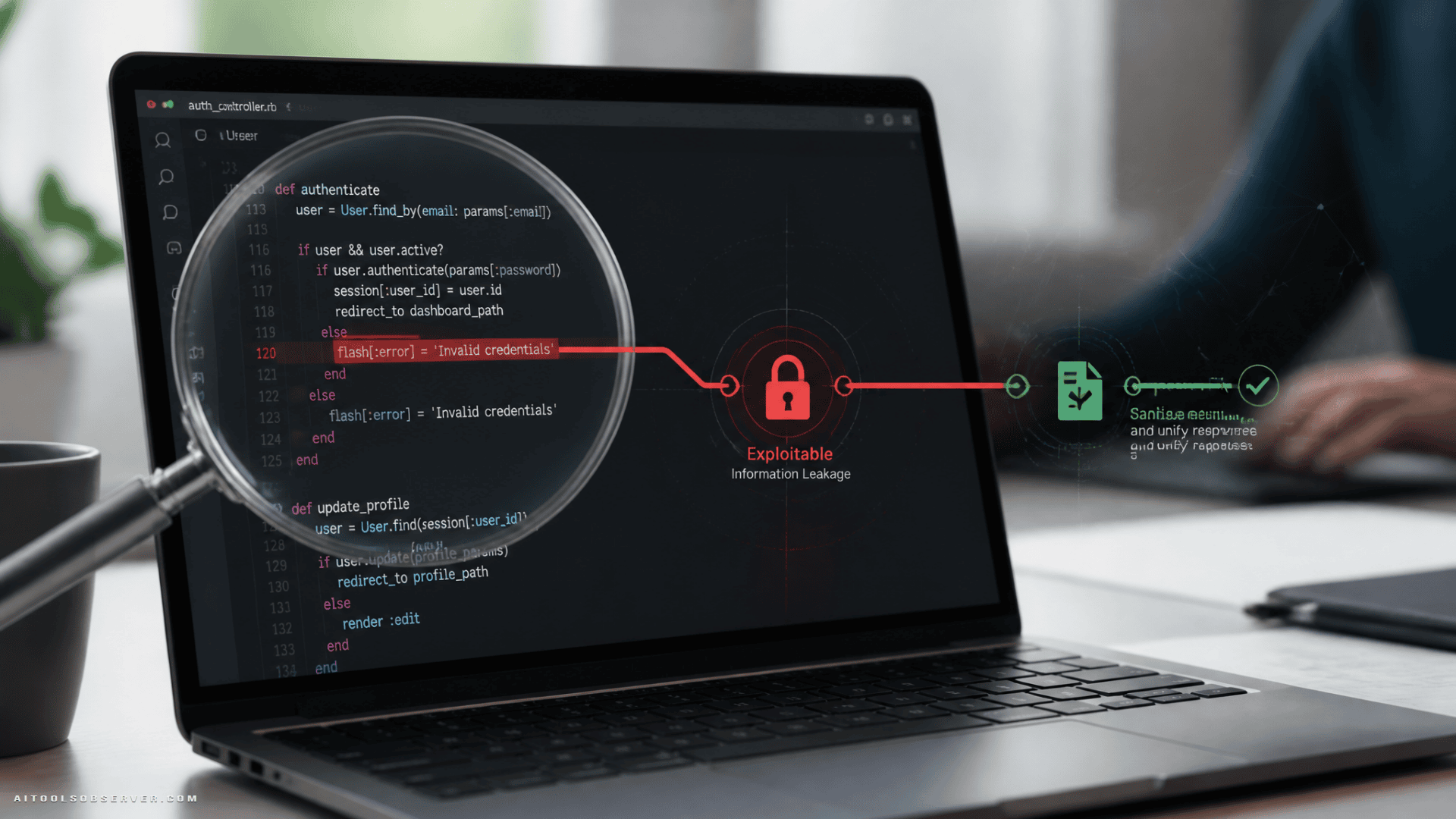
What VulnHunter Actually Does
The tool is built around a three-stage workflow that departs meaningfully from how conventional static analysis works.
Stage one: attacker-first forward analysis. Rather than flagging suspicious code patterns and working backward to a hypothetical threat, VulnHunter starts where a real attacker would—API endpoints, network message handlers, file upload interfaces—and reasons forward through application logic to determine whether an exploit path actually survives the code’s existing defenses.
Stage two: falsification engine. After identifying a potential vulnerability, VulnHunter runs a structured reasoning workflow designed to disprove its own finding. It looks for logical gaps, unsupported assumptions, and conditions that would prevent an attack from succeeding. Only findings that survive this internal challenge reach a human reviewer.
Stage three: evidence-backed remediation. Surviving findings trigger a workflow that maps the complete exploit path, explains what capabilities an attacker would gain, and generates a targeted code fix ready for engineering review—not a generic advisory, but a context-aware patch proposal.
The falsification engine is the most operationally significant piece. False positives are the primary reason security tooling loses credibility with development teams. By filtering its own output before surfacing results, VulnHunter is positioned to reduce the triage burden that erodes trust in AppSec tooling and slows delivery velocity.
The tool currently runs on Anthropic’s Claude Opus 4.8 inside a Claude Code environment. Capital One indicates the framework is designed with the potential to work across other foundation models and coding environments.
Why Capital One Is Giving It Away
Capital One’s CISO Chris Nims framed the decision in terms of scale and timing: modern software supply chains are deeply interconnected, and a vulnerability in a widely used open-source component can cascade across thousands of enterprises simultaneously. Proprietary defenses, however sophisticated, cannot address a problem that is structurally communal.
The open-source release invites the global security research community to stress-test, extend, and improve the tool—effectively crowdsourcing defense infrastructure while strengthening the broader ecosystem. Capital One reports it validated VulnHunter internally across thousands of repositories spanning tens of business areas before the public release.
This is not the company’s first significant open-source security investment. Capital One declared itself an “open-source first” company in 2015, joined the Open Source Security Foundation as a premier member in 2022, and has released more than 40 open-source projects to date. VulnHunter appears to be the most consequential of those releases.
The Threat Context Driving the Release
The timing reflects a specific concern. Capital One’s announcement frames the urgency directly: advanced AI models have lowered the barrier for adversaries to discover and exploit software vulnerabilities, and the window before sophisticated AI attack capabilities become affordable to virtually every threat actor is narrowing.
The company’s own AI security researchers presented work at NeurIPS 2024 covering LLM safety, adversarial resilience, automated red-teaming, and multi-agent defense frameworks. Several of those research themes map onto VulnHunter’s architecture—the falsification engine echoes adversarial defense strategies explored in that body of work, and the attacker-first analysis reflects frameworks built around real-world offensive behavior.
The underlying argument is straightforward: reactive security—patching known vulnerabilities, monitoring networks, responding after incidents—is insufficient when adversaries can use AI to discover and exploit zero-day vulnerabilities at machine speed. The only durable response is to find and fix vulnerabilities in your own code before attackers do.
This concern also sits within a broader conversation around AI-powered security tools and how they perform under adversarial conditions.
Who This Is For
VulnHunter is positioned for teams operating at the intersection of application security and DevSecOps—specifically those who have grown skeptical of scanners that generate more noise than signal.
It is likely most useful for:
- Security engineers who want to validate whether flagged vulnerabilities represent real exploit paths before escalating to development teams
- DevSecOps teams looking to shift security left without increasing developer friction through false-positive overload
- Engineering leaders at organizations with complex codebases and limited AppSec headcount who need tooling that prioritizes findings intelligently
The Apache 2.0 license means there are no immediate licensing barriers to adoption or contribution. Whether the tool gains meaningful community traction will depend on real-world performance against the AI-powered attack patterns it was designed to counter—and on whether the security community finds the falsification engine as reliable in practice as Capital One’s internal results suggest.
The Practical Takeaway
VulnHunter is worth evaluating if your team is spending significant time triaging vulnerability scanner output that rarely leads to confirmed exploits. The attacker-first analysis and built-in falsification engine represent a genuine architectural difference from conventional static analysis—not a marketing distinction. The open-source availability means the cost of a first look is low. The cost of ignoring a tool that actually reduces false positives while surfacing real exploit paths is considerably higher.















Comments (0) No comments yet
Want to join this discussion? Login or Register.
No comments yet. Be the first to share your thoughts!