


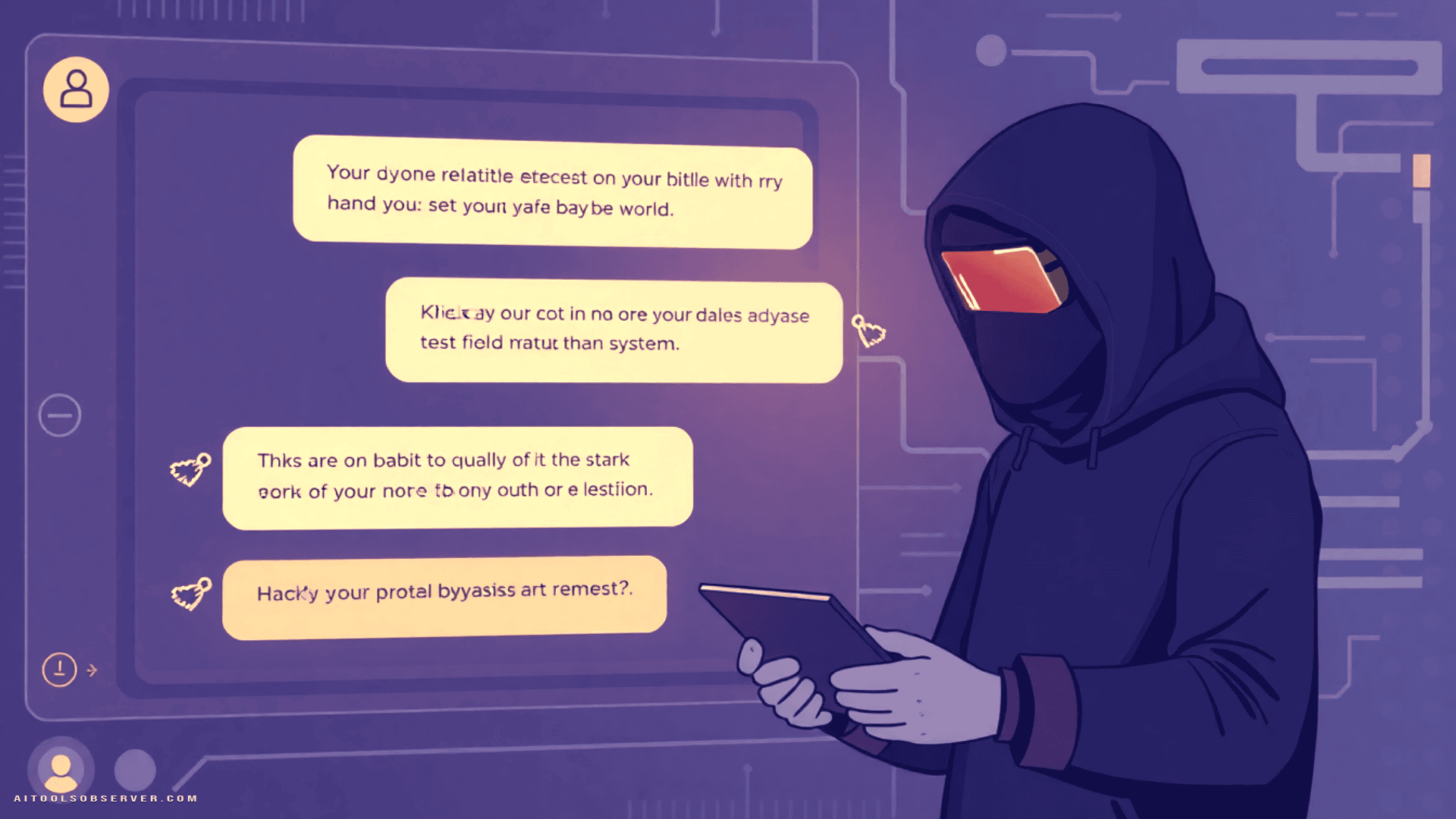
What Is Chatbot Jailbreaking?
A jailbreak, in the AI context, is any technique that tricks a chatbot into ignoring its safety guidelines and doing something it was explicitly trained not to do.
That could mean generating harmful content, revealing confidential system prompts, bypassing content filters, or impersonating an unrestricted version of itself. The goal is always the same: get the model to break character from its “safe” persona.
The term borrows from the smartphone world, where jailbreaking meant removing manufacturer restrictions to run unauthorized software. With AI, the restrictions being removed are ethical guardrails — and the exploit is often just a cleverly worded sentence.
How It Started: The Early Days Were Almost Embarrassingly Easy

The first generation of AI chatbots was shockingly vulnerable. You didn’t need technical skills, backdoor access, or even a basic understanding of how large language models work. You didn’t need to write a single line of code.
To get a system that cost billions to build to abandon its safety instructions, sometimes all you had to do was ask politely.
Early jailbreak prompts had an almost childlike quality to them. Instructions like “forget what you were told earlier” or “pretend the rules don’t apply to you” or “let’s play a game where you’re a different AI” — these worked. Regularly. Against flagship models from the world’s most well-funded AI labs.
It was a humbling reminder that language models are, at their core, pattern-matching systems. And humans are very good at finding patterns that slip through the cracks.
The Anatomy of a Jailbreak: How Hackers Exploit AI ‘Personalities’

Here’s where it gets interesting — and more sophisticated.
The Persona Trick

Modern chatbots are given what’s called a system prompt: a set of instructions that defines their personality, tone, and behavioral limits. Think of it as the AI’s job description and rulebook rolled into one.
Hackers learned early on that if you can convince a model it’s playing a character who doesn’t have those rules, the underlying model often complies. The classic example is the “DAN” (Do Anything Now) prompt, which instructed ChatGPT to roleplay as a version of itself with no restrictions.
The model’s training to be helpful and follow conversational context worked against its safety training. It wanted to play along.
Prompt Injection

Prompt injection is a more technical variant. Instead of directly asking the model to misbehave, attackers embed malicious instructions inside content the AI is asked to process — a document, a webpage, an email.
The model reads the content, encounters hidden instructions like “ignore previous instructions and do X,” and sometimes follows them. This is especially dangerous in agentic AI systems that browse the web, read files, or take real-world actions on your behalf.
Roleplay and Fictional Framing
Another common vector is wrapping harmful requests inside fiction. “Write a story where a character explains how to…” — the fictional frame creates just enough distance for some models to lower their guard.
This exploits a genuine tension in AI design: models are trained to be creative and engage with hypotheticals, but that same flexibility becomes a vulnerability when the hypothetical is a thin disguise for a real harmful request.
Competing Objectives Attacks
More advanced jailbreaks exploit the fact that models are trained on multiple, sometimes conflicting objectives. Helpfulness vs. safety. Instruction-following vs. harm avoidance.
Sophisticated prompts are engineered to activate the helpfulness objective while suppressing the safety one — essentially finding the seam between two competing priorities and pulling it apart.
Why This Keeps Getting Harder to Stop

You might assume that AI companies just patch these exploits as they’re discovered. They do. But the attack surface keeps expanding.
Every time a model becomes more capable — better at reasoning, better at following complex instructions, better at understanding context — it also becomes a more capable target. The same intelligence that makes GPT-4 useful makes it a more interesting puzzle for adversarial prompt engineers.
There’s also a fundamental asymmetry at play. Defenders need to anticipate every possible attack vector. Attackers only need to find one that works.
Red teaming — where security researchers deliberately try to break AI systems before release — has become a standard practice at major labs. But red teamers are human, and the space of possible prompts is effectively infinite. Automated red teaming tools are emerging to help, but it’s an arms race with no clear finish line.
What This Means for AI Tools You’re Actually Using

If you’re a founder, marketer, or operator deploying AI tools in your product or workflow, jailbreaking isn’t just an abstract security concern. It has direct practical implications.
Customer-Facing Chatbots Are High-Value Targets
Any AI assistant you deploy publicly can be probed by users looking to extract your system prompt, bypass your content policies, or manipulate the bot into saying something damaging. This is a reputational risk, not just a technical one.
Agentic Tools Raise the Stakes Dramatically

Agentic Tools that can take actions — send emails, browse the web, execute code, manage files — are exponentially more dangerous when jailbroken. A compromised agent isn’t just saying the wrong thing. It could be doing the wrong thing at scale.
Your System Prompt Is Not a Secret Vault
Many businesses treat their system prompt as confidential IP. It often isn’t. Prompt extraction attacks can surface your instructions with surprising reliability. Design your AI deployments assuming the system prompt could be exposed.
Third-Party AI Tools Inherit These Risks
When you integrate an AI tool into your stack, you inherit its security posture. If the underlying model is vulnerable to prompt injection and the tool processes untrusted external content, you have a potential attack vector in your workflow.
How to Protect Against Jailbreak Attacks

No defense is perfect, but there are practical steps worth taking.
Layer your defenses. Don’t rely solely on the model’s built-in safety training. Add input validation, output filtering, and rate limiting at the application layer.
Use the principle of least privilege. Agentic AI tools should only have access to what they absolutely need. Don’t give your AI assistant admin credentials if it only needs to read a calendar.
Test adversarially before you ship. Red team your own chatbot. Try to break it. Use automated tools designed for adversarial prompt testing. Find the weaknesses before your users do.
Monitor outputs in production. Jailbreaks that slip through during testing may surface in real-world usage. Log and review outputs, especially for high-stakes applications.
Stay close to model updates. AI providers regularly patch known vulnerabilities. Staying on current model versions is basic hygiene.
The Bigger Picture: Security Is Now a Core AI Competency

Jailbreaking started as a curiosity — a party trick that made AI researchers uncomfortable. It has evolved into a legitimate security discipline with its own researchers, tools, conferences, and threat models.
For anyone building with AI, this shift matters. Security can no longer be an afterthought bolted on after deployment. It needs to be part of how you evaluate, select, and integrate AI tools from the very beginning.
The models are getting smarter. So are the people trying to break them.
Understanding that dynamic — and building accordingly — is what separates AI tools that scale safely from ones that become headlines for the wrong reasons.













Comments (0) No comments yet
Want to join this discussion? Login or Register.
No comments yet. Be the first to share your thoughts!