


What changed
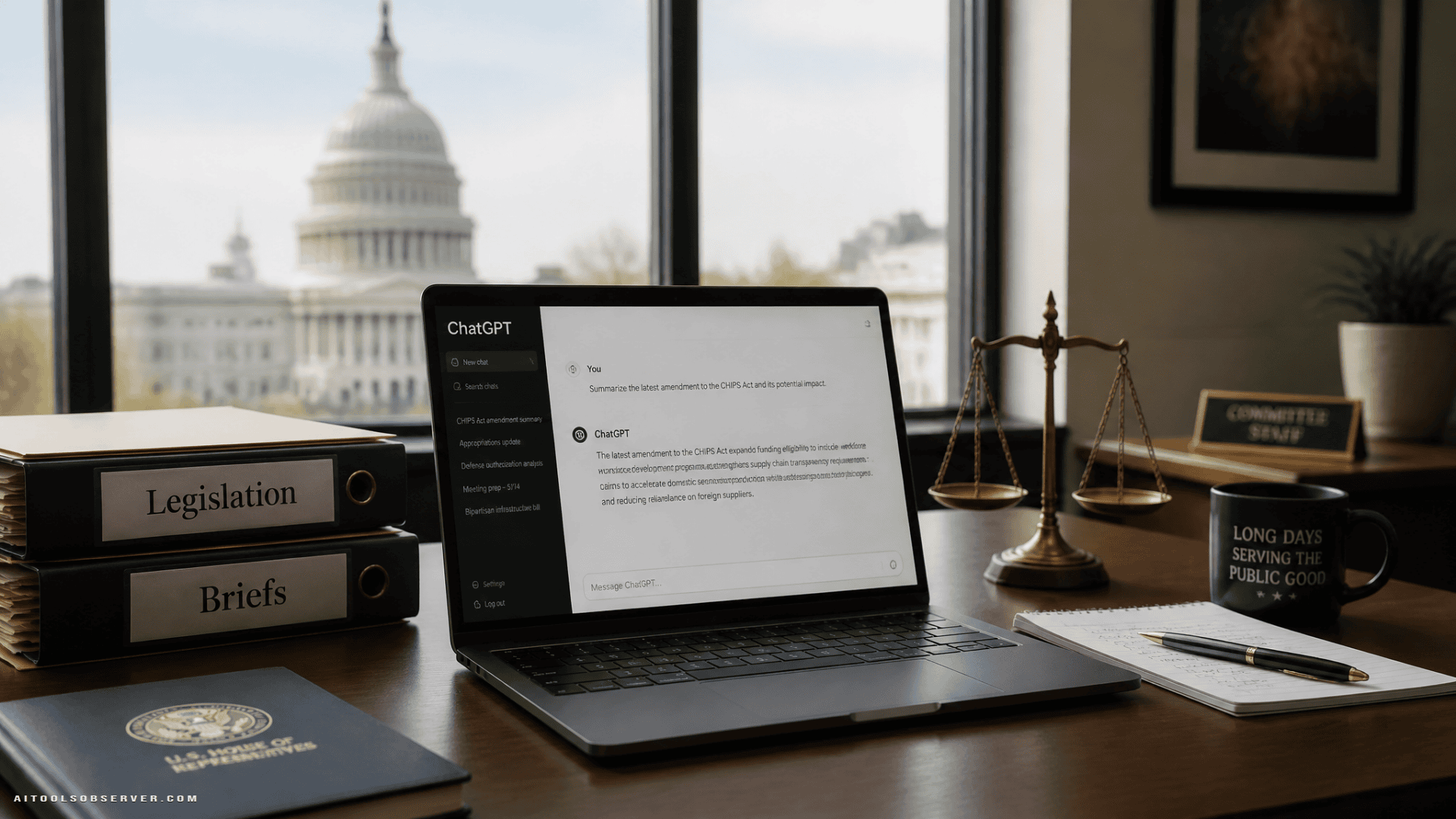
Based on the reported House disbursement analysis, ChatGPT accounted for about 88% of identifiable AI tool spending during the year ending March 31. Claude showed up too, but at a much smaller level.
The spending snapshot is limited, but still revealing:
- ChatGPT represented roughly $100,580 in identifiable House AI spending
- Claude accounted for about $13,160
- ChatGPT purchases appeared in at least 71 House member offices
- Democratic offices spent more than three times as much as Republican offices on identifiable AI tools
That does not mean Congress runs on ChatGPT alone. It means ChatGPT is the most visible product in the records people can actually inspect.
Why this matters
A software subscription in a congressional office is not just a software subscription. It shapes how staff research bills, prepare memos, respond to constituents, and process the daily avalanche of information.
That matters because lawmakers are debating how AI should be regulated, what guardrails should exist, and which vendors should be trusted in government settings. If one product becomes the de facto workflow layer early, it may influence both familiarity and policy instincts.
In plain English: the tool people use to summarize the problem can affect how they define the problem.
What Congress seems to be using AI for
The available reporting suggests a very practical set of use cases. No sci-fi. Mostly office survival.
Staff are reportedly using AI to help with:
- legislative summaries
- briefing memos
- hearing prep
- constituent communications
- policy research
- social post drafting
- sorting and organizing incoming material
That makes sense. Congressional offices run on compressed time, limited staff, and too much reading. AI slots neatly into that pain point.
One lawmaker described using ChatGPT to turn legislative and constituent materials into searchable internal resources, then generate briefing memos from that pool. The pitch is simple: fewer hours spent assembling context, more hours available for actual decision-making.
The catch: the numbers are real, but incomplete
This is not a complete map of AI adoption in Congress. It’s more like a flashlight beam.
The visible spending data does not fully capture:
- free-tier use
- AI bundled into broader software contracts
- many reimbursement-based purchases that don’t name the tool
- most Senate usage
- internal enterprise deployments that may not appear as obvious vendor line items
So the safest read is not “this is all Congress uses.” The safer read is “this is what public records make easiest to see.”
That distinction matters. Public procurement data often tells the truth, just not the whole truth.
Why ChatGPT likely got there first
Early advantage matters in enterprise software. It matters even more in institutional environments where habits form fast and switching is annoying.
ChatGPT appears to have benefited from exactly that. Early experimentation in the House, training exposure, and simple name recognition likely helped it become the product many offices knew first.
There’s also a branding reality here: for a while, “ChatGPT” was shorthand for “AI” in the same way people casually use brand names for whole categories. Once that happens, procurement inertia usually follows.
Not forever. But long enough to matter.
The awkward politics
One of the more interesting details is partisan asymmetry. Democratic offices accounted for much more identifiable AI spending than Republican offices, even though many Democrats have been among the louder voices raising concerns about AI’s effects on labor, privacy, civil rights, elections, and concentrated corporate power.
That’s not necessarily hypocrisy. It may just be modern governance in one sentence: regulate the thing, but also use the thing because your staff is drowning.
Still, it creates an odd visual. The party more publicly worried about AI risk also appears more active in visible AI purchasing.
Regulation gets messier when lawmakers are also users
This is where the story stops being about subscriptions and starts being about influence.
OpenAI, Anthropic, Google, Microsoft, and others are not just competing for revenue. They’re competing for institutional familiarity inside Washington. The vendor that becomes normal inside congressional workflows may gain a subtle advantage when lawmakers think about safety, usefulness, procurement standards, and oversight.
That does not mean policy is being written by whichever chatbot has the most logins. But it does mean product exposure can shape what feels credible, useful, or risky.
If lawmakers mostly experience one model, they may regulate the category through the lens of that model’s strengths and flaws, which ties directly to broader questions of governance.
Why model choice matters
There’s a practical governance issue here: if public institutions default to one vendor too early, they may lock in assumptions before they’ve done enough comparison.
Different models can behave differently on:
- summarization style
- policy analysis support
- instruction-following
- safety restrictions
- enterprise controls
- suitability for sensitive workflows
For Congress, that makes vendor diversity more than a procurement preference. It’s part of regulatory literacy.
If lawmakers are going to oversee AI, they probably need enough hands-on exposure to understand that “AI” is not one thing wearing different logos.
The real lesson for AI buyers
This story is about Congress, but the buying pattern is familiar everywhere.
One tool gets there first. It becomes the default. Teams build habits around it. Competitors arrive later with different tradeoffs, but now they have to overcome familiarity, not just feature gaps.
For founders, operators, and public-sector buyers, the takeaway is simple:
- early adoption shapes standards
- visible usage shapes trust
- procurement choices can become policy signals
So if you’re evaluating AI tools, don’t just ask which one is popular. Ask which one is becoming embedded, what work it is trusted to do, and whether your team has compared real alternatives.
Congress appears to be learning that in public. Everyone else can learn it a little cheaper.










Comments (0) No comments yet
Want to join this discussion? Login or Register.
No comments yet. Be the first to share your thoughts!