


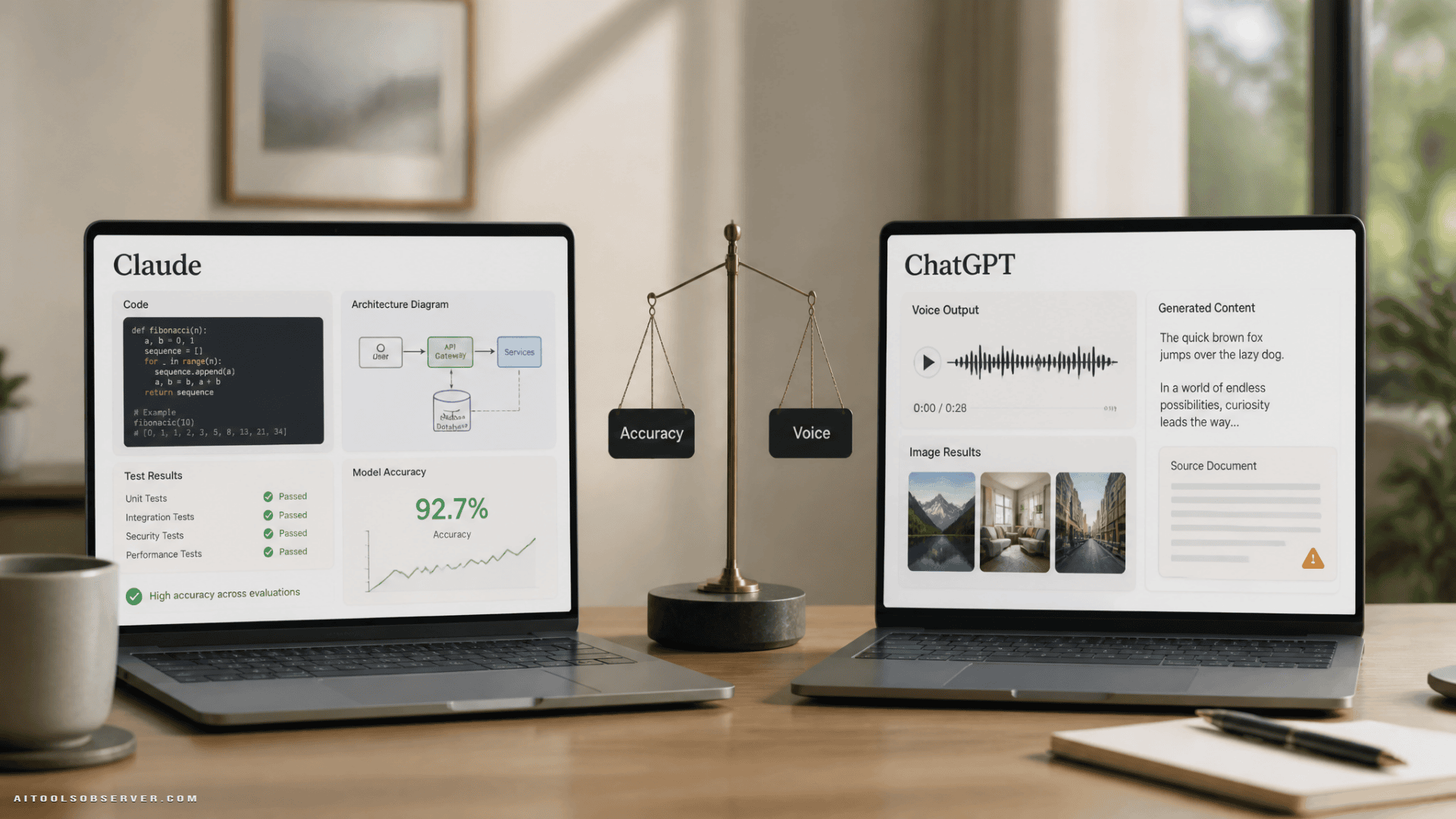
Accuracy: Claude Has the Edge, But It Depends on the Model
Measuring accuracy in large language models isn’t straightforward. The model tier you’re using matters as much as the platform itself.
At the flagship level — Claude Fable 5 and GPT-5.6 Sol — Claude scores marginally higher on the AA-Omniscience Accuracy benchmark: 61% versus 59%. In day-to-day use, you won’t notice that gap.
Where the difference becomes meaningful is in the mid-tier models, which most users rely on for everyday tasks. Claude Sonnet 5 scores 38% on the same benchmark, while ChatGPT 5.6 Terra scores 46%. At this level, ChatGPT’s mid-tier model pulls ahead on raw accuracy.
Hallucination Rates Tell a Different Story
Accuracy benchmarks only tell part of the story. Hallucination rates — how often a model confidently makes something up instead of admitting it doesn’t know — are arguably more important for professional use.
Here, Claude has a significant advantage across both model tiers:
- Flagship models: Claude Fable 5 scores 55% hallucination rate vs. GPT-5.6 Sol at 89%
- Mid-tier models: Claude Sonnet 5 scores 37% vs. ChatGPT 5.6 Terra at 85%
That’s not a marginal gap. If you’re using AI for research, client-facing work, or any task where fabricated information causes real problems, Claude’s lower hallucination rate is a meaningful advantage.
Coding and Work Features: Claude Cowork vs. ChatGPT Codex
Both platforms have invested heavily in work-focused features, but the implementations differ in ways that matter depending on your workflow. For a broader look at coding-focused tools, see Claude Code vs Copilot vs Gemini.
Claude’s Approach to Work
Claude Cowork, launched in January 2026, handles knowledge-based tasks autonomously — including file organization. It supports skills, which are instruction bundles you can invoke mid-conversation with a forward slash command. These skills work across Claude’s chat, Cowork, and Claude Code environments.
Claude Artifacts is another standout feature. It renders code snippets, single-page HTML sites, interactive React components, and diagrams instantly. Artifacts can pull live data through connected apps and MCP connectors, and you can share or publish them directly to the web. These kinds of features matter for teams building AI-assisted workflows.
ChatGPT’s Approach to Work
ChatGPT has a comparable skills feature, but with tighter restrictions. Skills are limited to individual users in Codex and the API — not regular chats — unless you’re on a Business or Enterprise plan.
ChatGPT’s equivalent of Artifacts is called Sites, but it’s positioned for internal business use, only available in Codex, and cannot pull live data. For teams that need dynamic, shareable outputs, that’s a notable limitation.
Where ChatGPT genuinely outperforms Claude is in voice and visual interaction. The voice mode sounds more natural, handles interruptions cleanly, and supports live video input through Advanced Voice Mode — useful for real-time troubleshooting. ChatGPT also generates photorealistic images, while Claude is limited to diagrams, charts, and interactive visuals built with HTML and SVG.
Is ChatGPT Getting Worse?
This is a question a lot of users are asking, and the short answer is: in some measurable ways, yes.
The hallucination rate comparison is telling. GPT-4.0 had a hallucination rate of 38%. GPT-5.6 Sol sits at 89%. Newer models score better on some benchmarks but appear to have regressed on reliability.
There are also experience-level changes worth noting:
- OpenAI introduced ads in the free and ChatGPT Go tiers
- Anthropic improved Claude’s free tier and added features without ads
- Tone and behavior shifts between model updates have been jarring for some users
OpenAI’s CEO previously described ads as a “last resort.” The fact that they’ve appeared suggests financial pressure that could continue to shape the free-tier experience.
There’s also a reputational factor at play. In February 2026, Anthropic’s deal with the US Department of Defense fell through after the company refused to allow its models to be used for mass domestic surveillance or fully autonomous weapons. OpenAI stepped in to fill that contract. The fallout contributed to a visible shift in user sentiment, with many moving to Claude based on perceived ethical positioning.
Pricing: Similar Tiers, Different Value
Both platforms use a comparable pricing structure, but there are a few differences worth knowing.
Claude pricing:
- Free: Sonnet 5, no ads
- Pro: $20/month ($17/month billed annually)
- Max 5x: $100/month — 5x Pro usage limits
- Max 20x: $200/month — 20x Pro usage limits
- Paid plans include flagship model access and Claude Code
ChatGPT pricing:
- Free: GPT-5.5, with ads
- $8/month: Increased limits, still shows ads
- $20/month, $100/month, $200/month plans mirror Claude’s structure
- Codex access available but usage limits can be restrictive
The practical difference: Claude’s free tier is cleaner and more capable for most users. ChatGPT’s $8/month plan offers a middle ground, but the ad-supported experience is a real friction point.
Who Uses These Tools — and How
Usage patterns reveal something about each platform’s strengths.
According to Anthropic’s Economic Index from March 2026, 45% of Claude conversations are work-related and 42% are personal. OpenAI’s data shows roughly 70% of ChatGPT usage is non-work-related.
That’s not just a demographic curiosity. It suggests Claude’s feature set — Cowork, Artifacts, skills across environments — is resonating with professional users. ChatGPT’s broader consumer base aligns with its strengths in voice, image generation, and general-purpose interaction, especially for more productivity-focused use cases.
The Bottom Line
Neither tool wins across every dimension. But the choice becomes clearer once you know what you’re optimizing for.
Choose Claude if:
- Hallucination rate and factual reliability matter for your work
- You need a capable workspace tool with live data, shareable artifacts, and flexible skills
- You prefer a cleaner free tier without ads
- You’re doing research, writing, or knowledge work where fabricated outputs are costly
Choose ChatGPT if:
- Voice interaction is a core part of your workflow
- You need photorealistic image generation
- You’re on a team with Business or Enterprise access that unlocks the full feature set
- Your use case is more casual or consumer-oriented
For most professional and productivity-focused users, Claude’s lower hallucination rate and stronger workspace integration make it the more reliable daily driver in 2026. ChatGPT remains the better choice for voice-first workflows and image generation — and it still has a larger ecosystem of integrations and a more established consumer presence.
Pick based on your actual workflow, not brand familiarity.







Comments (0) No comments yet
Want to join this discussion? Login or Register.
No comments yet. Be the first to share your thoughts!