


What MARIOW Actually Is
The system comes from a project called MARIOW — Maritime AI-Guided and Remote Operated Welding — led by the German Research Center for Artificial Intelligence (DFKI) in Bremen, with contributions from Fraunhofer IGD, TH Köln’s materials institute, and a firm called AMT GmbH. Funding came from Germany’s Federal Ministry for Economic Affairs and Energy.
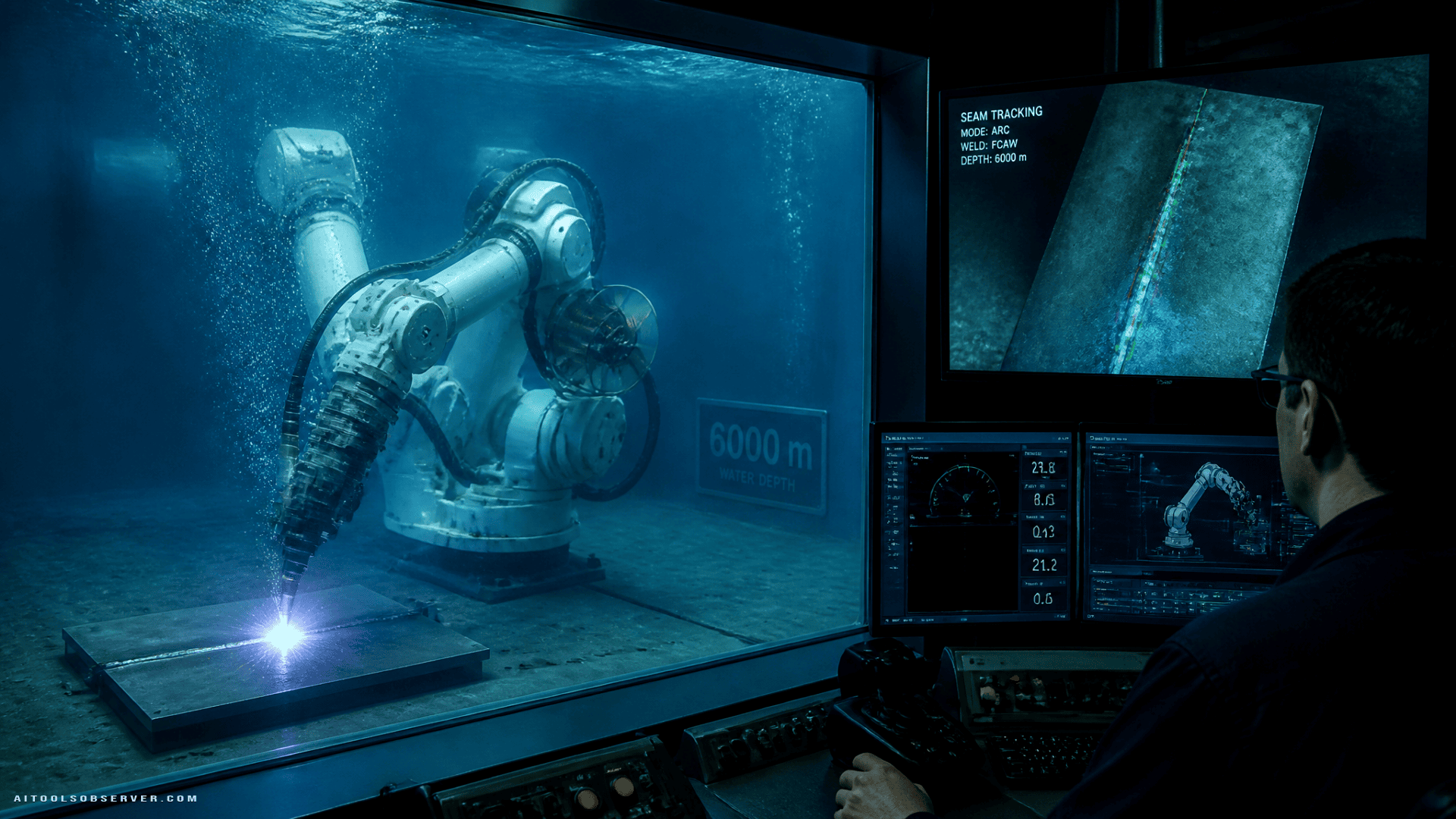
The sequence works like this: a stereo camera mounted next to the torch feeds images to an AI trained to identify a weld joint, locate its start and end points, and calculate a path. A six-axis robotic arm then runs the torch along that path without a human guiding it in real time.
Key specifications:
- Depth rating: 6,000 m (approximately 20,000 feet) — the arm’s design envelope, not its current operating depth
- Reach: 2 meters, with decentralized joint control for repeatable positioning
- Welding process: Continuous-wire UW-FCAW (underwater flux-cored arc welding), replacing stick electrodes that burn out every few centimeters
- Carrier platform: Either a seabed crawler called SherpaUW or a wall-mounted rig for vertical structures like harbor sheet piles
- Test environment: DFKI’s Black Basin saltwater test tank in Bremen
Why the Welding Process Matters More Than the AI
The AI seam detection is useful, but the more fundamental problem was the welding method itself.
Traditional wet welding uses consumable stick electrodes. A diver can swap them manually. A robot stopping every few centimeters to reload a new electrode is operationally useless. The consortium solved this by developing a continuous-wire flux-cored arc welding process adapted for the underwater environment. The wire feeds without interruption, which is what allows the machine to lay a long, even seam autonomously.
In tank testing, the system ran lap joints and fillet welds — the standard joins found on piers, bridge footings, and offshore platform legs. The DFKI project manager described the result as “not only feasible, but commercially promising,” which is a measured claim from an engineer who ran the tests.
What the Tank Test Does and Doesn’t Prove
The demonstration happened in a controlled saltwater basin, not on an actual harbor wall or offshore structure. That distinction matters.
Open water introduces currents that push the arm off path, wave action that moves the topside carrier, and pressure loads on every seal at depth. The team also describes the system as semi-autonomous rather than fully hands-off — a human is still in the loop for supervision and intervention.
A planned next iteration adds a laser for slag removal after welding. That capability is not yet integrated.
So the honest read is: the process works in a lab setting, the engineering path to open water is defined, and the hard problems — environmental disturbance, seal integrity at depth, full autonomy — are still ahead.
Where This Fits in the Broader Seabed Automation Picture
Robots have been watching subsea infrastructure for years. Inspection-class ROVs and autonomous underwater vehicles already patrol pipelines and cables. What MARIOW is attempting is different: not observation, but physical repair.
If the system reaches operational deployment, it would address two real pressures simultaneously. First, the shortage of qualified commercial divers — demand for subsea maintenance work runs well past the available supply of trained personnel. Second, the fatality risk — commercial diving has historically run at a significantly elevated rate compared to most industrial trades, and wet welding sits at the most hazardous end of that work.
Mechanized subsea welding is not entirely new. Dry hyperbaric welding inside sealed chambers has existed for decades, and pipeline tie-in systems in oil and gas have used mechanized rigs for some time. DFKI’s claim is more specific: a system capable of wet welding with AI-guided seam detection, operating without a diver present.
The Practical Takeaway
MARIOW is a credible prototype with a clear engineering rationale, not a concept render. The 6,000 m depth rating signals serious design intent, even if the system has not welded anywhere near that depth yet.
The gap between a working tank demonstration and a deployable offshore tool is real and not trivial to close. But the underlying problem — dangerous, skilled labor that is in short supply and difficult to scale — is exactly the kind of problem that tends to pull robotic solutions from prototype to production. Watch for open-water trials as the next meaningful milestone.


Comments (0) No comments yet
Want to join this discussion? Login or Register.
No comments yet. Be the first to share your thoughts!