


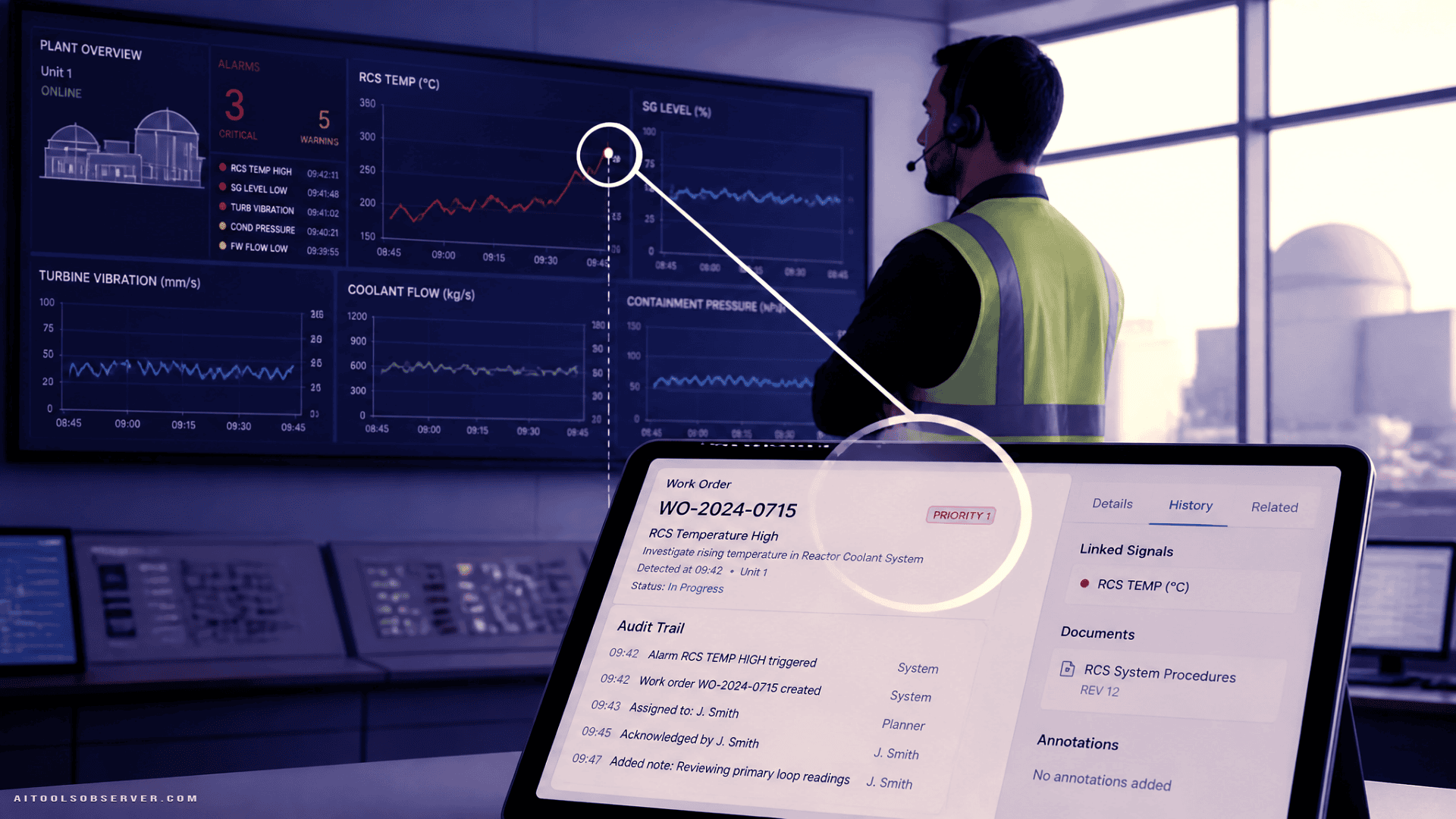
What Equipment AI Does
Equipment AI connects sensor data, work order history, operator logs, condition reports, procedures, design documents, and maintenance guidance into a single AI-powered workflow. The goal is to give engineers a complete diagnostic picture at the moment they need it—not a fragment pulled from one system.
Most industrial AI tools operate on either time-series sensor data or unstructured maintenance records. Equipment AI is positioned to reason across both simultaneously, which is a meaningful architectural distinction in environments where the context behind an alarm often lives in a condition report written years ago.
The platform integrates with systems nuclear teams already use:
- Plant historian (PI) data for real-time sensor trends
- Work order systems such as Maximo and SAP
- CAP/condition report platforms for operational history
The Problem It Addresses
Two pressures are converging in the nuclear sector. The first is alarm fatigue—the steady accumulation of low-level notifications that makes it genuinely difficult to distinguish a nuisance alarm from an early equipment failure signal. The second is workforce transition: as experienced engineers retire, the institutional knowledge they carry does not automatically transfer to the next generation.
Equipment AI is designed to address both at once. By surfacing decades of plant-specific documentation alongside live sensor data, it attempts to encode engineering judgment into the diagnostic workflow rather than leaving it locked in individual expertise.
Compliance and Traceability
Nuclear operations carry strict audit and regulatory requirements. Equipment AI is built with traceability, source-grounded outputs, and audit-trail functionality as core design requirements—not afterthoughts. Nuclearn describes its platforms as Part 810-compliant and designed for on-premise deployment, which aligns with the security posture most nuclear utilities require.
This is a practical differentiator. A general-purpose AI tool that cannot demonstrate where its conclusions came from is not a viable option in a regulated nuclear environment. Source-grounded workflows, where every output is traceable to a specific document or data point, are a baseline requirement here.
Availability and Current Deployment
Equipment AI is already live at several nuclear plants, with reported improvements in alarm response time and diagnosis speed. It is available for immediate purchase, and Nuclearn is offering demos through its product page.
Nuclearn was founded in 2021 and currently supports utilities across the U.S., Canada, and the U.K., with deployments at dozens of reactors. Equipment AI joins an existing product line that includes AtomAssist, CAP AI, Engineering AI, and Performance Improvement AI.
Who This Is For
Equipment AI is narrowly scoped by design. It is not a general industrial monitoring tool adapted for nuclear use—it is built specifically for nuclear plant operations teams dealing with real-time alarm management and equipment diagnostics. That specificity is both its strength and its natural boundary.
For utilities evaluating AI tools in this space, the relevant questions are practical: How does it integrate with existing historian and CMMS infrastructure? What does the audit trail actually look like under regulatory scrutiny? And how does it handle the edge cases where sensor data and documentation tell conflicting stories?
Those are the questions worth bringing to a demo.




Comments (0) No comments yet
Want to join this discussion? Login or Register.
No comments yet. Be the first to share your thoughts!