



The Real Problem With Traditional Test Automation
Browse any QA forum on Reddit and you’ll find the same recurring question: Which automation tool is less flaky?
That’s the wrong question.
The tool isn’t the problem. The underlying approach is. Traditional frameworks are brittle by design — they rely on static selectors that break the moment your application evolves. And modern applications evolve constantly.
Microservices, continuous deployment pipelines, cross-platform compatibility, and AI-powered features have made today’s software dramatically more complex than it was five years ago. Manual testing can’t keep pace. And legacy automation scripts fail too often to be trusted.
Something had to give.
Why Generative AI Is the Logical Next Step for QA
Generative AI doesn’t just automate — it understands.
Instead of mapping rigid selectors to UI elements, generative AI tools interpret context. They read natural language descriptions, infer intent, and generate test cases that reflect real user behavior. When the application changes, they adapt rather than break.
This matters enormously for QA teams under pressure. You no longer need a senior automation engineer to write every test script. Manual testers, business analysts, and product managers can now contribute directly to test coverage — in plain English.
The accessibility shift alone is a game-changer. But the speed and reliability improvements are what will make generative AI the default approach by 2026.
How Generative AI Tools Actually Work in Software Testing

Understanding the mechanics helps you evaluate tools more effectively. Here’s what’s happening under the hood.
Test Case Generation From Natural Language
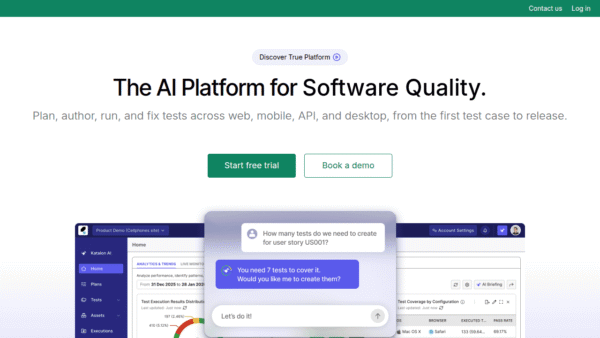
Describe a scenario — Test login with valid and invalid credentials on mobile — and the AI generates detailed test cases, including every step and expected outcome. No spec document required. No back-and-forth with developers.
No-Code Script Generation
Many tools let you write tests in plain English and then convert those instructions into executable automation scripts. These scripts run across web, mobile, and desktop without requiring you to touch a line of code.
Self-Healing Tests
This is the feature that directly solves the flakiness problem. When a UI element changes — a button shifts position, a label gets renamed — AI detects the change and updates the test script automatically. Your suite stays green without manual intervention.
Synthetic Test Data Generation
AI creates realistic test data that mimics real user behavior while staying fully compliant with privacy regulations. You can test edge cases and high-volume scenarios without ever touching actual customer data.
Intelligent Failure Analysis
After a test run, AI doesn’t just report pass or fail. It analyzes root causes, identifies patterns in failures, and suggests specific improvements. Your team spends less time debugging and more time building.
The Use Cases That Will Drive Adoption

Not every QA workflow benefits equally from generative AI. These are the areas where the impact is most immediate and measurable.
Regression Testing at Scale
Regression suites grow exponentially as products mature. Generative AI lets you build tests for new features quickly and maintain existing ones with minimal effort. Teams that once ran weekly regression cycles can now run them daily — or on every pull request.
Shift-Left Testing
Getting QA involved earlier in the development cycle has always been the goal. Generative AI makes it practical. Describe a feature in plain language before a single line of code is written, and AI generates preliminary tests immediately. Bugs get caught in design, not production.
Testing AI-Powered Features
Here’s a challenge that barely existed three years ago: how do you test an application that itself uses AI? Generative testing tools can evaluate whether an AI feature responds accurately across a wide range of inputs — something rule-based frameworks simply can’t handle.
Multi-Platform and Accessibility Testing
Tell the AI to verify that checkout works correctly and accessibly across Android, iOS, and web. It generates platform-specific tests without requiring separate scripts for each environment. Accessibility compliance gets built into the process rather than bolted on at the end.
Test Environment and Data Management
AI helps spin up environments that mirror production conditions and populates them with synthetic data that covers the scenarios you actually need to test. Less setup time, more meaningful coverage.
What the Tool Landscape Looks Like in 2026
The market has moved quickly. Tools built around generative AI and plain-English test creation are now leading the category.
The standout characteristic of the best tools is that they don’t require you to choose between power and accessibility. Platforms like testRigor let non-technical team members write tests in plain English while still producing robust, maintainable automation that scales with your product.
The criteria worth evaluating when comparing tools:
- Self-healing capability — does it adapt automatically when the UI changes?
- Plain-English input — can non-engineers write and understand the tests?
- Cross-platform support — web, mobile, and desktop from a single test suite?
- LLM integration — how deeply is the AI embedded in test generation and analysis?
- Synthetic data generation — can it create compliant, realistic test data on demand?
Tools that check all five boxes are the ones worth building your QA workflow around.
What This Means for QA Teams Right Now
The shift from traditional automation to generative AI isn’t coming — it’s already underway. The teams waiting for the technology to mature are already falling behind.
If you’re a QA lead, the immediate opportunity is to identify the highest-maintenance part of your test suite and pilot a generative AI tool against it. The ROI tends to be obvious within weeks.
If you’re a founder or engineering manager, the bigger picture is this: generative AI removes the bottleneck between product velocity and test coverage. You can ship faster without accepting more risk.
The Bottom Line
By 2026, the question won’t be whether to use generative AI in your QA workflow. It’ll be which tools you chose and how early you started.
The teams winning in software quality right now aren’t the ones with the largest QA departments. They’re the ones who stopped fighting their automation tools and started using AI that adapts, learns, and scales with their product.
Stop fixing broken scripts. Start building tests that fix themselves.














Comments (0) No comments yet
Want to join this discussion? Login or Register.
No comments yet. Be the first to share your thoughts!