

What Argon Actually Is
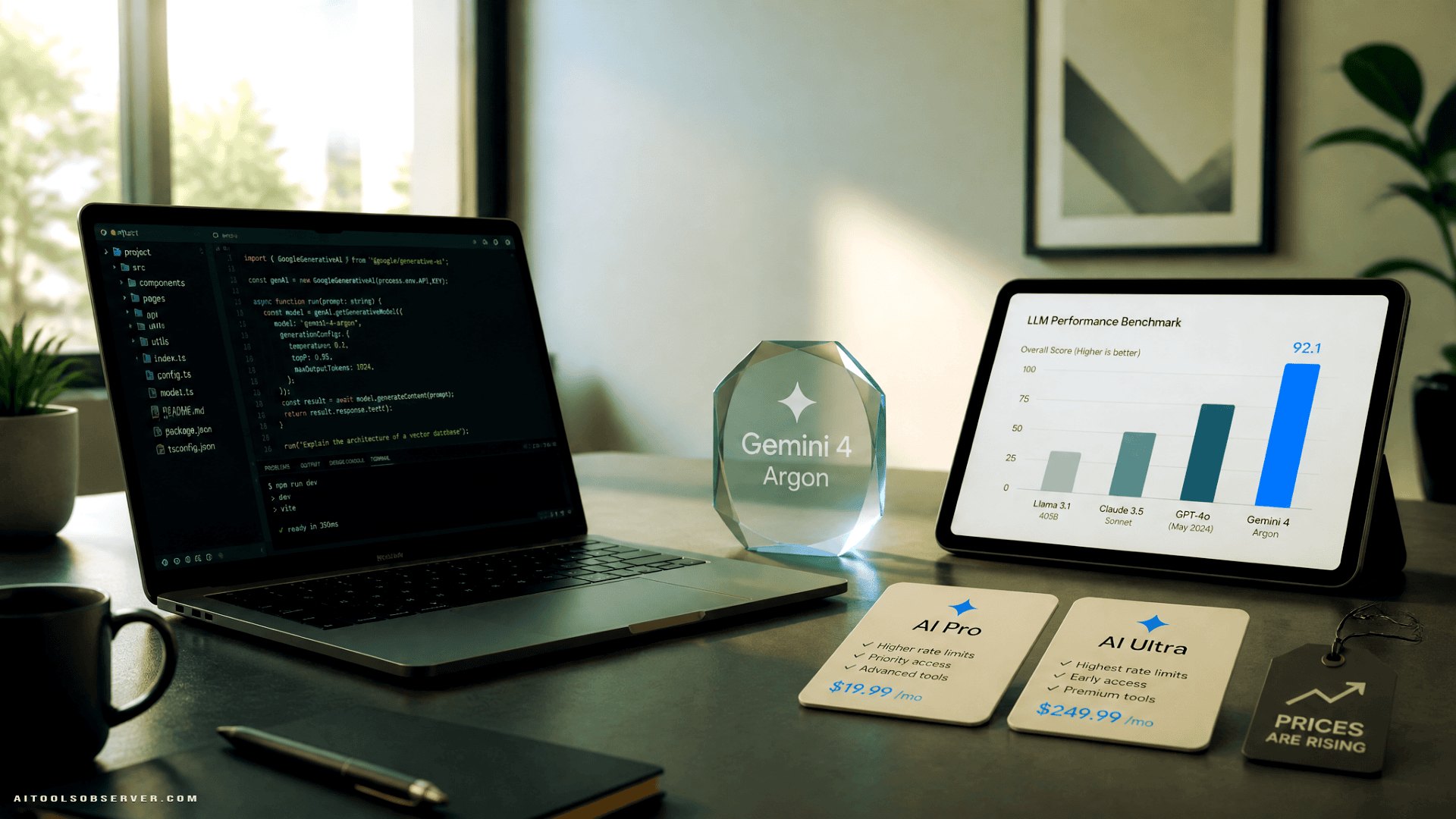
Gemini 4 Argon is Google’s latest frontier model, positioned above Gemini 3.1 Pro in capability. Based on the available context, it shows meaningful gains in spatial reasoning, coding, and what Google calls embodied reasoning — the ability to understand and act within 3D environments.
Google has been running Argon internally at scale. A few concrete examples stand out:
- YouTube’s comment system: Argon identified redundant emoji rendering that, when removed, cut server load by 45 percent.
- Project Wing drone simulator: The model surfaced critical bugs that had been sitting in the codebase since 2018.
- Robotics: Google reports a measurable step increase in embodied reasoning performance across its robotics program.
These aren’t abstract benchmark wins. They’re the kind of applied results that give the model credibility beyond a leaderboard.
Benchmark Performance
On the Embodied Reasoning Question Answering (ERQA) benchmark — which tests spatial problem-solving in 3D environments — Argon leads the current field:
| Model | ERQA Score |
|---|---|
| Gemini 4 Argon | 87.0% |
| Claude Opus 5.5 | 82.3% |
| GPT-6 Astra | 81.0% |
| Claude Fable 5.1 | 74.0% |
(N=400, tool off, higher is better)
The gap over the nearest competitor is meaningful, especially for teams working on robotics, simulation, or any workflow that involves spatial or physical reasoning.
Access Tiers and Restrictions
Not all Argon access is equal. Here’s how it breaks down:
Gemini App (Canvas Mode)
- Available to AI Pro and AI Ultra subscribers
- Code generation works in Canvas mode for Pro users
Antigravity and AI Studio
- Restricted to AI Ultra only
- Multi-threaded agentic workflows are compute-heavy, which explains the higher tier requirement
Free Users
- No access to Argon
- Limited to Flash-Lite following recent model access changes
If you’re on Pro and need more than Flash models but can’t justify Ultra, Google says Gemini 3.1 Pro remains available for now. There’s no confirmed timeline for when — or whether — Argon will open up to lower tiers in Antigravity.
API Pricing: The Window You Shouldn’t Miss
For developers accessing Argon through the paid API, Google has set an introductory rate that’s worth paying attention to:
Through November 30:
- $2 per million input tokens
- $10 per million output tokens
- 95% discount on cached tokens
After November 30:
- $4 per million input tokens
- $20 per million output tokens
That’s a 2x price jump at the end of the month. If you’re evaluating Argon for a production workflow, the window to test it at lower cost is short. Building a workflow now and then absorbing doubled output costs later is a real risk — especially for code generation tasks, which tend to produce long outputs.
Who Should Actually Care About Argon
Argon is a strong fit for teams working on:
- Code generation at scale — particularly complex, multi-file or agentic coding tasks
- Robotics and simulation — the ERQA benchmark gains are directly relevant here
- Internal tooling and infrastructure — the YouTube and Project Wing examples suggest Argon handles large, messy codebases well
It’s less relevant if your use cases are covered by Flash models, or if you’re not on a paid plan.
The Practical Takeaway
Argon is a capable model with real-world validation behind it, not just benchmark numbers. But the access structure is tiered, the API pricing doubles at the end of November, and coding-focused features are locked behind the most expensive plan.
If you’re a developer, the move is to test Argon against your actual workflows before November 30 — while the discounted rate holds. If you’re on AI Pro and curious about the model, Canvas mode gives you a reasonable entry point without needing to upgrade. And if you’re on free tier, the gap between what you have access to and what’s available at the frontier just got wider.



Comments (0) No comments yet
Want to join this discussion? Login or Register.
No comments yet. Be the first to share your thoughts!